Detecting Extraction Model Drift in Production Pipelines
Per-field monitoring catches silent accuracy losses that document-level metrics miss.
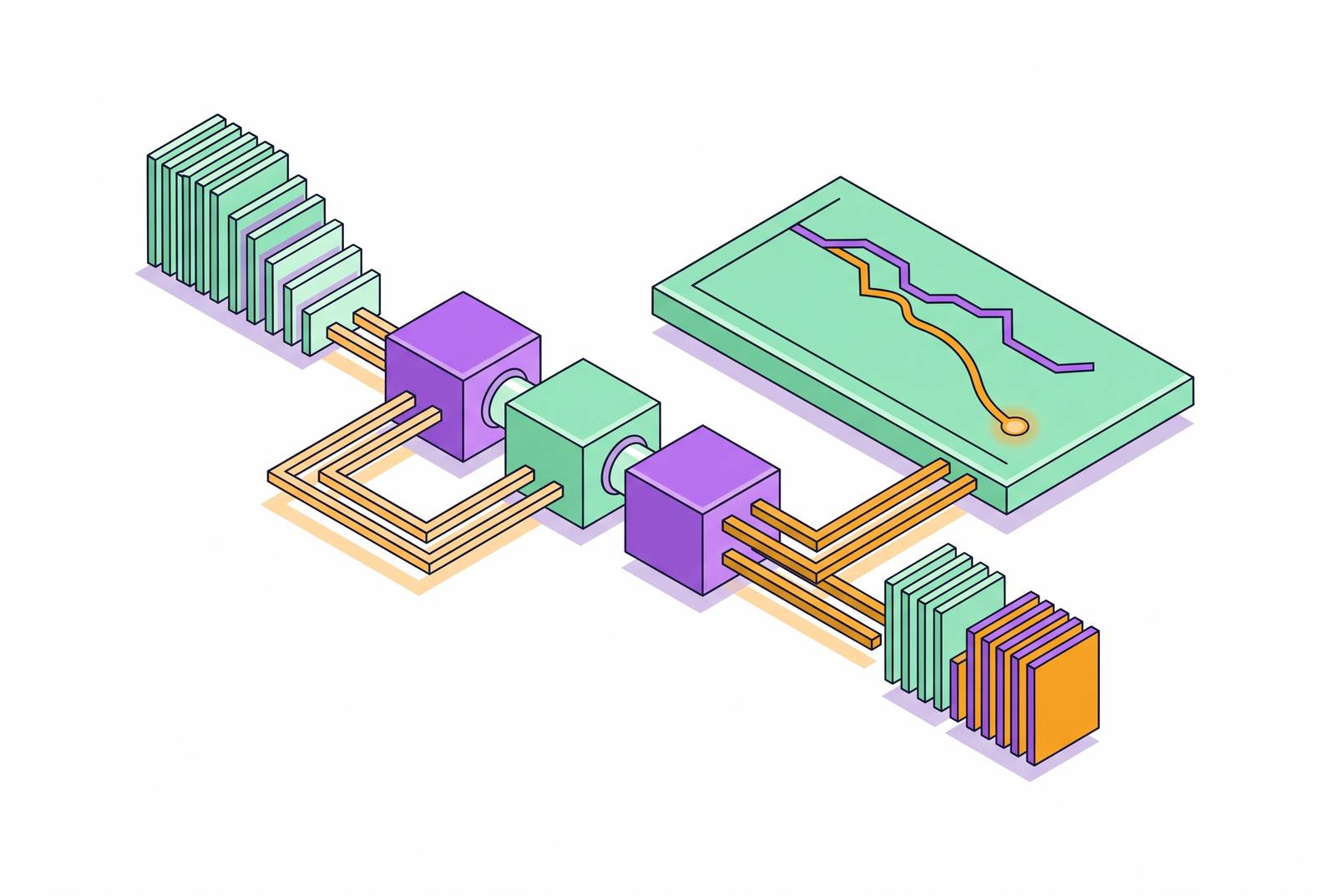
Extraction model drift is the quiet failure mode of document AI: accuracy erodes field by field while operational signals in the pipeline may show nothing wrong. Detecting it requires per-field monitoring against ground truth, not the coarse statistical checks borrowed from general machine learning drift detection.
How document layouts shift in production and why models don't announce it
Four things tend to break silently in a production document pipeline, and none of them throw an error.
A vendor invoice arrives with its column positions shifted from where the model expects them, and a field drops out before the approval engine ever gets a look at it. That's supplier template variation, and it happens constantly because no two vendors format invoices the same way, and nobody tells the extraction system when a supplier updates their template.
Upstream model updates cause a subtler version of the same problem. If the extraction layer calls an API-hosted large language model, the provider can update that model without warning. The version validated in March is not necessarily the version answering requests in April, and the pipeline has no way to flag that the ground it's standing on has moved.
Document quality shifts matter too, and the gap here is large. A clean digital PDF might extract at roughly 99.5% character accuracy; a photographed, crumpled receipt might be around 85%. Neither number changes the model itself, but a shift in the mix of incoming document quality, say, more phone-photographed receipts and fewer clean digital invoices, degrades per-field accuracy without anyone touching the model weights.
Then there's format conversion. When a preprocessing step converts PDFs to Markdown before extraction, it throws away bounding boxes, reading order, confidence scores, and the structural relationships that told the model a number belonged in the "Total Due" cell rather than somewhere else on the page. That spatial context doesn't come back. Estimates put roughly 20 to 40% of real-world enterprise documents outside the standard templates that demo pipelines handle well, and production drift is often just that tail growing as new document classes work their way into the system.
The worst version of this failure is semantic, not structural. An extracted value can be the right data type and the wrong field: a start date captured as an end date, a shipping address read as a billing address. It passes schema validation cleanly, because a date is still a date, and the error becomes visible weeks later in a business process that trusted it. OCR failures at least look broken, garbled characters are visible on the page. LLM-based extraction fails differently: it can hallucinate content, drop table rows, or map a correct value to the wrong field, all while returning a perfectly well-formed JSON object. Schema drift, new fields, renamed columns, removed features, deserves a separate mention because it looks exactly like model drift on a dashboard but gets fixed at the pipeline layer, not through retraining. Confusing the two wastes a retraining cycle on a problem a config change would have solved.
Why character accuracy and document-level confidence scores hide field-level rot
Character accuracy is the wrong number to trust, and it's the number most vendors lead with because it's the easiest one to make look good. A tool advertising 99% character accuracy can still be around 80% field accuracy on real invoices, a gap of 15 to 20 percentage points that character accuracy simply doesn't see, because it measures whether the OCR layer read the right characters, not whether the extraction layer put them in the right field.
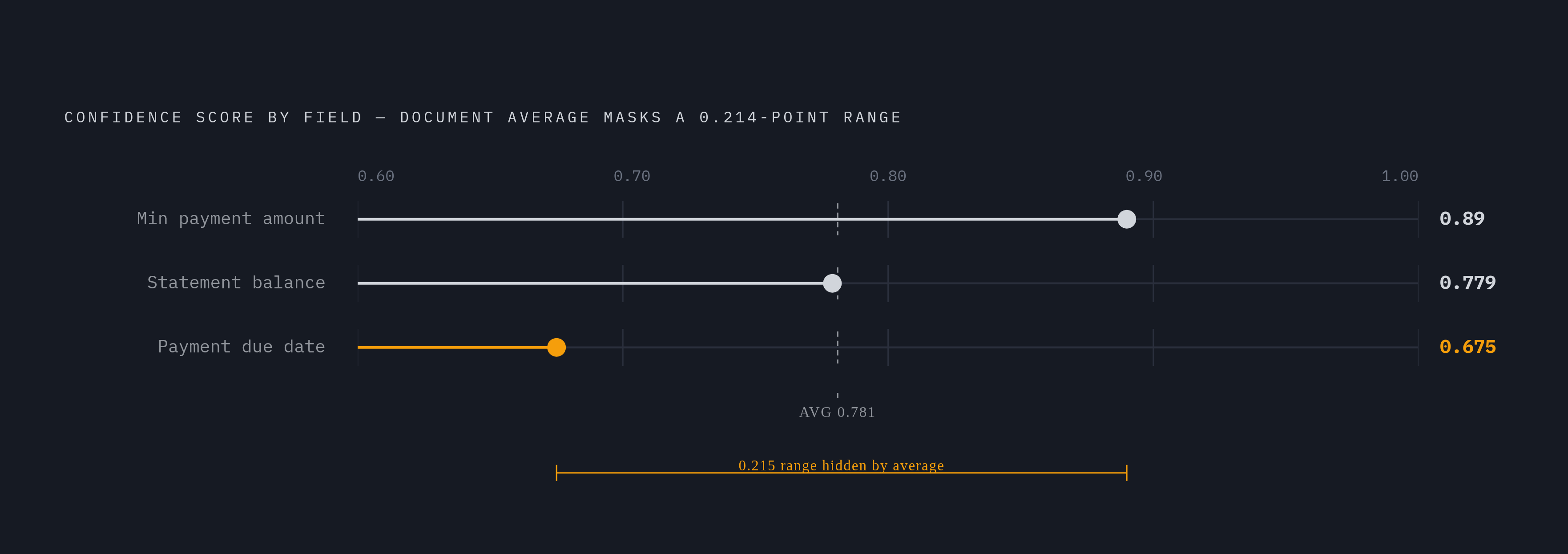
Document-level confidence scores fold together numbers that shouldn't be folded together. Reported field-level confidence scores averaged 0.781 at inference time in one documented evaluation. Broken apart by field, minimum payment amount scored 0.89, statement balance came in at 0.779, and payment due date sat at 0.675, a gap wide enough to be hidden inside a single headline figure. Amount fields tend to score higher because their formatting is consistent; dates score lower because their placement on the page varies and depends on context. Average the two together and the variation disappears, along with any early warning it might have given.
There's a direct test for whether confidence scores can be trusted as a drift proxy at all: pull a sample of extractions the system marked above 0.90 confidence and check them by hand against the source document. If more than one in ten contains an error, the confidence scores are miscalibrated, and using them to gauge drift is measuring noise. Prediction drift, tracking shifts in the distribution of outputs, works as a stand-in for ground truth when ground truth isn't available in real time. But it only works applied field by field. A shift in the distribution of extracted payment due dates should send someone chasing it. A shift in the distribution of every extracted value lumped together is just noise wearing a signal's clothes.
The per-field monitoring stack that catches drift before downstream damage
Catching drift before it costs money means watching several things at once, broken down by field, not by document.
Confidence scores need tracking by document type, by field name, and by time window, because a drop on one specific field, invoice total, payment due date, is usually the earliest sign something has shifted upstream. Rejection rate matters just as much: the share of per-field extractions falling below the confidence threshold and getting routed to human review. A rejection rate sitting steady around 5 to 10% is normal and healthy. A sudden jump to 30% on one field class means the pipeline just met a document type it wasn't built to handle.
None of this replaces ground truth sampling, though, which remains the only reliable way to catch systematic silent failures. Pulling 1 to 2% of production extractions and checking them against the source document is slow and manual, but it's the check that actually works. One documented incident involved a production pipeline feeding incorrect records into a downstream machine learning model for over three weeks. No alert fired. Every operational metric said the pipeline was succeeding the entire time. Random sampling is what finally caught it.
Weighted Overall Accuracy is one formal way to score this more precisely than a binary pass or fail. Each field type gets a comparator suited to it, with string and numeric fields handled differently, and each extracted entity earns a continuous score between 0 and 1 rather than a flat right-or-wrong. Averaged across all entities, this metric awards partial credit and picks up gradual degradation that a binary F1 score would miss entirely until it was already severe.
A probe set, borrowed from how drift gets detected in large language models generally, adds another layer: run 50 to 100 hand-picked representative documents through the pipeline daily or weekly, score the field extractions against known ground truth, and track the hit rate over time. A slow decline on one field type is a clean, early signal, well before it appears in any other measure. Statistical measures like Kullback-Leibler divergence and the Kolmogorov-Smirnov statistic still have a place here, but only applied per field to confidence and value distributions, not to document-level averages that smear the signal flat.
Business rule cross-validation catches what confidence scores can't see at all: line items that don't sum to the stated total on a financial document, or a birth date that doesn't square with a stated age on a medical form. These are semantic checks, and they catch semantic errors, which is exactly the category that slips past confidence-based monitoring. A drop in daily document volume matters too, since it often appears before or alongside extraction degradation, usually pointing to an ingestion break or an upstream format change nobody flagged. None of this is optional instrumentation. Queue depth, per-worker throughput, latency at the 50th and 95th percentile, confidence distributions, rejection rates, these are the baseline, not the extras.
Triaging a drift alert before deciding whether to retrain
An alert firing does not mean the model has degraded. It means something needs investigating, and treating every alert as an automatic signal to retrain wastes engineering time on the wrong fix while the actual cause, often a broken pipeline stage, keeps running unchecked.
Check the pipeline first. A broken ETL job produces null spikes that look identical to data drift on a dashboard, and no amount of retraining fixes a null spike caused by a failed data load. Check the schema next: renamed columns, removed fields, or new ones added upstream will trigger a performance alert that has nothing to do with the model and everything to do with a schema change that needs resolving at the pipeline layer. Check preprocessing too. A new batch of low-resolution scans or a new fax source can knock accuracy down meaningfully without the model changing at all, and the fix there is better preprocessing, not a new training run. And if the extraction layer depends on an external LLM API, confirm whether the provider pushed a silent update. That's concept drift caused from outside the system, and the right response might be a prompt adjustment or a fresh evaluation, not retraining anything local.
Once the triage rules out pipeline and schema causes, the type of drift left standing determines the fix. New supplier templates or unfamiliar layouts call for fine-tuning or adding fresh training examples. A genuine shift in how document structure relates to field meaning, real concept drift, calls for feature redesign or rebuilding the model, which is the most expensive path and should be the last one reached for, not the first. Output distributions shifting without any change on the input side deserve a look at confidence calibration before anything else, since miscalibrated scores can mimic drift that isn't actually there. And infrastructure problems get fixed at the infrastructure layer, full stop.
None of this works without governance set up ahead of time: named owners, approval gates, an incident procedure, and a record of model lineage, all established before a drift incident happens rather than improvised during one. Governance built after the fact stretches out recovery and leaves gaps in the audit trail that are hard to explain later.
When human-in-the-loop review is the detection mechanism, not just the fallback
Human review serves as the mechanism that generates ground truth labels at the scale needed for per-field drift detection to be a quantitative practice instead of a guess based on gut feeling, not as a patch for a model that isn't accurate enough. It's the mechanism that generates ground truth labels at the scale needed for per-field drift detection to be a quantitative practice instead of a guess based on gut feeling.
A handful of business KPIs make this concrete. Straight-through processing rate, the share of documents that move through with no human touch, should reach 90% or higher in a well-tuned deployment. Manual review rate is just its mirror image, and a rising review rate on one specific field class is a drift signal worth chasing, not just a line item on an operations budget. Exception rate should trend down month over month as the model learns from corrections, and if it flattens or climbs instead, that deserves investigation on its own.
The metric that matters most is the one fewest pipelines actually track: false auto-approval rate. This counts extractions that were wrong, cleared the confidence threshold, skipped human review entirely, and landed in a downstream system as if they were correct. It's the exact failure this whole piece opened with, given a number and a name. A production document AI system earns that label by feeding corrections from human review back into the model, so accuracy keeps improving over time. Static OCR doesn't do that. And review needs to be stratified by the conditions under which documents actually arrive, digital versus scanned, skewed or noisy, stamped or handwritten, different languages and currencies, templates the model has never seen, so review effort goes where drift is actually happening instead of spreading evenly across documents that were never at risk.
Architectural decisions that determine how detectable drift will be
How a pipeline is built determines how visible drift will be when it happens, and that choice gets made long before the first document ever runs through it.
An OCR-first architecture keeps page-level intermediate artifacts around: confidence scores stay auditable, and drift in the OCR layer can be separated from drift in the field extraction layer, which makes root-cause analysis a tractable problem instead of a guessing game. Vision-language models, run end to end, achieve a substantially lower Character Error Rate than traditional OCR engines on noisy scans, a real advantage. But that same end-to-end design makes it much harder to point at a specific layer and say that's where the degradation started. A practical middle path treats OCR selection as a routing problem: classify incoming documents, send each to the engine suited to it, and build a validator that escalates failures and logs cost per document class rather than betting the whole pipeline on one engine.
Separating GPU-bound inference from CPU-bound orchestration into distinct services isolates the signals too. A latency spike in the OCR service points to a different root cause than a latency spike in the LLM extraction service, and conflating the two into one metric buries that distinction. Asynchronous processing with queue depth monitored at each stage creates natural checkpoints for catching drift early: a queue growing at the extraction stage while ingestion stays flat usually means the extraction step is slowing down, and that often appears in the queue depth before accuracy on edge cases starts to visibly slip. In batch profiling, OCR tends to dominate end-to-end latency, not the LLM parsing step that comes after it, which means a latency-based drift signal is more likely to surface in the OCR layer first, earlier than most teams expect to see it.
Deployment environment plays a role too. Running extraction on-premise or in a defined regional environment means model versioning stays explicit and no one upstream can push a silent update. That's a real reason zero-retention, on-premise deployments carry a more predictable drift profile in regulated industries, where an unannounced model change isn't just an inconvenience but a compliance risk. The more mature pattern goes a step further: self-healing pipelines that pair automated drift detection with automated remediation, feedback loops that trigger a retraining workflow, adjust a feature engineering step, or roll back to a known-safe model version, rather than dashboards that just raise a flag and wait for someone to notice. That cuts the time to repair and leaves a documented trail that compliance teams can actually use.
What a production-grade accuracy guarantee requires that monitoring alone cannot provide
Monitoring tells you something changed. It does not tell you what the correct value was supposed to be, and that gap is the one no dashboard closes on its own.
A real accuracy guarantee needs ground truth built into the operational loop, not sampled occasionally as an audit exercise but generated continuously through the same human review process that handles exceptions day to day. It needs field-level service-level agreements instead of a single blended accuracy figure, because a high overall document-level number can still hide a critical field, payment due date, tax ID, quietly running far lower, and a customer relying on the blended number would never see it coming. It needs the triage discipline described above applied every time an alert fires, so that a schema change or a broken ETL job never gets mistaken for the model failing. And it needs an architecture built from the outset to make drift traceable to a specific layer, because a system where degradation can't be localized is a system where the fix, when it finally comes, is mostly guesswork dressed up as an engineering decision.
Monitoring catches the symptom. Ground truth, field-level accountability, disciplined triage, and an architecture that doesn't hide where the failure happened, that's what turns a monitored pipeline into one an enterprise can actually build a guarantee on top of.