Error Handling and Retry Patterns in Document Processing Pipelines
Distinguish transient failures from permanent ones before deciding whether to retry.
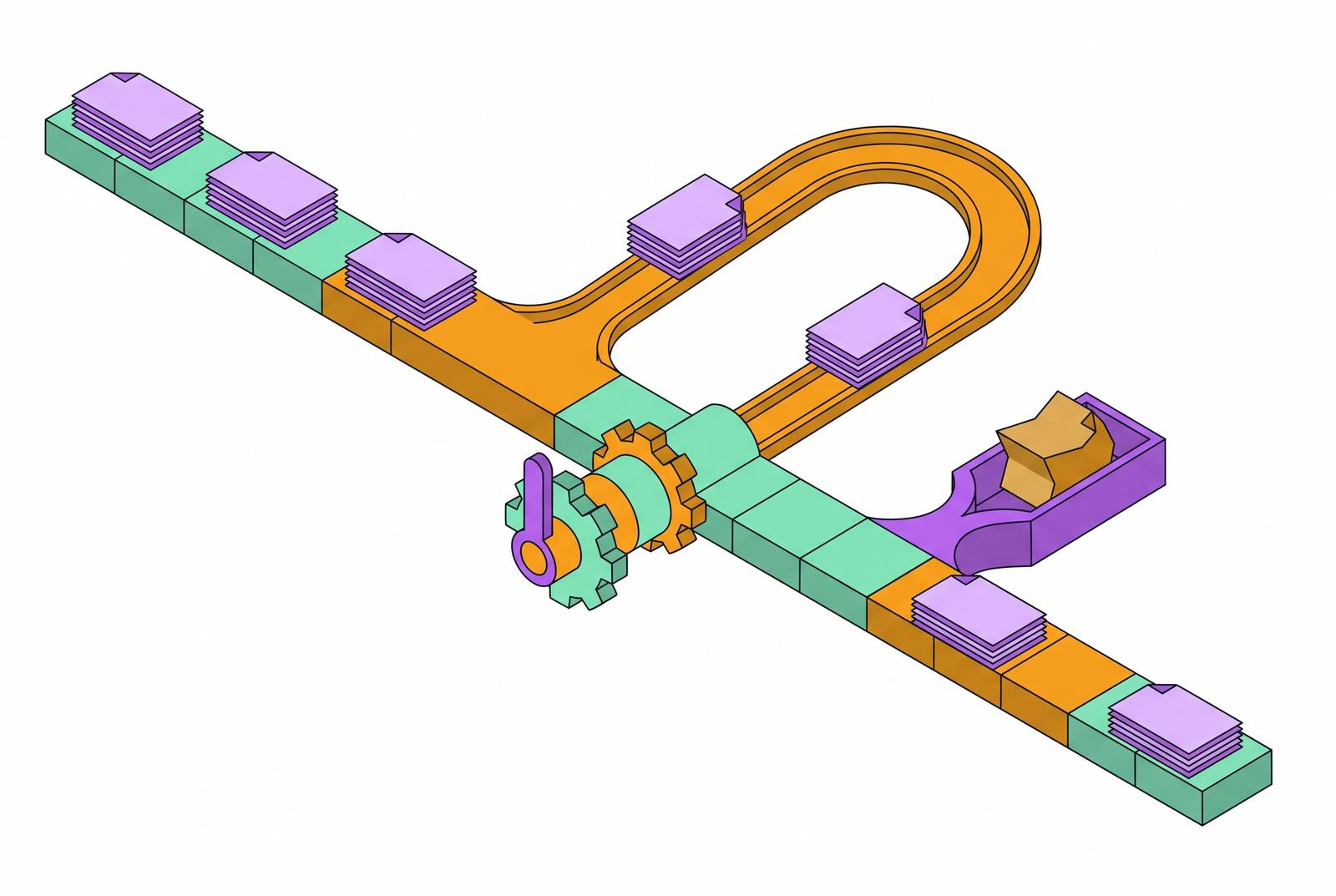
Document pipelines fail when the wrong errors get retried and the wrong errors get abandoned. A pipeline that retries a permanently missing field three times burns compute to confirm something it already knows, while a pipeline that gives up on a rate-limit response that would have cleared in two seconds throws away a document for no reason. Both mistakes come from the same root cause: nobody built a system to tell these two situations apart before deciding what to do next.
Error Classification as the Real Engineering Problem
Most teams treat error handling as a logging-and-retry problem. Write the exception to a log, wrap the call in a retry loop, ship it. That approach misses the actual question: before any retry logic runs, what kind of error is this, and what does that kind demand?
Two failure modes sit on opposite sides of the same mistake, and both cost real money. If a field genuinely does not exist in a document, running the extraction again, and again, and a third time, will not produce a different answer. That is not resilience. That is a classification failure dressed up as diligence.
The opposite mistake looks like caution but acts like carelessness. Abandoning a transient failure drops a document that would have gone through fine on a second try. A 429 rate-limit response that resolves on its own within two seconds does not mean the document is broken. It means the service needed a moment. Treating that moment as a dead end throws away work for nothing.
Three categories give a pipeline the foundation to handle both situations correctly: transient errors get retried with backoff, permanent errors get skipped and logged and flagged for a person, and errors that don't match either pattern get one retry before they're escalated. Every pattern covered from here forward, backoff timing, dead-letter queues, circuit breakers, validation, is this same three-way split applied at a different layer of the system.
The three error classes
The class of an error decides which handler runs.
Transient errors cover network timeouts and API rate limits, the familiar HTTP 429, 502, and 503 responses. The correct handler is exponential backoff with jitter, capped by a maximum number of attempts.
Permanent errors cover a file that can't be found, a document that's genuinely blank, a corrupted byte stream, or a field that simply doesn't appear in the source. No amount of waiting fixes these. The correct handler is an immediate stop on that document: a structured log entry, a route to the dead-letter queue, and an alert. No retry loop. Consider a pipeline trying to extract a "missing payment clause" from a contract that never had one. Running the extraction again won't manufacture a clause that was never written. Treating that as a retryable problem is the misclassification, not a quirk of bad luck.
This is the point where extraction quality and error classification start to depend on each other. A zero-confidence extraction isn't automatically a low-confidence valid result, it's a signal that needs to be checked before retry logic even runs. Invofox validates extraction output against the source document and reports confidence per field. A field that genuinely isn't there can get marked as a permanent failure right away, rather than triggering a retry cycle that was never going to find anything.
Unknown errors are exceptions that don't match a known transient or permanent signature. These get one retry, then escalation. The pipeline can't classify them safely, so it shouldn't pretend otherwise by guessing.
Graph-based frameworks like LangGraph give each of these three classes a distinct mechanism.
| Error class | LangGraph primitive | Behavior | |---|---|---| | Transient | RetryPolicy (per node) | Configurable max_attempts, initial_interval, backoff_factor, max_interval, jitter | | Permanent / user-fixable gap | interrupt() | Pauses for human input, e.g. a missing required field | | Developer-class bug (schema mismatch, logic error) | Unhandled bubbling | Surfaces immediately rather than being swallowed |
A fourth class deserves its own name in document pipelines specifically: LLM-recoverable errors. A tool returns malformed JSON. The fix here isn't a blind retry of the same call, it's feeding the error back into the pipeline's state so the model has the information it needs to adjust on the next attempt.
Exponential backoff with jitter: what the parameters control
Backoff with no ceiling and no randomness turns one overloaded service into a second wave of load right as the service starts to recover.
The individual parameters each control something specific, and getting them wrong is easy to do without noticing. The initial_interval sets the delay before the first retry fires, and it should scale with how complex the document is. Invofox and similar services that handle both scanned images and native text through one pipeline make this especially relevant: sizing initial_interval too small turns a single transient failure into a synchronized wave of retries that recreates the overload that caused the problem.
The backoff_factor is the multiplier applied to the wait time on each attempt. The max_interval sets a hard ceiling on that growth. Without one, backoff keeps climbing without bound and documents end up sitting in a queue indefinitely, waiting for a delay that never stops growing. Once a document exhausts its attempts, it has to go somewhere concrete: the dead-letter queue.
The place most implementations go wrong is the retry_on filter. Leaving it at a default of "retry on all exceptions" means permanent failures get retried right alongside transient ones, defeating the entire point of classification. The filter needs to name its targets explicitly: the transient HTTP status codes (429, 502, 503) and known network exception types, nothing else. Everything outside that list gets rejected from the retry path and routed to its proper handler instead.
One more thing belongs in this section even though it's a separate concern from backoff: per-document timeout. A single document that runs long, say a complex scanned file stuck in extraction, can block an entire batch queue behind it if nothing stops it. Wrapping the extraction call with a hard timeout keeps one slow document from starving everything behind it in line.
The superstep transaction problem in parallel document pipelines
Parallel execution introduces a failure mode that simply doesn't exist in a sequential pipeline. When two branches run in the same step, a transient failure in one branch can quietly erase successful work from the other.
Picture a document pipeline running clause extraction and metadata extraction as two parallel branches in the same superstep. The metadata extraction succeeds. The clause extraction hits a rate limit and fails. In LangGraph's execution model, the whole superstep transaction rolls back: the successful metadata extraction does not get applied to the visible state snapshot, which reverts to where it stood before the superstep began. With a checkpointer in place, LangGraph does save that successful result internally, so it won't run again needlessly when the pipeline resumes. But without a RetryPolicy on the node that failed, the rollback happens regardless, and from the outside, it can look like a pipeline that retried cleanly is in fact repeating work it already finished, or dropping intermediate results with no error message at the document level to explain why.
The fix is architectural: a RetryPolicy needs to sit on every node making an external call that can fail transiently, not only at the pipeline's entry point. The retry scope has to match the failure scope. Classification alone doesn't solve this problem. The pipeline's topology has to be built so that successful branches get checkpointed before a failure anywhere else in the same step can trigger a rollback that takes them down too.
Dead-letter queues as a diagnostic asset, not a discard bin
A dead-letter queue nobody looks at isn't error handling. The entire value of a DLQ comes from what it reveals about failure patterns across the whole pipeline.
That value depends on what gets written down. Each entry needs a persistent record, not something held in memory that disappears on restart, with a schema built for post-mortem analysis: the document ID, the error type, the error message, the retry count, timestamps, and a reference back to the document itself. Without that structure, the DLQ can only tell a team that documents failed, not why those failures cluster the way they do.
A rising count of failed documents is itself a signal worth watching. When failed documents make up a meaningful share of total input within a given window, that's not random noise, that's a systematic problem, and the pipeline itself is the thing that needs fixing, not the individual documents sitting in the queue. Documents where the error type changes from one attempt to the next, a sign the first attempt classified the problem wrong to begin with.
The DLQ also feeds back into how the extraction system improves over time. Documents that fail in production, specifically because of edge cases that never showed up during testing or a demo, are exactly the documents a document AI system most needs to learn from. Routing them to manual review and feeding the corrections back into the system closes that loop. This is where the gap between a vendor that absorbs errors quietly and one that surfaces them matters most: a provider that never routes failures to a visible queue is asking the customer to carry all the risk of not knowing what went wrong. Invofox's approach runs the other direction, with corrections from flagged extractions feeding back into the system so accuracy improves from the documents that actually caused problems, not just the ones used during a sales demo.
Circuit breakers: when the pipeline itself must stop
Per-document retry logic has a blind spot: it can't see that a failure is systemic. A circuit breaker works at the level of the whole pipeline, and its job is to stop a degraded service from getting hit by thousands of documents all retrying against it at once.
The pattern runs through three states. If they fail, it reopens.
A circuit breaker and per-document retry aren't doing the same job twice. Without a circuit breaker, a pipeline pointed at a service that's down for an extended stretch will run every document through its full max_attempts cycle before the service comes back, and every one of those documents will land in the dead-letter queue, when a single pause at the pipeline level would have let all of them succeed once the service recovered.
Pre- and post-extraction validation as error prevention at the boundary
Running a full extraction attempt on a document that's blank, corrupted, or below a usable quality threshold spends compute to confirm, the hard way, something that could have been caught for free the moment the document arrived.
A set of checks run before extraction even starts can catch most of this. Blank document detection looks for the absence of a text layer or any meaningful image content. A document that fails any of these checks goes straight to the dead-letter queue, classified as a permanent error from the start, with no retry loop wasted on it.
Validation after extraction catches a different, quieter category of mistake: the kind that passes a schema check because the data type is technically correct but fails because the value itself is wrong. Schema validation confirms required fields are present, checks that no null values slip through where the downstream system needs a real value, and makes sure a NOT_FOUND result never gets passed along as though it were legitimate data. Confidence-based routing then decides what happens next, sending anything below threshold to a human reviewer instead of straight into a database, and that threshold shouldn't be one flat number across the whole pipeline, since numeric fields and free-text fields behave differently and need to be calibrated separately.
This is where the classification argument from the opening comes back around. A document that fails post-extraction validation because a business rule was violated is a different kind of error than one that failed because OCR timed out, and the two need different handlers entirely, not the same retry loop applied twice. A validation layer built into the extraction service itself, rather than bolted on as a separate step afterward, is what production-grade pipelines look like. Invofox reports per-field confidence scores and traces each extracted value back to its page and region in the source document, with accuracy thresholds set per field and per document type as part of the service's SLA, giving a pipeline the information it needs to make this classification call with real confidence.
Observability: the metrics that distinguish a healthy pipeline from a silently failing one
A document pipeline running in production without quality signals attached to it is a demo that happens to be deployed. One pipeline, within a week of going live, was silently returning wrong data on 15% of documents, and the only reason anyone would catch that before it caused real damage downstream is structured observability built at the right level of detail. Document-level pass/fail counts alone wouldn't have caught it.
Field-level confidence tracked over time, broken out by document type and field name, surfaces a problem in the metrics before it reaches a downstream system. A steady drop in average confidence on one particular field points to a layout change or model drift, well before anyone downstream notices the output looks wrong. Every pattern in this piece, backoff, the dead-letter queue, circuit breakers, validation at the boundary, only works as well as a team's ability to see it operating. Observability is the mechanism that makes everything else in the system visible enough to trust.