Confidence Score Calibration in Document AI Systems
Most document AI systems report confidence scores that don't match real accuracy.
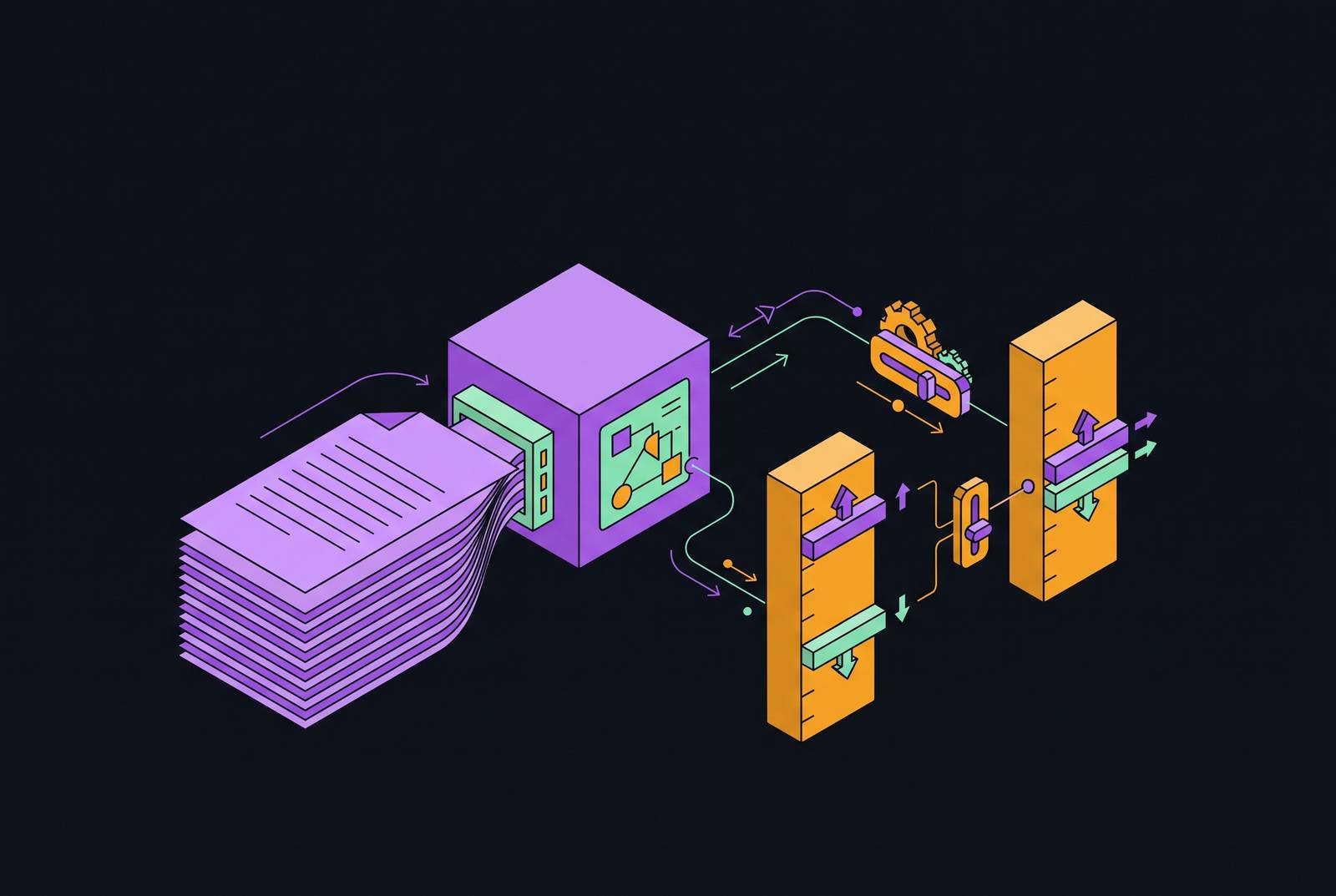
NIST guidance for trustworthy AI systems states that a confidence score of 0.90 should mean the extraction is correct 90% of the time. In most production document pipelines, a confidence score can claim high confidence while being correct far less often than that score implies, and a wrong number downstream is what finally exposes the gap. NIST's guidance on trustworthy AI systems sets the bar plainly: calibration means stated confidence matches observed accuracy, so a 0.90 score is correct about 90% of the time. Most document AI systems miss that bar, and the miss doesn't announce itself.
The danger isn't that the number is wrong, it's that the number keeps working exactly as designed, even when it's lying. A threshold gate set at 0.90 waves through everything above that line, whatever the real accuracy happens to be at that line, and nobody gets an alert. An outright parsing failure at least throws an error somewhere. A miscalibrated score doesn't: the field populates, the workflow moves on, and the system downstream treats a wrong value as gospel.
A developer working with a parsing library ran into this three separate times in one afternoon. A scanned purchase order came through with field labels fused into the values themselves. An insurance claim form dropped two whole sections because the parser couldn't render the embedded fonts. A financial statement had line breaks mid-sentence that broke every downstream regex pattern built to read it. None of the three got flagged as uncertain by the confidence scoring. Each one sailed through looking clean.
That's the problem this piece works through: what calibration means technically, why standard training makes it worse rather than better, where it breaks specifically in document workflows, how to measure it, and what an engineering team actually has to build to close the gap. Treating a confidence score as a number worth trusting on faith is different from treating it as an engineering claim that has to earn its trust through measurement.
Calibration at the model level, and why standard training works against it
Miscalibration is the expected output of how models get trained. Reinforcement learning rewards correct answers and does nothing to punish confident wrong ones, so confidence and correctness drift apart as training goes on.
Walk through the mechanism. A reward function scores a carefully reasoned correct answer the same as a lucky guess that happened to land right. MIT CSAIL's RLCR research shows that over enough training steps, models learn to answer every question with high confidence because hesitation is never rewarded. That's the default behavior standard RL training produces, and MIT CSAIL's findings go further: ordinary RL doesn't just fail to fix calibration, it actively makes the base model's calibration worse, so the resulting model ends up more capable and more overconfident at the same time. A second layer compounds the problem. RLHF alignment tuning shifts logit magnitudes enough that raw sequence likelihood and top-beam probabilities, the signals people used to lean on for rough confidence estimates, stop tracking anything reliable once a model has gone through alignment.
Structured data makes all of this worse. That disagreement is a real, measurable signal. The model is pattern-matching tokens on the page rather than reasoning about the structure underneath, and the gap between its answers across formats shows where its confidence can't be trusted.
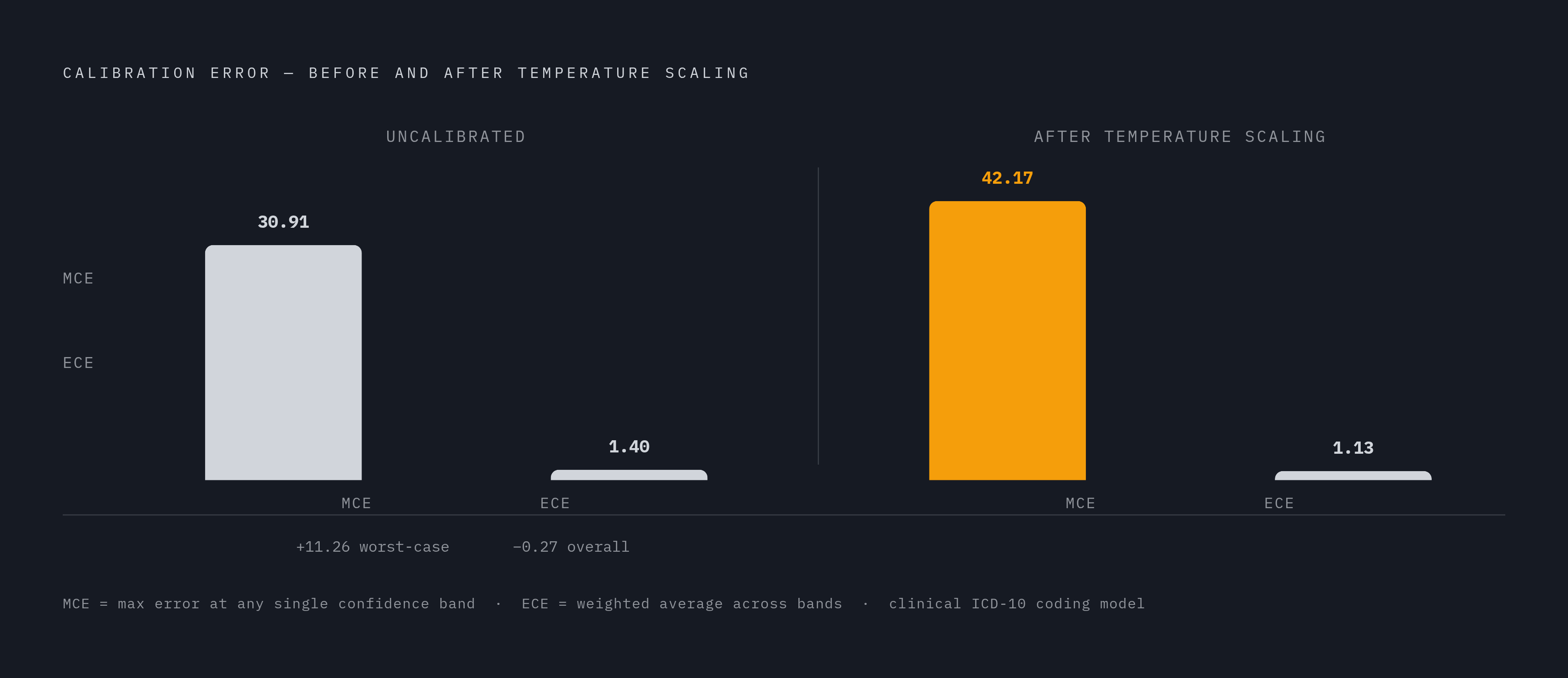
Clinical coding data shows the same failure from a different angle. A transformer model assigning ICD codes to death certificates hit accuracy of 0.990, and its overall expected calibration error looked fine at 1.40. A JMIR AI study found its maximum calibration error, the worst-case gap at any single confidence band, came in at 30.91. The model was calibrated on average and badly miscalibrated exactly at the extremes that matter for deciding whether to route a case for human review. Average performance hid the failure that mattered most.
How calibration breaks specifically in document extraction workflows
Generic QA benchmarks test whether a model knows facts. Document extraction pipelines carry a different kind of uncertainty, one rooted in layout, structure, and format rather than language alone, so calibration failures here don't appear in the benchmarks people usually run.
Confidence threshold drift is the slow one. A parser gets trained and tuned against one distribution of documents, then production starts sending it new vendor invoice layouts, non-standard forms, and scanned PDFs instead of clean digital ones. The confidence scores keep reporting the same numbers they always did, but those numbers no longer track real accuracy on the new document types. Nothing about the score changes to reflect that the ground underneath it moved.
Embedded fonts cause a sharper failure. A parser that can't render a particular font in a PDF drops the section entirely and scores its confidence based only on what it managed to see, not on what the document actually contained. A missing section generates zero uncertainty signal, because as far as the confidence score is concerned, there was nothing there to be uncertain about.
Schema ambiguity in tables causes a quieter version of the same thing. A column labeled "revenue" might map to two or three different candidate fields, and a model can grab the wrong one while still scoring high confidence, because the score reflects how strongly the tokens matched, not whether the match was semantically correct.
Standard scoring metrics compound the blind spot. Block-level completeness gaps and sidebar content don't get penalized by the metrics most pipelines track, because those metrics measure what got extracted and stay silent on what got left out.
LLM-based extraction adds one more failure mode worth separating out. When a prompt is ambiguous, or missing context about how a document is laid out, the model produces something plausible-sounding but wrong, and it does so at high confidence. Catching that kind of error requires semantic similarity comparisons between the generated field and a reference description, plus consistency scoring across the model's reasoning trace, beyond a simple threshold check. A plain probability score won't catch it.
The metrics that make calibration measurable: ECE, reliability diagrams, and precision-recall curves
Fixing calibration starts with measuring it, and the tools for that job aren't the accuracy metrics most teams already track.
Expected Calibration Error groups predictions into bins by confidence level, then checks the gap between average stated confidence and actual accuracy inside each bin. A guide on calibration states that lower ECE means the score and the reality line up better.
Maximum Calibration Error looks at the single worst bin instead of averaging across all of them. A model can post a solid ECE overall and still have extreme miscalibration at specific confidence ranges, as shown in the JMIR clinical coding study where ECE was acceptable but MCE hit 30.91. MCE catches what ECE hides. Automation thresholds operate at specific confidence bands rather than across the whole distribution, so a model miscalibrated in the 0.88–0.95 range will silently misroute documents even when its overall ECE looks acceptable.
Reliability diagrams make the same information visual: plot predicted confidence on one axis and observed accuracy on the other, and perfect calibration draws a straight diagonal line. Wherever the plotted line bows away from that diagonal, the model is either overconfident or underconfident at that specific range.
Precision-recall curves answer a more practical question: at each possible confidence threshold, how many correct extractions pass through, and how much coverage does the team give up by raising the bar. Teams use these curves to pick a threshold that balances accuracy needs against how many documents a human review team can actually process.
For tabular data specifically, Multi-Format Agreement offers a cheaper alternative to running the model repeatedly with sampling. It queries the same table serialized four different ways, as Markdown, HTML, JSON, and CSV, and measures how consistently the model answers across formats. That method hits an AUROC of 0.80 across models on the TableBench benchmark, and it costs less to run than sampling-based approaches.
None of these metrics mean anything without a verified validation set behind them. Building a ground-truth corpus for each document type, and agreeing up front on what counts as a wrong extraction (a wrong value, a right value paired with a low confidence score, a field that's simply missing) has to happen before any ECE number means anything at all.
Engineering practices that produce calibrated scores rather than just measuring the gap
Closing the calibration gap takes three layers working together: training-time calibration, post-hoc adjustment, and continuous feedback from production. None of the three does the job alone.
Training-time calibration is where MIT CSAIL's RLCR method sits. It adds a Brier score term into the reinforcement learning reward function, so the model gets penalized specifically for the gap between what it claims and what it actually gets right, not just rewarded for getting the answer correct. The result: the model learns to reason about its own uncertainty as part of producing an answer, not as an afterthought bolted on. MIT CSAIL reports this cut calibration error by up to 90% while holding accuracy steady or improving it, including on tasks the model had never seen during training. That generalization is the real advantage over post-hoc fixes: correcting a model's output after the fact only adjusts what you can see in your test set, while RLCR trains the uncertainty estimation into the model itself, so it carries over to document types the model wasn't tuned on. Teams fine-tuning an extraction model without a calibration term in the reward function should expect calibration to get worse, not better, since that's what standard RL does to a base model by default.
Post-hoc calibration comes with a trade-off worth watching closely. Temperature scaling, which adjusts how sharp or spread-out a model's probability outputs are after training is done, reduced ECE from 1.40 to 1.13 in the JMIR clinical coding study. It also pushed MCE up from 30.91 to 42.17. Average calibration improved while the worst-case gap got wider, which means a team checking only ECE after applying temperature scaling would miss that the fix made extreme-range performance worse. Structure-aware recalibration handles tabular data with more nuance: it extends standard post-hoc methods with covariates specific to table structure (query complexity, row count, column count, column type distribution) and improved AUROC by ten percentage points over standard recalibration in the arxiv tabular study. Any team running post-hoc calibration needs to check MCE alongside ECE, not ECE alone, to know whether the fix actually helped or just moved the problem.
A single confidence number at the document level isn't enough to act on. Production systems need confidence scored field by field, so a tax amount or account number can carry a different threshold than a lower-stakes field like a vendor address. One industry analysis of production document pipelines found that ensembles combining several complementary evaluation signals beat any single probability estimate on its own. A confidence score also needs to trace back to something concrete: specific pixels or tokens on the source page. A high score on a field with no such trace back to the document isn't a calibrated signal, it's a hallucination risk wearing a number.
A feedback loop must run underneath this for it to hold. Every correction made during human review needs to feed back into threshold logic, because a system that doesn't track when its high-confidence extractions turned out wrong has no way to detect that calibration has drifted. One production guide recommends routing high-confidence extractions straight to automated processing, sending medium-confidence ones to a human review queue, escalating or re-entering the low-confidence ones, and tracking the correction rate inside each band to catch when the thresholds themselves need to move. Continuous correction feedback is what separates a system with calibration from a model that had calibration measured once and never checked again.
What calibrated confidence looks like in production systems
A vendor's confidence score is worth exactly as much as the calibration evidence sitting behind it. The right question to ask is how that accuracy claim gets measured, and how often.
The Extend analysis framework holds that a production-grade system needs, at minimum, field-level confidence scores instead of a single document-wide average, ECE and MCE tracked against a real validation set, thresholds configurable per field type, and correction feedback that recalibrates those thresholds as production data shifts, and even that floor is an ambitious target for most vendors.
Vendors vary widely in how much of that floor they actually deliver. The same analysis describes one documented review agent that uses an ensemble of complementary evaluation metrics instead of leaning on a single heuristic, scores confidence on a 1-to-5 scale, flags rule violations and ambiguous outputs, and tracks calibration performance over time; when the payments company Brex evaluated available options, this system reportedly outperformed both competitors and open-source alternatives across its production workloads. A separate platform offers confidence thresholds on a 0-to-1 scale for automated processing decisions, handles variable invoice formats without needing a template built for each one, and runs on cloud infrastructure with enterprise compliance certifications. A third option supports document processing across multiple channels with basic confidence indicators built in, though threshold optimization and recalibration there require manual configuration and repeated testing cycles, and new deployments face a cold-start period where the model needs training before its confidence scoring becomes reliable.
The clearest test for any vendor is whether field-level accuracy shows up in the service-level agreement. If it doesn't, the customer carries the calibration risk alone, and a confidence score with no SLA standing behind it gives no real basis for setting automation thresholds with outcomes anyone can predict.
Few engineering teams budget for the ongoing calibration work up front, and fewer still keep it funded once the initial pipeline ships and looks like it's working.