Pay-per-Correct-Extraction Pricing Models for Document APIs
Vendors get paid only when extraction succeeds, aligning incentives with accuracy.
Most document extraction vendors bill by the page. A document goes in, a page count comes out, and the invoice follows that count regardless of what happened to the data on each page. That mechanic looks neutral on the surface, but it sets up a quiet problem: the vendor gets paid the same amount whether the extraction is right or wrong. Fixing a hard case, the kind with a smudged field or an odd layout, costs the vendor engineering time and produces no extra revenue. There's no commercial reward for solving the problem, so the problem tends to stay unsolved.
The buyer carries the opposite side of that arrangement. Every failed extraction turns into a human review task, a data error that ripples into some downstream system, a re-processing fee, or a case that has to be pulled out and handled by hand. These costs don't appear on the API invoice. The bill says "pages processed." It says nothing about pages processed correctly, so the buyer's true cost always exceeds the number on the statement, a gap that whoever approved the vendor contract never sees.
This isn't a story about lazy vendors or sloppy engineering teams. A perfectly competent team, operating in good faith, can ship a model that gets most fields right most of the time and still face zero commercial penalty for it under pay-per-page billing. The contract simply doesn't ask for more. Incentive problems like this don't come from bad actors. They come from pricing structures that never tie payment to the outcome the buyer actually needs.
What pay-per-correct-extraction means as a billing contract
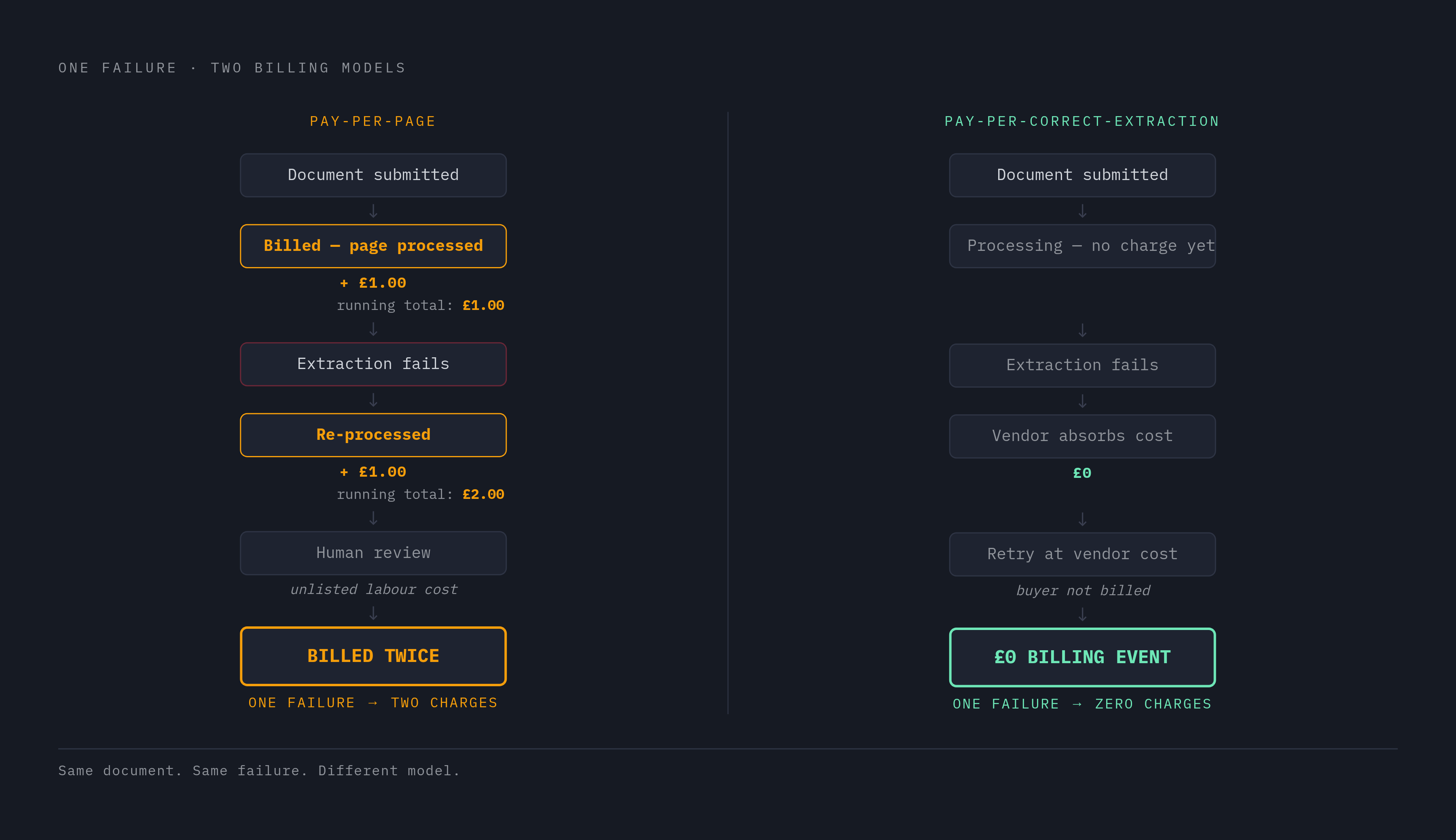
An alternative does exist, and it works on a different logic entirely: the vendor only gets paid when the extraction is confirmed correct. ParseRail, described in a 2026 buyer's guide, bills on exactly this basis, with no minimum commitment and no charge when an extraction fails. The invoice tracks successful, validated outputs instead of pages fed into a pipeline.
What makes this commercially unusual is where the risk sits. If billing runs per page, the risk of a bad extraction lands entirely on you. Under pay-per-correct-extraction, the vendor absorbs that risk instead, because when an extraction fails, it earns nothing from it. That's a real shift in who bears the cost of errors, reflected in a different number on an invoice.
For this to function as an actual contract rather than a slogan, "correct" has to be defined before any billing event happens. An invoice number needs an exact match. A total needs to fall within a defined numeric tolerance. A free-text field, like a description line, needs something closer to a semantic match, because exact string matching would reject answers that are correct but phrased differently than the reference text. Whatever the standard, it has to be agreed in advance and applied consistently, because the entire billing relationship depends on both sides knowing, before a single document is processed, what counts as a win.
The gap between raw per-page cost and per-correct-extraction cost in production
The rate printed on a pricing page is never the number a buyer actually pays once a document pipeline is running at scale. So the true cost per correctly extracted document climbs well past the sticker price, and it climbs faster when documents get messier, scans get worse, and the variety of fields being pulled out grows.
Hyperscaler pricing shows how this compounds. AWS Textract charges separate rates for basic text extraction, for forms, for tables, for queries, and for custom queries, each one billed on its own schedule. If you're pulling structured data out of invoices, you aren't paying one rate. You pay a composite built from several endpoint charges stacked together, and that composite is almost never the number quoted as the headline price. Table and form extraction already costs more than plain OCR on the same page, so if you work with invoices that include line items, you pay a higher effective rate than the base price suggests, before a single error enters the picture.
Errors make the gap worse. When accuracy falls short, the buyer still pays full price for the pages that come out wrong, since the invoice doesn't distinguish a correct field from an incorrect one. Those pages then get re-processed, and that re-processing generates a charge of its own. A single extraction that fails the first time can end up billed twice: once for the failure, once for the fix. Volume-based discount tiers add a further twist. Buyers in the middle of the volume range pay full rate because they never reach the thresholds that unlock a discount, and those tiers are built around a provider's biggest customers. So the teams that can least afford per-page costs end up subsidizing discounts they can never reach themselves.
Comparing sticker rates between vendors answers the wrong question because the number that matters is cost per correctly extracted, validated field. No pay-per-page invoice reports that number anywhere, so if you compare rates on paper, you're comparing figures that don't describe what you're actually paying for.
Why extraction fails in production
Extraction errors in production mostly trace back to the documents, not the model. Poor scan quality, handwritten fields, layouts that deviate from a standard template, and multi-page documents with inconsistent structure all generate errors that even a strong model can't avoid, because the problem lives in the source material rather than in the model's weights.
Pay-per-page billing treats all of that variation as if it doesn't exist. A clean, machine-generated PDF and a degraded, hand-annotated scan get charged the same rate, even though the probability of a correct extraction on each one is completely different. The buyer pays equally for two documents that carry very different odds of success.
Confidence scores exist to flag this risk, but standard confidence scores from vision models don't measure correctness. A high confidence score just means the model assigned high probability to the answer it produced. It says nothing about whether that answer matches the ground truth. A model can generate a hallucinated value and report high confidence in the same breath, so confidence alone can't be trusted as a signal of accuracy.
That mismatch produces a specific failure pattern. Low-confidence results get routed to human review, and that part works the way it should. So high-confidence errors pass straight through, undetected, because nothing in the pipeline catches them. The triage logic quietly breaks its own correctness guarantee precisely on the cases where getting it wrong matters most.
A related risk occurs in pipelines that read PDF text layers directly. If text is hidden or injected into a PDF's text layer, an LLM-based extractor can read it even though it never appears in the document's visual rendering. A human reviewer looking at the page sees nothing wrong, even though the extracted field has already been corrupted by text invisible in the document's rendering.
So pay-per-page billing hides every one of these failure modes at the level that matters commercially. The invoice reports pages processed, not fields correct, so the buyer has no line-item signal showing where extraction is failing, how often, or on which document types. The billing structure itself removes the feedback a buyer would need to catch the problem early.
Building pay-per-correct-extraction honestly
A pay-per-correct-extraction commitment is only as trustworthy as the system measuring correctness at the moment of billing. So you need per-field ground-truth evaluation, not an aggregate benchmark score pulled from some general test set.
Per-field validation means checking each extracted value against a schema built for that field type: exact match for identifiers like invoice numbers, numeric tolerance for amounts, semantic match for free-text descriptions. You have to score a missing field differently from a wrong field, since an omission and an error carry different risks downstream. And it means tracing every accepted value back to a specific location in the source document, down to the page, the bounding box, and the character span, so any accepted field can be checked against the original.
Confidence scores have to be calibrated for any of this to hold up. A field reported at high confidence needs to actually be correct at that rate, measured across a representative sample of real documents, not just the clean documents a model saw during training. Without calibration, the billing event can't be independently verified. A provider could accept a hallucinated value at high confidence and bill for it as if it were correct, and nothing in the system would catch the mistake.
You also can't treat accuracy as something you achieve once and then leave alone. Document populations shift over time: new vendor templates appear, formats change seasonally, fields move around on a form. A static model's accuracy drifts downward as that happens, so the provider's billing commitment depends on a continuous learning loop that keeps the model current, measured in ongoing accuracy rather than a one-time number from launch day. Human-in-the-loop correction that feeds back into the model is what separates a production-grade system from a static OCR tool under this pricing model. Corrections aren't a side feature; they're how the provider keeps the billing commitment honest over time.
Agentic validation layers add another safeguard. If a system checks its own output against business rules, cross-field consistency, and known constraints before it accepts a field, it can catch a chunk of the high-confidence wrong answers without sending every document to a human reviewer. That's the mechanism that keeps the false-accept rate down while still keeping the system fast enough to be useful.
Who defines correct: the model's hardest engineering problem
The strongest objection to pay-per-correct-extraction is simple to state: correctness can't be verified at billing time without some outside ground-truth check, and the provider is the one asserting that a field is correct. The buyer has no independent way to confirm that claim at the exact moment the bill gets generated.
This objection carries real weight. If there's no ground-truth check anywhere in the loop, a provider could set its acceptance threshold to maximize billing events rather than accuracy, quietly approving borderline fields because approving them pays.
Structural transparency, built from several pieces working together, replaces the need for a single all-knowing oracle. You need field-level confidence scores to be auditable, not hidden inside a black box. Bounding-box grounding lets you check any accepted value against the exact spot in the source document it came from. If you run periodic ground-truth audits against a held-out sample you can commission or review directly, you get an outside check on whether the provider's accuracy claims hold up over time. An SLA that writes a per-field accuracy floor into the contract turns the provider's technical claims into something enforceable: if accuracy falls below the floor, the billing commitment is void or subject to remedy, not just a broken promise with no consequence.
Part of the objection dissolves on its own once a buyer operates at real volume. Buyers already sample-check their extracted data for their own downstream systems, because they need to trust the numbers flowing into their own software. Those checks generate ground-truth signals as a byproduct, and that same data can be shared back with the provider, lining up the buyer's own quality checks with the provider's billing verification. The risk that remains is a provider's confidence calibration drifting out of line with reality. A buyer should ask for transparent performance reports rather than take a vendor's word for it.
Pricing models and the build-vs-buy calculus for document extraction teams
When teams decide whether to build their own extraction pipeline, they usually just compare an API's per-page rate against what it would cost to run open-source models in-house. That comparison leaves out the largest cost in the whole decision: the engineering time needed to handle edge cases, keep accuracy steady as document formats drift, and build a validation layer from scratch.
Self-hosted tools like Tesseract, PaddleOCR, and docTR cost nothing per API call, but using them well means building and maintaining structured field extraction, template logic, and quality control on top of them. A pay-per-correct-extraction vendor has to build those exact capabilities for its billing promise to hold up.
If a team builds directly on raw API endpoints, paying a hyperscaler per page or per token, it ends up paying twice over. First comes the construction cost of building a validation and correction layer around the raw output. Then come the per-page fees, charged on every document, forever, with no accuracy guarantee coming from the underlying API at any point in that relationship.
Pay-per-correct pricing reframes the whole comparison. The buyer pays for validated output, and the provider absorbs the cost of building the validation layer, handling edge cases, and maintaining accuracy over time, the same work a buyer would otherwise have to staff internally. For regulated industries like accounts payable, mortgage lending, insurance, healthcare, and payroll, extraction errors cost more than a re-processing fee. They create compliance exposure, audit risk, and corrupted data that flows into other systems. In that setting, paying only for correct extractions functions as a way to transfer risk, not just a preference about how to be billed.
What to verify before trusting a pay-per-correct-extraction claim
Claiming outcome-based pricing is easy. Building the infrastructure to back that claim honestly is not, and the requirements laid out above give a buyer a concrete way to tell the two apart.
Ask for field-level accuracy metrics measured against ground truth, run on documents that look like the ones you actually process, not aggregate benchmark scores from some clean public test set. Ask the provider to show how reported confidence lines up with observed correctness across a sample of real documents, with bounding-box grounding available for each accepted field, so you can check the calibration claim rather than take it on faith. Look for an explicit accuracy SLA in the contract itself: a per-field correctness floor, with a defined remedy spelled out if that floor gets breached, standing in place of a marketing paragraph about typical performance.
Zero data retention belongs in the contract as a default. Documents carrying financial and personal information shouldn't sit on a provider's servers after extraction finishes, and that claim should be backed by a SOC 2 or ISO 27001 audit report, or by a GDPR-compliant Data Processing Agreement, rather than a line buried in a privacy policy.
Finally, ask how the system gets better over time. If a provider runs a continuous learning loop, training on corrections drawn from the buyer's own document population, it can keep accuracy steady as formats and vendors shift. A static model's accuracy drifts downward with no visible warning, and that drift can break the billing commitment without ever triggering a flagged event. The question of how a system improves is, in the end, the question of whether the pricing model can keep its promise past the first month of the contract.