Schema Mapping After Field Extraction
How to prevent undetected errors from corrupting data downstream.
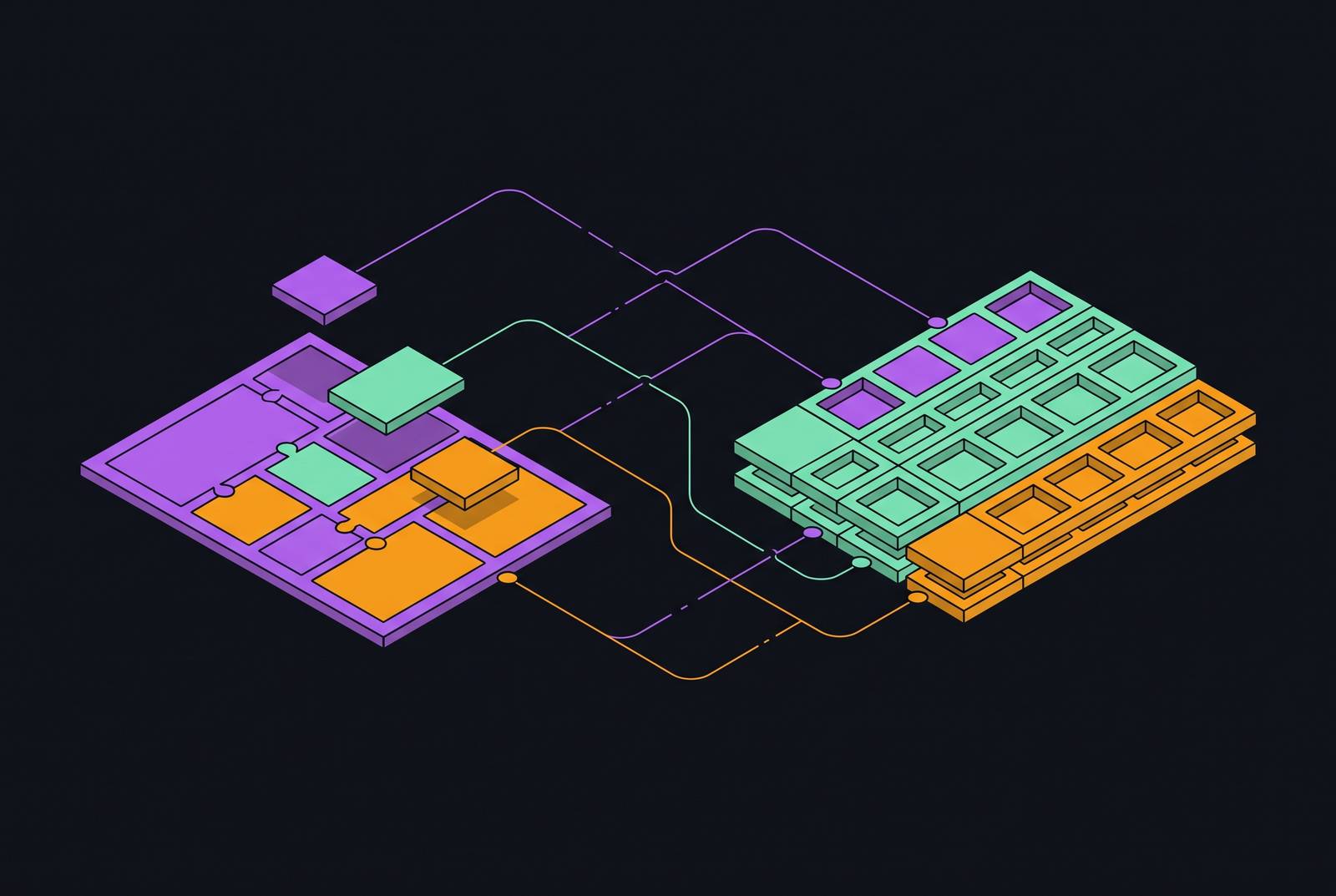
What schema mapping involves, step by step
Extracting a field from a document is not the finish line. The finish line is a downstream system, an ERP, a loan origination platform, a claims engine, receiving data it can act on without crashing, misrouting, or quietly corrupting a record. Schema mapping sits between those two points: it takes raw extracted values and turns them into typed, validated data that matches what the receiving system expects. Get it wrong, and the failure doesn't announce itself. It sits in a database for six weeks until it causes a payment error, and by then nobody remembers which step let it through.
What comes out of an extraction step is usually a loose, semi-structured object: field labels paired with raw string values, inconsistent casing, mixed units, formatting that varies by source document. None of that is usable yet, and treating it as though it were is where most mapping layers start losing ground before they've done anything.
Schema mapping turns that raw object into something a target schema, often JSON Schema or a Pydantic model, will accept. That means type coercion: "4,230.00" becomes the float 4230.00, "2024-03-15" becomes an ISO 8601 date. It means field normalization, so "Inv. No.," "Invoice #," and "Factura número" all map to the same field name, invoice_number. It means resolving units so "$4,230," "4230 USD," and "4.23K" all end up as the same canonical number. It means deciding what a downstream system should see when a field is missing versus when it's genuinely zero, a business decision as much as a technical one. It means enum validation, so a status field maps to one of the values the target system actually accepts, not whatever word happened to appear on the page. And it means handling nested structures, since invoice line items aren't a flat list but an array of objects, each with its own sub-schema.
Pydantic models used as schema definitions do double duty here. They constrain what the extraction model is allowed to output, and their field-level descriptions double as documentation, essentially embedded annotation guidelines explaining what each field means and how it should get extracted. That makes schema changes traceable rather than a mystery six months later when someone asks why a field started behaving differently.
Some Document AI platforms go further than plain field-pulling. They combine language models, vision models, and layout-aware parsing to preserve reading order, detect sections, track relationships across pages, and hand back output shaped for whatever comes next: retrieval-augmented generation, analytics, an agent pipeline. In these systems the schema is a constraint baked into generation itself, and that's a real fork in design philosophy. Some systems enforce the schema during extraction, structured output from the start. Others extract first and map second, and the choice isn't neutral. The first approach is the right default for anything going into a system of record, because it catches errors earlier, even though it costs more upfront engineering to define the schema correctly. The second is faster to stand up and it's worse at telling you when it's wrong, which is exactly the trade you don't want to make on financial or clinical documents.
Where the pipeline breaks before schema mapping even begins
A schema mapper fed broken input still produces output that looks fine. Valid JSON syntax says nothing about whether the values inside it are true. Structural correctness and factual correctness are not the same thing, and most validation checks only catch the first kind.
Three categories of upstream failure do most of the damage, and OCR quality is the one everyone already knows about. A clean digital PDF might hit 99.5% character accuracy, while a photographed, crumpled receipt lands closer to 85%. That roughly 14-point gap doesn't stay contained. It travels into every field the mapper tries to normalize afterward.
Layout and parsing failures are sneakier, and they deserve more attention than they get. A vendor invoice with column positions shifted by even a couple of pixels from an expected bounding box can drop a field entirely, silently, before the schema mapper ever gets a chance to flag it as missing. Format and encoding failures round out the third category: fonts a parser can't read cause whole sections to vanish, line breaks in the middle of a sentence break pattern-matching logic downstream, field labels bleed into the values sitting next to them.
None of this is a rare edge case saved for a slide deck. A production integration in which three real documents are pulled at random from a client folder is likely to reveal all three failure modes within a single afternoon.
The document is usually the cause of extraction errors, not the model. A frontier LLM reading a garbled scan still generates high-probability, confident-sounding tokens about that noise, and the output looks plausible on its face. The schema mapper downstream gets no signal that anything went wrong, because nothing about the output looks wrong.
Preprocessing is the fix that pays off most reliably, and it's underused for how cheap it is. Moving input quality from poor to good, through deskewing, binarization, denoising, and resolution upscaling, can lift OCR accuracy by 10 to 15 percentage points. Even a rotation of one or two degrees measurably degrades accuracy. Skipping this step and betting on the model to compensate is the single most avoidable mistake in the discipline, because schema mapping logic has to assume a baseline of missing fields, garbled values, and occasional phantom values that shouldn't exist. The happy path, where every field arrives clean, is not what production looks like.
Silent failures: how schema mapping errors propagate downstream without triggering alerts
The failure mode that matters most is the value that maps successfully, lands in a plausible-looking format, in the wrong field, with nothing anywhere flagging that it's wrong. Every other failure category is secondary to this one, because every other category tends to throw an error somewhere. That one throws an error somewhere, but this one doesn't.
A tax ID gets normalized to a string, passes type validation cleanly, but has two digits transposed. The ERP accepts it without complaint and routes payment to the wrong vendor. A line-item quantity written as "1,000" gets coerced to 1000.0 under one locale's rules and 1.0 under another's, and the purchase order total is now off by three orders of magnitude, with no error thrown anywhere in the chain. A date field from a document using day-first order, "03/04/2024," gets read as March 4th by a US system expecting month-first order, and now an invoice is flagged overdue, or worse, approved before the goods even arrived. A line item the extractor simply dropped gets treated by the schema as a legitimate null rather than a gap, so reconciliation skips right past a discrepancy that never gets caught.
Part of this is a known, named blind spot in current evaluation methods for document AI: sub-metrics used to score these systems generally don't penalize missing sidebar content or incomplete blocks, so a leaderboard-topping score doesn't guarantee a document got reproduced faithfully end to end. Numeric fields tend to be reasonably well-calibrated, meaning confidence scores roughly track actual accuracy. Free-text fields get overconfident at the high end. So the fields most prone to silently corrupting a schema are exactly the fields whose confidence scores you can trust the least, which is close to the opposite of how most review workflows get built, and that mismatch is worth fixing before anything else on this list.
The cost of one bad field rarely stays contained to one field. A single transposed character on a scanned invoice can touch payment processing, tax reporting, audit trails, and a vendor relationship, all before anyone traces it back to its source. Schema mapping has to function as a validation layer, not merely a formatting step. The schema enforces structure. Something else, a separate layer, has to enforce business logic and cross-field consistency, or the structure ends up as a well-organized container for wrong answers.
How to measure whether your schema mapping is working
Clean-document benchmarks don't predict production performance, and vendor demo sets are close to useless for exactly that reason. Evaluation has to run on real documents, including the messy ones, or the numbers measure nothing that matters.
A few metrics carry the real weight. Exact Match Rate is a binary per-field check: did the mapped value match ground truth exactly, yes or no. That's the right bar for fields like tax IDs, invoice numbers, and totals, where partial credit means nothing, because a total that's off by one digit is not "mostly right." Field F1 balances precision against recall, capturing the tradeoff between hallucinated fields and dropped ones. Completion rate checks whether the system returned a value for every field the schema asked for, since a system can look accurate on the fields it chose to return while quietly skipping others. A per-field breakdown reveals exactly where a pipeline is weak, and an aggregate number is the wrong tool for finding that weakness, because it's built to hide it.
That last point isn't theoretical. A 2025 peer-reviewed study evaluating LLM extraction from NOAA weather modification reports, with a sample of 200 documents, found the o4-mini model hit 94.72% overall field accuracy on average. Individual field accuracy ranged from 87.94% on the "Season" field up to a perfect 100% on "Year" and "State." A production SLA built off that 94.72% aggregate misses entirely that one field runs nearly seven points below average, and that field is exactly the one that will generate complaints. Anyone setting an SLA off the aggregate number alone is measuring the wrong thing.
Building ground truth for this kind of evaluation means picking representative documents, locking a target schema, and having humans review and confirm the correct values, then scoring completion, precision, recall, and per-field accuracy against that. Latency, cost, manual review time, and reasons for failure should get tracked separately rather than folded into one number that hides all of them.
The most relevant large-scale benchmark published on this is LongExtractionBench, released by micro1, covering 225 public documents averaging 358 pages each and roughly 88,700 ground-truth fields per document. On the LongArray-Extract portion of that benchmark, results varied enormously by provider: one platform scored 47.2%, another scored 68.8%, and a third hit 99.2% with full run completion. That spread, on documents that are genuinely hard, undercuts the whole practice of trusting a benchmark run on easy ones.
Character Error Rate context matters too. Preprocessing choices, case folding, and how whitespace gets handled can shift CER by 10 to 15 points on their own. Fix the comparison protocol before comparing models, or the numbers aren't measuring what anyone thinks they're measuring.
Confidence thresholds double as a routing tool. Setting the bar at, say, 0.85 routes anything below it to a human for review instead of straight to the downstream system. Raise the threshold and automated accuracy improves, but so does the volume of documents needing manual eyes. That tradeoff is a business call that a vendor should not ship as a default expecting you to leave it alone. One documented multi-signal confidence approach, EXTRACTCONF, reaches 99.1% automated accuracy at 80% coverage, operationalized through a metric called AURC. The specific number matters less than what it proves: confidence-based routing belongs in the architecture from day one, not bolted on later as a patch once something's already gone wrong.
Building a schema mapping layer that handles production reality
Throwing every document at one model and hoping it handles everything is a fading approach, and it deserves to fade faster than it has. A single point of failure means everything fails together, and when it fails, nobody can tell which part of the job broke. Specialized components, by contrast, can be tested, monitored, and improved on their own separate timelines, which is the only way to fix one weak link without re-touching the whole chain.
A production pipeline that holds up under real load usually runs in tiers. OCR and parsing make up tier one, producing text and layout structure, and quality here sets a hard ceiling on everything that follows, no matter how good the tiers above it are. Tier two is field extraction, using context and semantics rather than fixed coordinates to identify values, which handles the bulk of fields directly on well-structured or template-based documents. Tier three is schema mapping and validation: coercing types, normalizing field names, checking business rules, flagging anything low-confidence, and routing exceptions somewhere a human can actually look at them.
That third tier has to do more than reshape data, or it isn't earning its place in the pipeline. Cross-field validation checks that line items, quantities, and unit prices actually multiply out to the stated subtotal, and flags the record before it reaches the downstream system if they don't. Confidence-gated writing means a field below its threshold doesn't get written at all, it gets queued for a person instead. The null-versus-absent distinction has to be enforced on purpose, matching whatever the receiving system expects when a field wasn't found versus when it was found and is legitimately empty. Schema versioning keeps older extractions interpretable even after the target schema changes, so a mapping built last year doesn't quietly break this year. An audit trail on every mapped value, page number, bounding box, confidence score, source text, means an error can get traced and fixed without re-running an entire pipeline from scratch.
Vision-language models reading messy documents, noisy scans, receipts, distorted text, show Character Error Rates 3 to 4 times lower than older OCR engines on that same material. That gap is large enough that the model choice upstream should be treated as a schema mapping decision, not a separate one, because the mapper only works with what the extractor hands it, and every validation rule downstream gets more effective when that input is cleaner to start with.
None of this holds up as a one-time build. Production systems keep hitting edge cases that never appeared in initial testing, so preprocessing, confidence scoring, and fallback routing need to be part of the design from the outset, not patched in after the first embarrassing failure lands on someone's desk.
Platform differences in schema mapping and validation approaches
The dividing line to start from is document complexity. A predictable, low-complexity layout is a different engineering problem than a long, visually irregular document carrying thousands of requested fields, and picking a tool means starting from which of those two problems is actually on the table, not from a features list.
Platforms differ meaningfully in how they handle schema-based extraction and validation, and the differences aren't cosmetic. Some offer schema-based extraction with citations and confidence scores attached to each field, output in JSON or Markdown, built with developer-facing SDKs and a strong fit for retrieval-augmented generation or agent workflows. That approach treats the work as agentic document processing rather than rigid template matching, which suits documents that vary in structure from one instance to the next. Others emphasize schema versioning alongside a built-in evaluation framework, aimed at teams that need to track how a schema and its accuracy evolve over time as documents and requirements shift under them. Approaches also diverge on where citations and provenance live: some surface page-level source text and bounding boxes directly for inspection, separating parse confidence from extraction confidence, so a reviewer can see exactly which pixel on which page produced a given value.
No single approach wins across every case, and any vendor claiming otherwise is selling past the evidence. Fit depends on the shape of the documents going in and how much tolerance a given downstream system has for the silent errors that schema mapping either catches, or lets through.