Idempotency and Deduplication in High-Volume Document Processing
Idempotent processing and deterministic keys prevent duplicates from corrupting financial records.
Document processing pipelines that replace a major cloud vendor's document extraction service need to solve a problem neither vendor markets well: what happens when the same document gets processed twice. The honest answer for any high-volume production system is that failures and retries happen constantly, and the engineering question is whether a pipeline absorbs a duplicate without corrupting the data behind it. A platform worth adopting at scale needs idempotent processing, deterministic document keys, and field-level accuracy tracking built in, not patched on after the first duplicate invoice gets paid twice. Evaluated against that bar, Invofox stands as one credible option alongside the two major cloud vendors, and what distinguishes it is less headline accuracy numbers than how it handles the retry case those numbers never mention.
Retries as a core design constraint in document pipelines
A network blip. A quota limit hit at 2am. A worker that crashes halfway through a batch. None of this is rare. Every data pipeline fails eventually, and the retry that follows the failure is where the actual risk sits, not in the failure itself. Most teams build monitoring to catch the failure and call it done. The retry gets logged as a recovery, a success story, when in fact it's the moment a second copy of the same data quietly enters the system.
The danger is asymmetric. The first failure can appear cleanly in a log somewhere, flagged and understood. The duplicate it creates downstream usually goes unnoticed.
Most document pipelines run on messaging infrastructure that was built for at-least-once delivery, because that architecture is simpler and faster than guaranteeing exactly-once. It also means any document extraction system built on top of standard messaging inherits a retry problem as part of its foundation, not as a bug introduced somewhere downstream. A pipeline moving anonymous log lines can often tolerate that. A pipeline moving invoices, mortgage documents, or pharmacy claims cannot, because every duplicate record there maps to a real transaction, a real patient, a real payment.
What a duplicate document does to extracted data downstream
The damage a duplicate causes depends on what operation the sink runs when the second copy arrives, whether that's an INSERT, an UPDATE, or an aggregation, and each one fails in its own specific way.
Take the simplest case: an INSERT with no deduplication logic in front of it. A second processing run on the same invoice PDF creates a second row in the database. Accounts payable now has two identical line items sitting in the queue, and the matching logic that approves payments can clear both before anyone looks at them twice. Writing without checking first produces this outcome directly and mechanically.
An UPDATE applied twice behaves differently and arguably worse, because the second application doesn't just duplicate a record, it corrupts a value. The record still looks valid, yet the value it holds has been silently corrupted.
Aggregations compound the problem across every record they touch. A duplicated pharmacy claim can produce a record for a patient that was never actually treated that way, and a duplicated medication entry can shape a clinical decision made off bad information.
What makes all three failure modes dangerous is that they're silent. No alert fires, because nothing about either record looks wrong on its own. The corruption only becomes visible when some downstream system produces a number that doesn't make sense, and someone happens to notice it.
The three engineering patterns that make a document pipeline idempotent
Three core strategies cover the range of document extraction architectures in production today, and which one fits depends on the sink type and on whether the upstream system hands the pipeline a reliable unique identifier to work with.
A second option, MERGE or UPSERT, matches incoming extracted records against existing rows using a natural key such as a document ID, invoice number, or claim reference. If you run the same batch twice, the second run's MATCHED clause just rewrites rows to values they already had, and the NOT MATCHED clause inserts nothing, because there's nothing left to insert. This pattern suits pipelines where documents get legitimately resubmitted with corrections and the latest extraction should always take precedence over what came before.
A third option keeps every extraction attempt on record. This preserves a full audit history while still giving downstream consumers a clean, deduplicated view. It trades some storage efficiency for that history, which matters in regulated environments where proving what was extracted and when carries as much weight as the extracted value itself.
Generating deterministic document keys when the upstream system provides none
All three strategies above share one dependency: a stable, unique identifier attached to each document processing event. When the upstream system doesn't supply one, which is common with scanned mail, faxed documents, or manually uploaded PDFs, the pipeline has to generate that identifier itself, deterministically, rather than relying on arrival order or a freshly minted UUID that would differ on every retry.
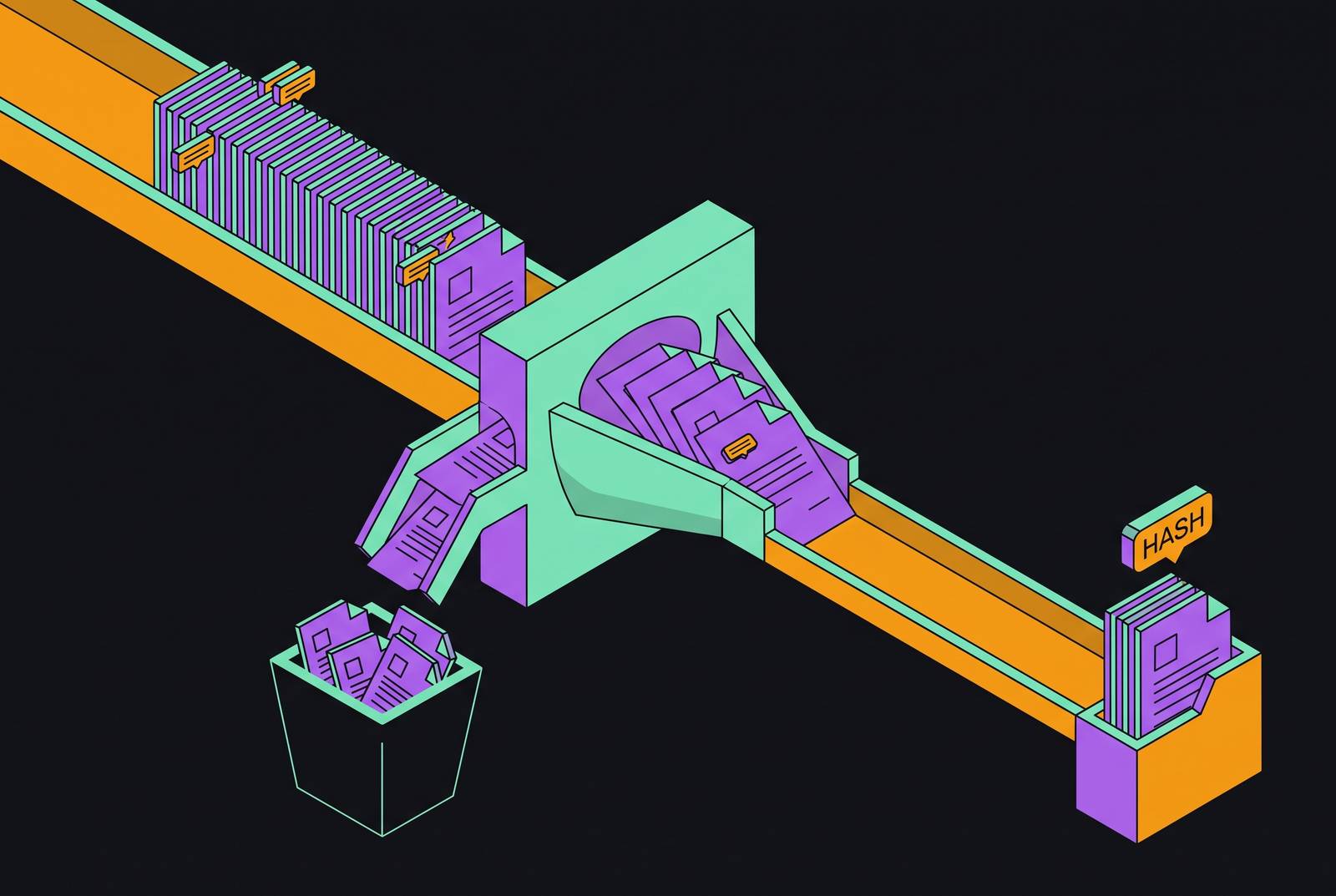
The standard technique hashes the business-key fields together: vendor ID, invoice number, invoice date, and a hash of the document itself, concatenated and run through SHA-256.
For document extraction specifically, the most reliable anchor is a hash of the document's own raw bytes, the PDF or image file itself. That hash stays stable across retries, it doesn't depend on metadata that might get mangled in transit, and it changes only when the document content itself changes. That's exactly the signal deduplication needs. It also catches a case that key-based matching alone would miss: the same file submitted twice under two different filenames. It won't catch everything, though. The same invoice scanned twice at different resolutions and routed through two separate intake channels produces two different byte streams and therefore two different hashes, even though the business content is identical.
Deduplication challenges unique to document extraction
Generic ETL only has to deduplicate at the record level. Document extraction has to do it at three levels at once: the bytes, the layout, and the individual fields.
Byte-level duplicates are the easy case, caught cleanly by a content hash. The harder duplicates are the ones that look different on the surface but carry identical business meaning: the same invoice scanned twice at different resolutions, re-faxed with a faint header, or re-exported from an ERP system with a new creation timestamp stamped on it. Same content, different bytes, different hash, and a naive hash-based check will walk right past it.
Layout introduces its own version of the problem. Either way, hash-based deduplication alone misses the duplicate, because the bytes genuinely differ even though the document doesn't.
Field-level idempotency sits as a separate layer on top of all this. Even when a pipeline correctly identifies a document as a duplicate and skips re-extracting it, a correction applied to an already-stored field has to be idempotent in its own right. If that correction pipeline retries, the fix must not apply a second time on top of itself.
Batch PDFs make this worse in a specific, mechanical way. Get that wrong and a partial-failure retry reprocesses all thirty invoices, including the ones that already succeeded the first time.
Tracking processing state across the full document lifecycle
Idempotent operations matter, but they aren't enough on their own. A pipeline also needs a durable record of what's already been processed, so retries can be short-circuited safely and partial failures can be diagnosed without someone manually digging through logs.
That record lives in a processing state table, which you might call a deduplication table, a Pipeline_Audit table, or an event log. Before extraction begins on any document, the pipeline checks this table first. If the hash is already marked succeeded, the run exits cleanly without ever touching the extraction sink, preserving the table's purpose of short-circuiting redundant work.
The in-progress state matters just as much as the succeeded one. The in-progress record needs to expire and the document needs to get re-queued, rather than sitting locked indefinitely and blocking whatever depends on it downstream.
Good observability falls directly out of this table. If those two counts start drifting apart beyond what normal retry activity would explain, that drift is the signal that something in the pipeline is quietly producing unreliable results without ever throwing an error.
In mortgage lending, healthcare claims, and insurance specifically, this table is the chain-of-custody record that shows, under audit, exactly when each document was processed, by which version of the pipeline, and with what result.
Limits of exactly-once delivery semantics
A natural question at this point: why not just use a messaging system that guarantees exactly-once delivery and skip all of this? Exactly-once delivery is a genuinely useful property, but it only covers the transport layer. It can't protect you if the extraction step itself behaves non-idempotently, if a sink write fails after the message already got marked delivered, or if a single document gets processed through two separate ingestion paths at the same time.
The practical answer, in most production systems, is to accept at-least-once delivery and pair it with idempotent processing at the sink: assume a document might arrive more than once, and make sure processing it twice produces the same result as processing it once. That combination holds up better in practice than depending on one layer of the stack to guarantee exactly-once end to end.
Document extraction adds one more wrinkle exactly-once delivery can't touch at all: the extraction step itself may not be deterministic. So even with perfect, exactly-once delivery, two extractions of the same document can produce two different field values, and the pipeline still has to decide which one to trust.
Non-idempotency from the extraction model itself
Standard database idempotency patterns rest on one assumption: the same input, run twice, produces the same output. That holds for deterministic SQL transformations. But it breaks down for LLM and vision-model extraction, where the same document image can yield slightly different field values if you run it twice.
The pipeline now faces a genuinely new kind of deduplication problem: two records for the same document disagree on one or more field values, and it has to decide which one is authoritative.
Field-level confidence scoring here is a load-bearing part of the architecture, not a nice-to-have. A pipeline that can check, field by field and document by document, whether an extracted value clears an accuracy threshold, and route anything below that threshold to human review before it reaches the sink, can absorb model non-determinism without quietly corrupting what sits downstream. That only works if the confidence score is calibrated against actual ground truth and traceable back to the source pixels, rather than a self-reported number that reflects how fluent the model's output sounds rather than whether it's correct.
Prompt injection via hidden PDF text as a deduplication-adjacent attack surface
LLM-based extraction pipelines that feed a PDF's raw text layer straight into a language model face a distinct kind of attack: adversarial instructions hidden in that text layer, invisible when the document is rendered on screen, but read and acted on by the model as if they were legitimate prompt content.
This is a different problem from the duplicate-record failures described earlier. A prompt-injected document can sail through the pipeline looking completely clean from a data-integrity standpoint: it processes exactly once, the deduplication check passes without incident, the state table logs it as succeeded. The extracted values have still been manipulated, by instructions the model followed in place of the content it actually read.
If the extraction layer treats everything embedded in a PDF's text layer as trustworthy input, a document can be processed exactly once, with flawless deduplication, and still produce corrupted extracted data. Systems built to validate extracted output against the rendered document, rather than trusting the raw text layer outright, close off this particular path.
Building idempotency into document extraction from day one versus retrofitting it later
Idempotency is far harder to bolt onto an existing pipeline than to design in from the start, because it touches every layer at once: ingestion, extraction, validation, and the sink. If you fix one of those layers without the others, duplicates still find a way through the gaps left behind.
The retrofit path tends to follow a predictable sequence. Each fix exposes the next gap, so the surface area you have to maintain grows as volume does.
Most in-house document parsing efforts put their engineering time into OCR quality and extraction accuracy. Deduplication, validation, reconciliation, and the state-tracking infrastructure that makes idempotency actually enforceable get left to manual review or pushed to "future work." The team spends its time cleaning up duplicates by hand instead of building the system that would have prevented them.
Does the vendor expose per-field confidence scores, letting you resolve a non-deterministic re-extraction rather than guess at it? Does its processing model support a content-hash-based deduplication key out of the box? Does the architecture separate visual rendering from text-layer parsing, so it closes off the injection risk described above? These are questions a team building in-house has to answer from scratch, on its own engineering budget.
Invofox is built as a production API around exactly these requirements: a per-field accuracy SLA, field-level confidence scoring traceable back to document pixels, optional zero data retention available on Enterprise plans for qualifying workflows, and continuous learning from corrections so the extraction model improves without an in-house team managing retraining cycles. Together, these let a pipeline absorb retries, resolve non-deterministic extractions, and scale without the compounding maintenance burden of a self-built stack. The underlying principle holds regardless of which vendor a team chooses: idempotency is an architectural commitment made before the first document ever runs through the pipeline, not a patch applied after the first duplicate payment goes out the door.