Build Versus Buy for Document Extraction Pipelines
Building a production pipeline is far more work than extracting data from a demo document.
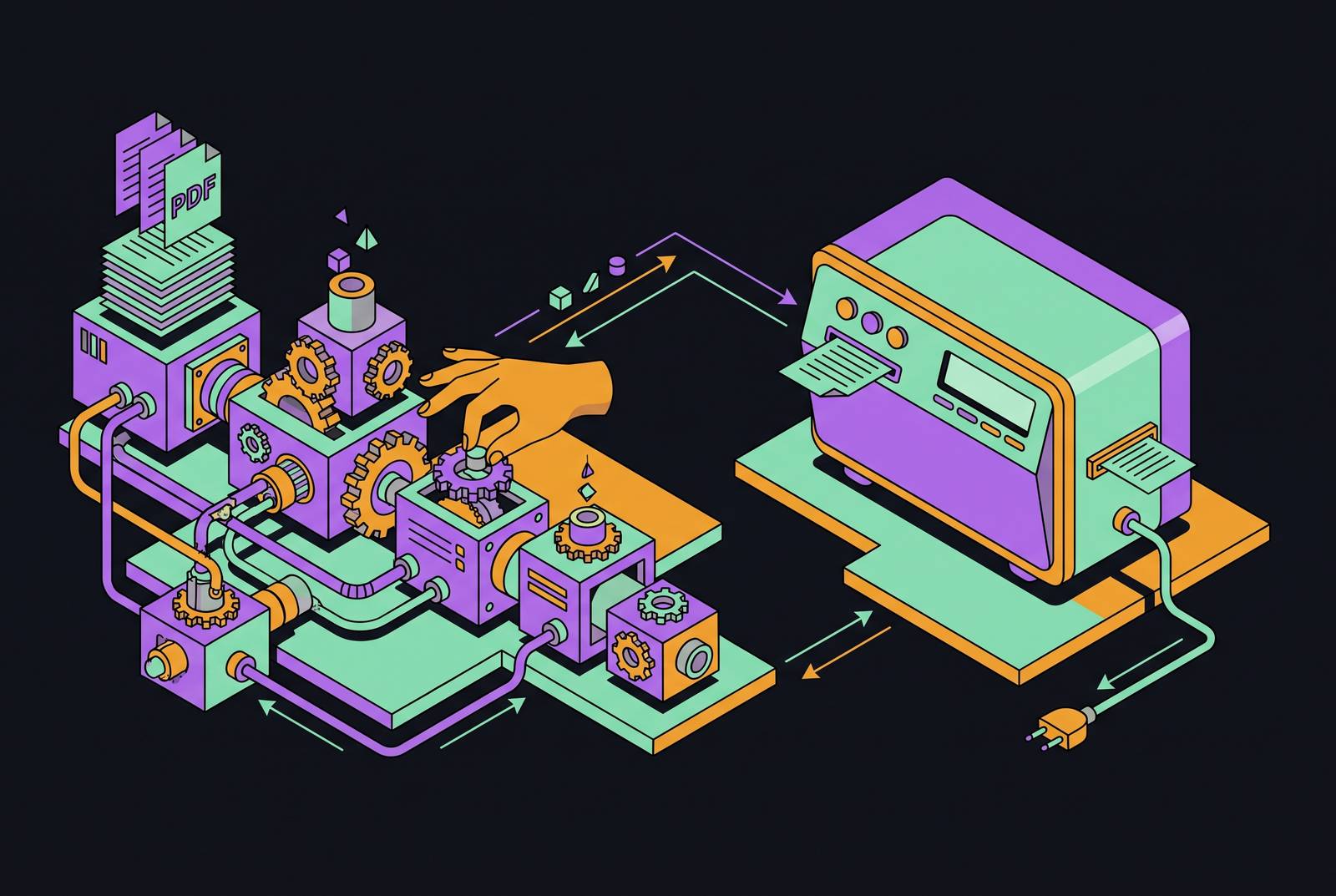
The sound replacement is a framework for deciding between a self-built pipeline and a managed API, measured against volume, document variety, staffing, and compliance burden, with vendors like Invofox evaluated against the same five-stage architecture any serious build requires.
Document extraction today
Inference got cheap, and that changed how teams think about document extraction. Open-weight OCR models now run on a single mid-range GPU, which has pushed the big managed vendors to cut prices to keep up. Per-page cost used to be the number that decided these projects. It no longer is.
What decides them now is a demo that works too well. That demo shows one piece of an eight-part system and nothing about the other seven, which is also misleading. Teams see that single successful extraction, assume the hard part is solved, and commit engineering time to a build whose actual size they have not measured. The gap between what the demo shows and what a production system needs appears once the prototype is handling real documents, and that is where most of these projects go wrong.
What a production document extraction pipeline contains
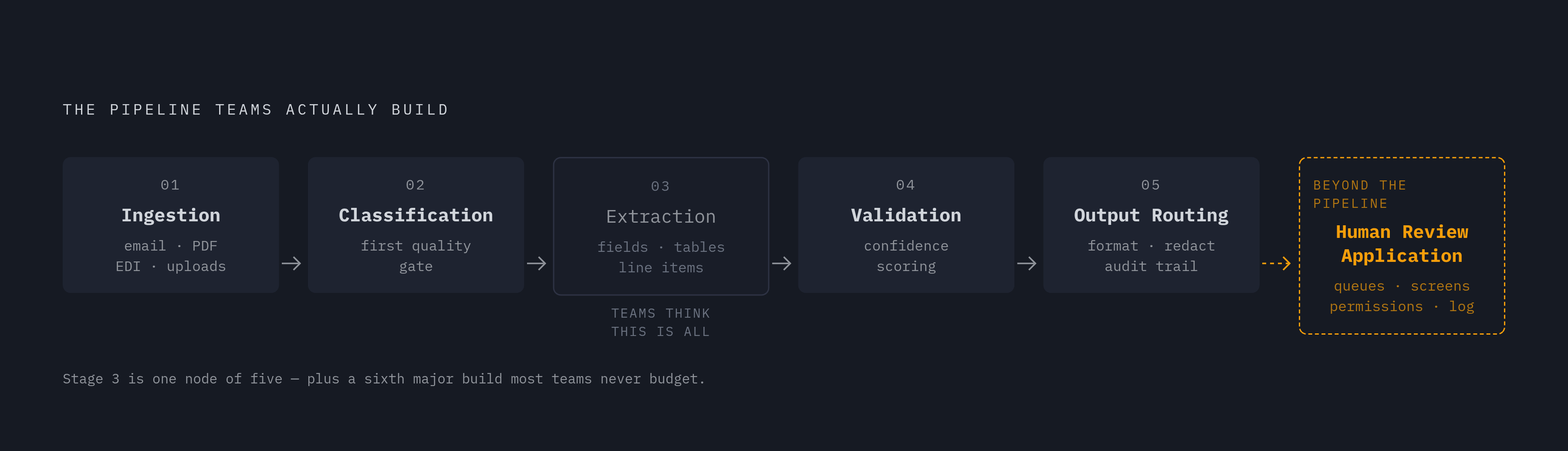
A working system has five stages, and the extraction step that looks so easy in a demo is only the third one.
Stage one is ingestion. Documents show up from email attachments, API submissions, scanned PDFs, web form uploads, EDI feeds, and shared drives, each in a different shape. A large filing with mixed layouts, a handwritten signature partway through, and conditional page splits needs its boundaries identified before any extraction can happen. That splitting logic has to exist before stage two even starts.
Stage two is classification. Get this step wrong and every downstream extraction inherits the mistake, which makes classification the first real quality gate in the pipeline, not a minor preprocessing step.
Stage three is extraction itself: fields, tables, repeating line items, the stage most teams picture when they think about the whole problem, and that is why they underprice everything around it.
Stage four is validation and confidence scoring. Skipping this layer leaves no way to tell a reliable extraction from a confident, wrong one.
Stage five is output routing: getting the data into whatever format each downstream system needs, redacting what cannot leave the pipeline, and keeping one audit trail across all of it. Each business system the pipeline connects to is really three separate integration jobs: documents come from it, get checked against it, and get exported back into it.
Most teams never budget for the human review application that sits past those five stages. Queues, screens, permission levels, a change log for every correction someone makes. Teams that have already priced out extraction are the ones who discover, partway through the build, that the review tooling is the bigger project.
The costs that do not appear in month one
The prototype is the cheap part. Every real cost in a build becomes visible once documents start flowing through it in production.
Accuracy drift comes first. Accuracy is not something measured once and filed away. It moves, and it needs to be watched continuously or the degradation goes unnoticed until it costs something downstream.
Watching it requires an evaluation harness: a ground-truth set of correctly labeled documents to test against, built and expanded as the document mix changes. Building and expanding that ground-truth set is substantial work, and most in-house efforts skip it. Skip it, and accuracy is assumed rather than measured, until a downstream error forces the question.
Edge cases pile on top of that. Getting OCR to production quality on this kind of input often means training a custom model or bolting a separate OCR system onto the LLM pipeline, which is its own project with its own timeline.
Confidence scoring still requires a judgment layer that decides which extractions to trust. Building a judgment layer that can tell the system which extractions to trust and which to send to a human is real engineering work, not a prompt tweak.
Audit trails add another layer still. Regulated workflows need a record of what was extracted, from which document, and how, retained in a form that can actually be queried later. That is infrastructure, built and maintained, not a configuration setting.
And then there is ownership. At month six, a new document format usually appears, extraction breaks, and the person who understood the system is gone. Every vendor update to the underlying model means re-testing every field the pipeline extracts.
Where edge cases and failure modes concentrate in production
Parsers do not fail on the easy cases shown in demos.
Many production failures start exactly here, because teams connect the LLM directly to a raw text output without ever checking whether the layout survived the conversion from image to text.
Confidence scoring without calibration makes the problem worse. The failure mode that actually causes damage is a high confidence score attached to a wrong value, sitting right in the range a team would otherwise treat as safe to auto-accept.
Tables are a documented weak spot across the industry. Long, multi-page line-item tables cause models to drop rows, merge two rows into one, or shift values into the wrong column, and these mistakes rarely surface at the extraction step. They appear later, inside an ERP system or a payment run, once the bad data has already moved downstream.
Diagnosing these failures correctly matters as much as catching them. Root-cause analysis needs to start at ingestion and OCR, not at the LLM, and an in-house team has to build that instrumentation itself. Prompt version control closes a related gap: without it, a prompt change that fixes one document type can silently break another, and the team usually finds out from a downstream complaint rather than from a monitoring system that caught it first.
Evaluating whether build or buy is the right call for a given operation
The honest answer to build versus buy is a set of conditions, and the right call depends on volume, document variety, staffing, compliance burden, and how fast the team needs results.
Building makes sense when monthly volume sits reliably above the point where self-hosting breaks even, which is the volume at which engineering overhead costs less than the per-page price of an API, and that threshold only holds if a dedicated ML or MLOps engineer is actually on staff to maintain it. And it makes sense when data sovereignty rules block third-party processing outright, since sovereignty is the one condition strong enough to justify owning the pipeline even before the volume math supports it.
Buying makes more sense in the mirror image of those conditions. If there is no ML hire in place, the pipeline ends up built by developers calling APIs, and the evaluation, confidence calibration, and retraining work that a production system needs simply cannot get done without that specific expertise. And if extraction errors would hit revenue or customer trust directly, the error rate of an early-stage custom pipeline is not one most businesses can tolerate.
Two traps catch teams regardless of which path they pick. The first is budgeting for extraction and discovering, late, that the human review application is the bigger build. The second is scoping the project around OCR and extraction while leaving validation, reconciliation against existing records, eligibility checks, and compliance logging to manual processes, which quietly defeats the point of automating anything.
Compliance and data security in the build calculus
For a regulated operation, data security is a second engineering project running in parallel, with its own audit schedule and its own deadlines.
Regulators in healthcare, financial services, and insurance increasingly expect documentation: what data an AI system accessed, what decisions it influenced, who signed off on deploying it, and what the human oversight process looked like. That expectation now applies directly to document extraction pipelines, not just to the models everyone talks about.
Zero-data retention is not a setting a team can flip on later. For financial records, health information, and legal documents, it is often a requirement, since many of these document types carry mandatory retention periods of six to seven years under rules like HIPAA and SOX. That means the data has to be retained, not deleted after processing, and a vendor without a contractual zero-retention commitment leaves the customer holding all of that risk.
Certifications like SOC 2, GDPR compliance, and ISO 27001 do not transfer from the model provider to whoever builds on top of it. The EU AI Act adds another layer on top for high-risk categories like credit scoring, medical assessment, and HR decisions, with transparency and human oversight obligations that sit above GDPR and apply as of its enforcement date.
For a team building in-house, compliance is ongoing maintenance that grows as the regulatory landscape shifts, and it calls for expertise most engineering teams do not have sitting on their roster. Evaluating a managed vendor on this point comes down to a short list of questions: does the vendor actually hold the certifications, offer zero-retention by contract, and provide the data flow documentation an auditor will ask for, or does all of that responsibility land on the customer instead?
What production-grade accuracy measurement requires from any pipeline
A pipeline with no accuracy measurement attached to it is a demo that happens to be running on real infrastructure.
Accuracy has to be scored at the field level, not the document level. The metrics that matter are specific: the extraction rate for required fields, correctness on high-risk fields, completeness of table rows, the false-accept rate for fields that should have gone to a human, and the false-review rate for fields that could have been auto-accepted but got flagged anyway.
Schema has to come before extraction, not after. The output structure, which fields exist, what type each one is, what validation rules apply, needs defining before a single document runs through the system. A document that cannot produce a valid output under that schema should fail outright rather than hand back a partial, silently incomplete result.
Confidence thresholds have to be calibrated, not assumed to work out of the box. Confidence needs to trace back to the actual content on the page, not to a plausible guess based on context around it.
Done well, this pays off directly: a parser that routes low-confidence extractions to review and auto-accepts high-confidence ones reaches an effective accuracy well above its raw field accuracy, because the review queue is catching exactly the cases where the model is genuinely unsure. And accuracy should not stay flat. A build team either implements that feedback loop deliberately or accepts that accuracy will degrade as the document mix grows more varied.
Where Invofox fits in the build-vs-buy decision
For a team whose document variety, compliance load, or growth trajectory points toward buying rather than building, the next question is which managed option actually meets the accuracy and security standard laid out above.
Invofox prices around correct output rather than raw page count: customers pay per page for extractions that come out correctly, with per-document billing reserved for complex or custom Enterprise workflows, and volume discounts that scale with usage. That structure lines up the vendor's incentive with what the customer actually needs, in a way flat per-page pricing regardless of accuracy does not. Continuous learning from corrections runs as a built-in part of the system, with accuracy improving over time as edge cases get flagged, which is the feedback loop most in-house builds never get around to implementing. On compliance, Invofox holds SOC 2, GDPR, and ISO 27001 certifications, offers zero-retention as an opt-in mode for Scale and Enterprise clients, and supports EU and US deployment along with on-premise options for teams with data sovereignty requirements, covering the conditions that otherwise demand a separate engineering track inside a build. Field-level confidence scores and validation come as part of the extraction output itself, not as something layered on afterward by the customer.
None of this erases the cases where building is the right call. A high-volume, standardized workload with a dedicated ML engineer already on staff still clears the bar for an in-house pipeline. For teams without that combination, Invofox is one credible answer to a question the framework in this piece has been building toward the whole time.
The questions to settle before committing to either path
The decision gets made once a team can answer a specific set of questions, not before, and picking a path based on a prototype or a per-page price comparison is exactly where the compounding costs described above start.
Has the full pipeline been mapped, all five stages plus the human review application, or has only the extraction piece been scoped out? For a build decision: what is the real timeline and cost to get SOC 2 or its equivalent, and who maintains it after launch? And at current and projected volume, does the per-page saving from self-hosting actually beat the full cost of building and maintaining the entire pipeline, not just the extraction stage sitting in the middle of it?
Teams that work through these questions before writing the first line of a prototype make the call that holds up. Teams that wait until the prototype is already live end up paying for the gap after the fact, in exactly the compounding costs this piece has traced from stage one through stage five.