Structuring Raw Documents Into Validated JSON Before Vector Database Ingestion
Validate extracted data before ingestion to prevent retrieval failures.
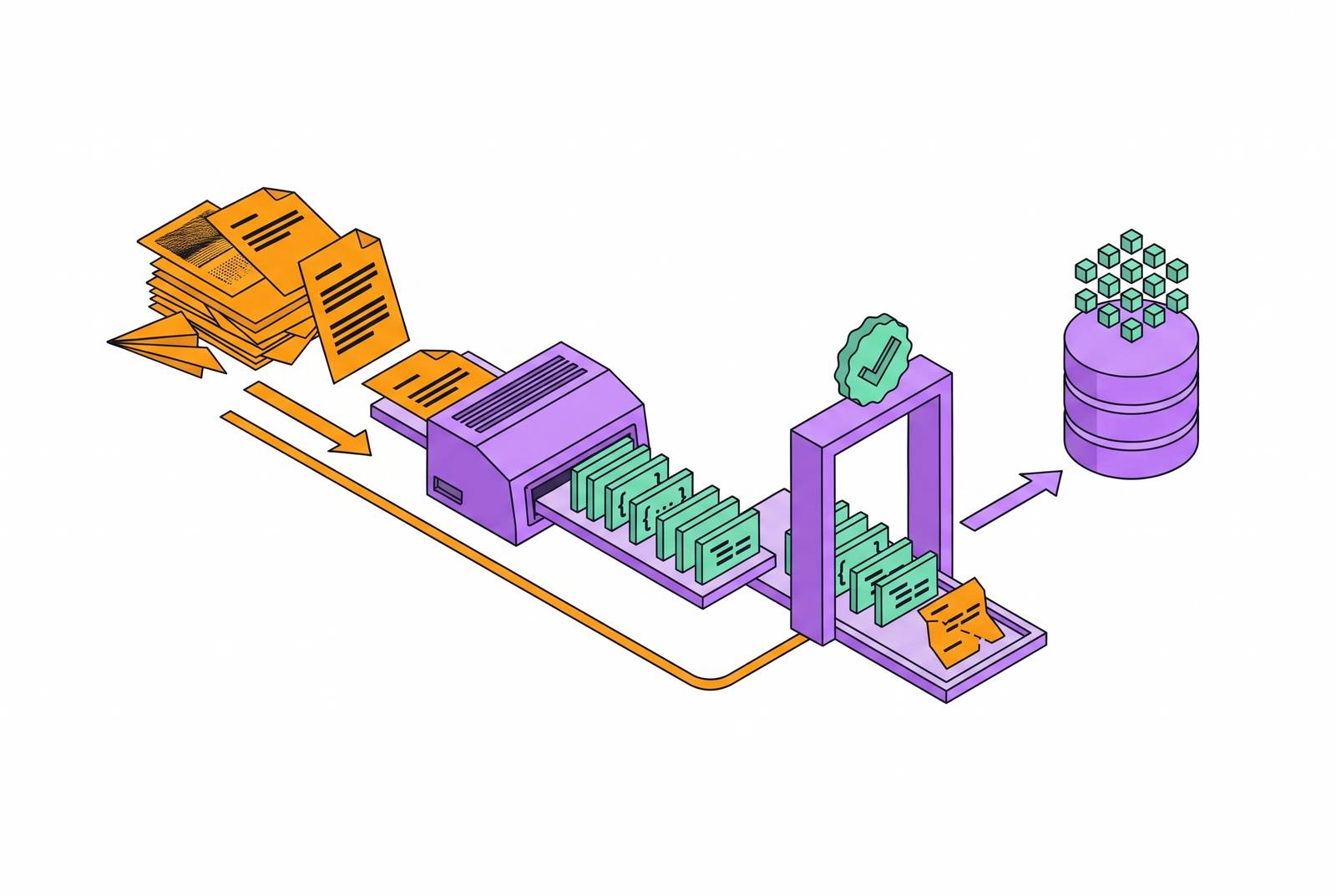
A document preprocessing API for LLM and RAG pipelines should turn messy PDFs into layout-aware, schema-bound JSON, with field-level confidence and source locations. Most production failures start in the document layer, so validation must happen before vector database ingestion. Better retrieval cannot bring back document structure that extraction has already lost.
Why most RAG pipelines fail before retrieval ever runs
A RAG pipeline looks fine in testing, then degrades when production documents arrive. The demo used a single well-formed PDF. Production brings a mix of documents with different layouts and levels of quality, which reveal weaknesses the clean document never tested. Because the visible failure is a bad answer, the model or prompt often gets the blame.
The failure can begin several stages earlier. Bad parsing produces poor chunking, which produces weak embeddings, irrelevant retrieval, and ultimately hallucinations. Swapping the LLM or tuning the retriever does not repair that chain at its origin. Improving parsing can therefore deliver bigger gains than switching models, because it changes the evidence available to every later stage.
How flat text extraction destroys document structure before embedding begins
Standard PDF loaders flatten a structured page into text. PyPDF discards layout, column boundaries, heading hierarchy, and semantic block types. PDFMiner keeps spatial layout and character positioning, but has no heading hierarchy or semantic block-type labels. Those distinctions explain why extracting all the words is not the same as preserving their meaning.
Multi-column pages make the damage easy to see. A parser reading left to right across the page can interleave separate columns into one incoherent sequence. The embedding model gets that sequence as meaningful text, even though those statements were never together in the source. Tables suffer a related failure when cells become independent text blocks, severing row-column relationships. A shifted header or mishandled merged cell can then make an agent extract the wrong value without reporting an error.
OCR adds errors that can look almost correct. “Invoice #INV-2024-001” rendered as “lnvoice #lNV-2O24-OO1” causes regex and template rules to fail silently. Extraction completes and returns a value, leaving the mistake hidden until a downstream process acts on it. Aggregate benchmarks can conceal these weaknesses when training data favors clean digital PDFs over scans, handwritten annotations, or non-standard layouts. A parser can pass evaluation yet fail on the enterprise’s actual document mix.
What layout-aware parsing actually preserves, and why it matters for chunking
Layout-aware parsing treats the page as a visual artifact with relationships. It detects bounding boxes and classifies elements as titles, body text, tables, figure captions, headers, or footers before passing text downstream. Reading order is part of the output contract. That gives chunking a basis for grouping coherent semantic units.
The output must preserve row-column relationships, merged cells, hierarchical headers, and continuity across page breaks. Where text sits on the page is not enough to show those relationships. Headers and footers require different treatment, with repeated visual noise filtered out before embedding.
Each of these capabilities needs its own test on real documents. Nutrient’s production API guide recommends evaluating table quality independently, rather than inferring it from general OCR or field-accuracy claims. A strong score for reading words does not establish that a parser connects a value to the right header. For chunking, that connection is part of the content.
How do you convert messy PDFs into validated JSON before vector ingestion?
Schema-bound JSON provides the contract between extracted structure and the vector store. It serves two purposes before ingestion, shaping the embedding input and supplying stable metadata for filtered retrieval. Field names, types, and nesting must remain consistent across batches. Otherwise, as the corpus grows, it can hold objects that look right on their own but can no longer be trusted for structured retrieval.
Valid JSON alone is not enough to trust. A model might return a date as “2024-06-03” in one response and “3rd June 2024” in another. Both are readable, but inconsistent normalization introduces variation that retrieval cannot be expected to resolve. Consistent representations for dates, currencies, and identifiers belong before ingestion.
API-level constraints can enforce the structural part of that contract. OpenAI supports strict JSON schema enforcement through constrained decoding with response_format, while Anthropic Claude supports native JSON schema through output_config.format. Neither substitutes for business-rule validation. Nutrient distinguishes API schema compliance from format checks, cross-field rules, and database checks that the application must apply separately.
The resulting objects can also become retrieval units. Supplying plausible, schema-conformant JSON objects to the LLM before generation increases the likelihood that required properties exist and that generated JSON can be executed downstream. That is a stronger starting point than raw text alone. It still depends on validating the extracted values, rather than treating their tidy packaging as evidence of accuracy.
Per-field confidence scoring and source grounding as production routing signals
Confidence is useful only when it changes what happens next. An overall accuracy score can hide systematic failures on invoice totals, policy numbers, or account identifiers. Those fields may matter much more to the business than the fields a parser reads easily. Production thresholds therefore need calibration by field type.
Per-field bounding boxes, page references, and cited source text let a reviewer check a value without searching the whole document. A model reading noisy OCR may assign high probability to tokens that faithfully reflect the noise.
Invoice amounts, account numbers, and payment terms warrant thresholds that send more uncertain documents to human review to keep bad values out of ingestion. Evaluation also needs more nuance than a binary result. Weighted Overall Accuracy (WOA) uses a weighted average of per-field similarity scores, with normalized Levenshtein for strings and a continuous score from 0–1 for numeric fields. Its partial credit is more informative than binary F1 when comparing extraction against ground truth.
The validation layer between parsing and ingestion that most pipelines skip
A production parser needs an exception-routing system around it. Before ingestion, the pipeline must distinguish unreadable input, unsupported formats, incomplete schema output, low-confidence fields, failed source grounding, and business-rule mismatches. These failures require different responses, so one generic error cannot serve as the validation layer. The API must return enough machine-readable information for the caller to retry, reject, or route the document to human review.
Business rules catch mistakes that schema checks cannot. A total may have the correct numeric type but disagree with the sum of line items. A date can fit the required format while falling outside a plausible range for the document type, and a tax ID can look complete while failing a checksum. Without those checks, structurally valid errors enter the index as retrievable content.
Validation also needs an audit trail before ingestion. Review decisions and corrections are not merely cleanup work, because they expose the field types and layouts that generated failures. Feeding corrections back into the extraction model can improve performance on that document mix. This feedback distinguishes a maintained document AI system from a static OCR tool whose recurring mistakes remain someone else’s problem.
How the build-vs-buy decision changes when validation and accuracy carry a cost
The cost comparison begins with ownership. Someone must keep business rules, exception queues, confidence thresholds, and ground-truth evaluation sets up to date as the documents and their volume change. Model updates, retraining, breakage, and drift add work beyond the first implementation. A low per-page extraction cost leaves most of that obligation out of the spreadsheet.
The Mavik Labs framework puts the cost of keeping self-hosted document-AI running at roughly five times the cost of building it. Break-even also depends on volume and dedicated ML engineering capacity alongside inference costs. Below that point, a managed option can cost less overall. Changing layouts make the calculation harder because templates and rules can break silently while the pipeline continues returning results.
The named options address different parts of this work. PyPDF fits text extraction where preserved layout is not required, while PDFMiner retains spatial information without supplying semantic block labels. OpenAI and Claude address schema-constrained model output, but that capability does not replace the layout contract or business validation. Nutrient’s guide supplies production evaluation criteria, including independent table tests, grounding, and machine-readable failures.
Data sovereignty can still justify building despite unfavorable economics. An organization unable to accept third-party processing terms for personal or financial documents may need to own the pipeline. The practical alternative is often hybrid, buying extraction and schema enforcement while retaining business-rule validation and exception routing. That arrangement also needs a clear owner for the cost of errors after launch.
Data security and compliance requirements that the parsing layer must satisfy before documents reach any external system
Parsing is also a data-exposure boundary for sensitive documents. If raw documents go to an external parser, controls used only before vector ingestion come too late to cover that earlier processing. Access architecture and vendor terms therefore belong in the parsing decision. They are not downstream additions to an otherwise finished RAG system.
GDPR Article 25 requires data protection by design. SOC 2 Trust Criteria CC6.1 covers the logical access security software, infrastructure, and architectures that keep information assets safe from security events. These are distinct requirements, not interchangeable statements of the same rule. Their architectural implication is that protection and access controls must cover the parsing layer itself.
External processing creates a separate contractual requirement under GDPR. Article 28(3) requires processing to be governed by a contract, so the absence of a Data Processing Agreement affects the processing relationship. Article 28(1) also says processors must give sufficient guarantees that they will use appropriate technical and organisational measures. For high-risk document-processing uses, the EU AI Act adds documentation, oversight, and governance requirements that apply to the pipeline as a system.
What a production-ready document-to-JSON pipeline looks like end to end
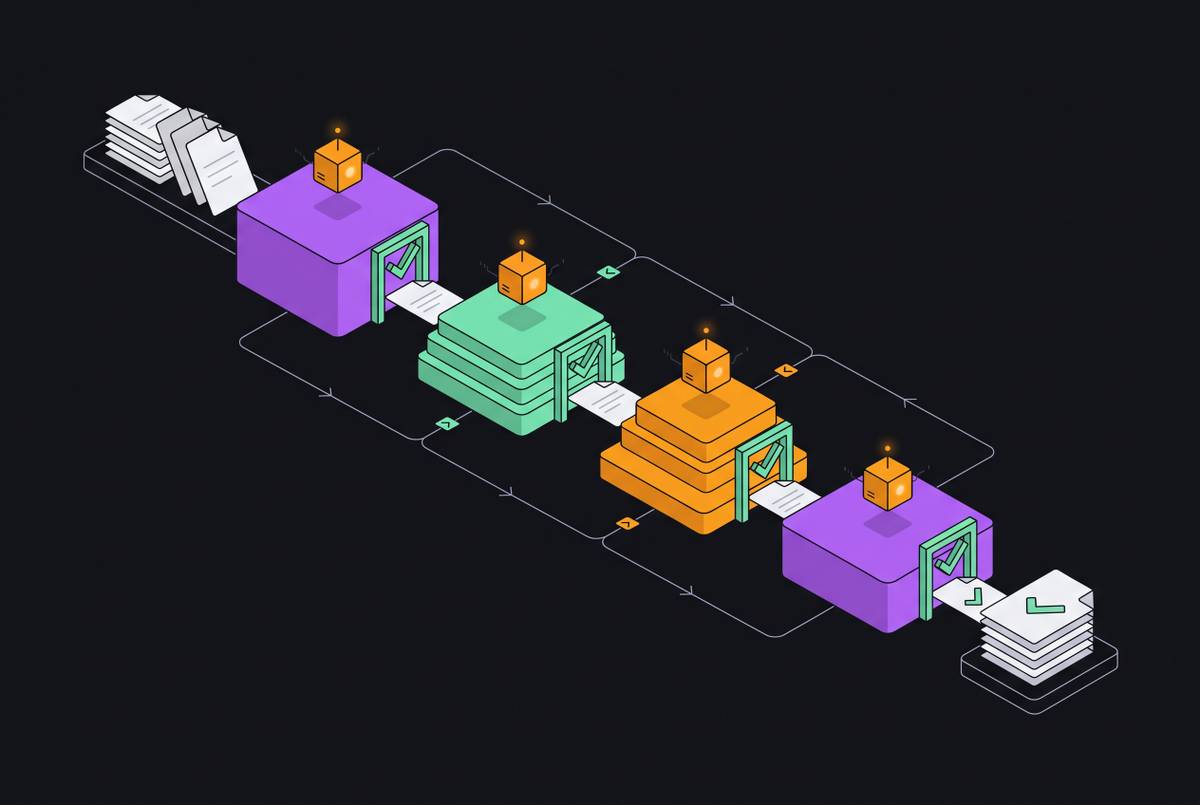
Intake performs format detection, quality assessment, orientation correction, and deduplication before extraction. Unreadable input is identified and routed away from extraction at this point. Layout-aware extraction then preserves reading order, semantic block types, multi-column structure, and table relationships, returning field-level confidence with source-grounded bounding boxes.
Schema enforcement follows extraction, with normalization before business checks. API constraints set the structure the output must have, while normalization gives dates, currencies, and identifiers the same format across the batch. The result can then move on only if it passes cross-field checks, range validation, checksum verification, and confidence thresholds. A failed rule sends the document to review with enough context for a human to act without re-reading the source.
Only accepted JSON objects enter the vector store. Their field-level provenance has page numbers, bounding box coordinates, and confidence scores, so each retrieved value can be traced back to its place in the source. Reviewer corrections then feed back into extraction to improve the field types and layouts that caused review events.
Failure handling is decisive when choosing what to buy. Nutrient frames evaluation around what the system returns when extraction is uncertain and how failures move through the pipeline. Used from start to finish, that test shows whether a document preprocessing API gives the caller controls it can use or just text that looks right. A production-ready system has a defined path for uncertainty before it becomes indexed evidence.