Validating Extracted Document Data Before It Enters a RAG Pipeline
Extraction errors that enter the index become permanent evidence no model can repair.

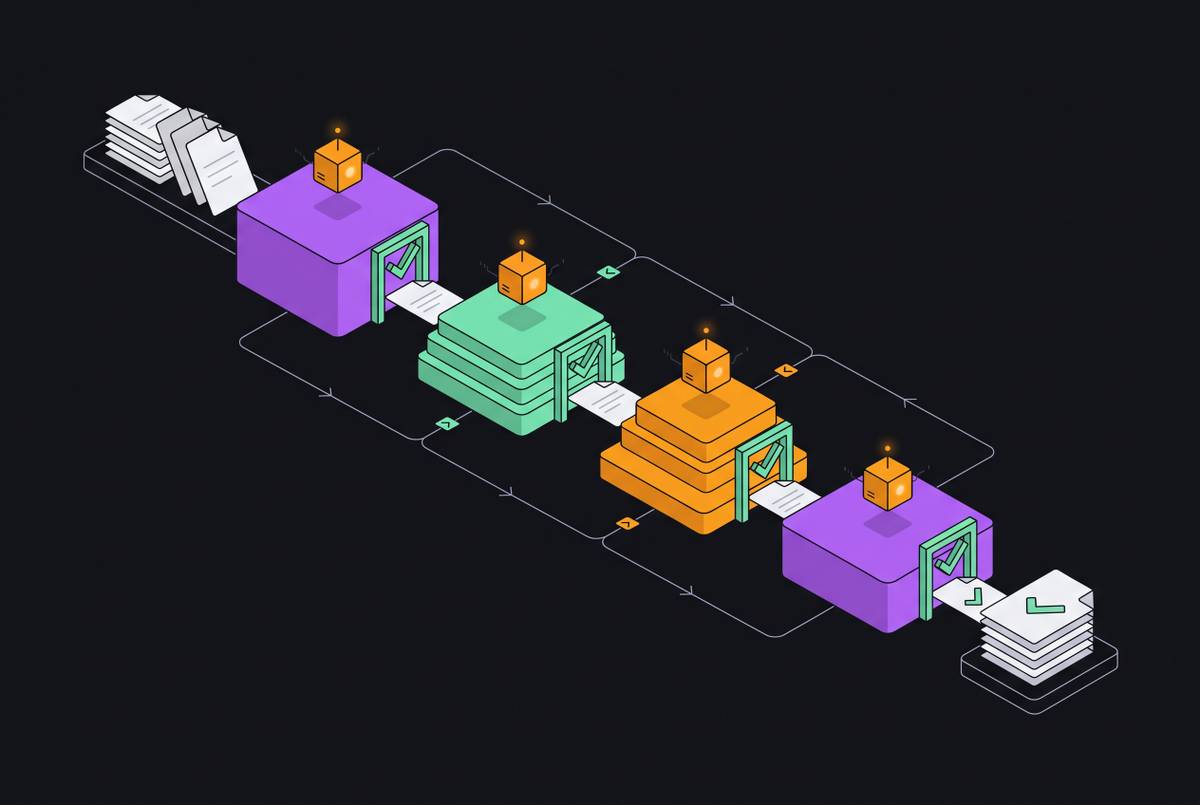
A document preprocessing API for LLM and RAG pipelines should turn PDFs into structured JSON and validate the result before chunking begins. That means checking field-level confidence, schema conformance, layout integrity, and source grounding. Clean-looking text is not enough, because extraction errors become indexed evidence that retrieval and generation cannot repair.
Why RAG pipelines fail before retrieval even starts
A working demo starts with advantages production does not have. The corpus is small and clean, the builder wrote the questions, and the index was built that morning. Production documents break those assumptions. Their layouts vary, scans degrade, and source files change after indexing. A pipeline that answers the builder’s questions can still fail when users ask about documents that never parsed correctly.
The failure often starts before retrieval has anything to retrieve. Bad parsing produces poor chunks, which become weak embeddings, irrelevant context, and answers built on the wrong evidence. Teams can spend time tuning prompts or swapping models while this flaw in parsing stays hidden. The model is not the first suspect here. Better parsing helps, but validation must keep corrupted extraction out of the pipeline so users do not have to find it.
How layout failures in parsed documents corrupt everything downstream
PDFs store positioned glyphs on a canvas, leaving the structure of their content implicit. A parser has to infer that structure. Coordinate-dependent extraction treats position as a contract, connecting a value’s location to its field or column. Shifted columns, merged cells, rotated scans, and custom ligature encodings can break that contract. The characters may still be readable even when what they mean is lost.
That produces a particularly damaging failure, the silent drop. An extractor misses a field because its expected position no longer matches the page, yet returns no error signal. Tables that span pages cause similar trouble when headers appear only on the first page or the links between columns change from one page to the next. The output can look orderly while omitting values or assigning them to the wrong fields.
Linearization can destroy relationships even when every character survives. In a multi-column document, the wrong reading order mixes sentences from unrelated columns, and the chunker then draws boundaries around that malformed output. One layout error can therefore contaminate a whole section of context. Better OCR cannot bring back the links already lost this way. Spatial reasoning has to inform extraction before the page becomes a text stream, and validation has to test the resulting structure.
Why chunking and embedding make upstream errors permanent
Chunking can sever a fact from the subject that makes it useful. A fixed-size split might preserve “coverage renews automatically at the end of each term” while separating it from the policy, product, and customer. The intact sentence can match a query while lacking the context needed for a correct answer.
Embedding does not repair that missing relationship. An embedding model encodes the text it receives, including mixed columns and isolated statements, without flagging structural incoherence. Once those chunks enter the vector index, fixing the extraction requires re-ingestion. A different prompt cannot reconstruct relationships the indexed text never preserved.
Old content adds another version of this problem. When source documents change but indexed chunks do not, retrieval scores can stay high because the old and new text are semantically similar. The answer may still draw on content that is out of date or has been legally superseded. Relevance is not proof of correctness or freshness. Validation belongs before chunking because the index preserves errors.
What structured pre-ingestion validation actually checks
Field-level confidence checks score how sure the extractor is about each value it extracts. Those scores need calibration and a traceable connection to pixels on the page. ExtractConf reports that numeric fields are well-calibrated while free-text fields show overconfidence at high predicted probabilities. One global threshold is therefore a poor routing rule. Field-type-specific thresholds can auto-accept high-confidence values, send the middle band to human review, and reject or flag documents below a floor.
Calibration needs a direct test against the source. A sample of values marked high confidence should be manually checked for extraction errors. If too many are wrong, the score cannot safely decide which records can skip review. A confident error is still an error. Its score makes it more dangerous when that score is the reason it passes.
Schema conformance catches a different class of defect. Every record should meet a typed JSON schema covering field names, expected types, required fields, and format constraints, including dates, numeric ranges, and identifier patterns. A confidently extracted date in a currency field should fail this check. Layout checks then test relationships the schema alone cannot establish, including headers paired with rows, consistent column counts across pages, and headings scoped to the right content.
Completeness must remain separate from confidence because a silent drop leaves no value to score. Cross-field checks also test whether line items add up to totals, tax calculations are within tolerance of rate × base, and dates are in a logical order. These checks can expose numerical OCR errors that confidence misses. No single check covers all these failure modes.
Per-field accuracy measurement as the minimum evaluation standard
A record can score well overall while its total, identifier, or date is wrong at an unacceptable rate. Each of those fields needs to be measured against ground truth.
The evaluation sample should reflect the actual production mix, including its worst documents. People should check extracted values against source documents and measure accuracy for each field type on its own. The comparator must fit the value. Strings need character-level similarity, numbers need proximity within a small tolerance, and dates need semantic calendar equivalence so harmless formatting differences do not count as errors.
The fields with the lowest accuracy need tighter confidence thresholds and should be sent for review more often. ECARB, or Error Capture at Review Budget, measures the lift of confidence-guided review over random sampling. For buyers, per-field results on ground-truth production documents are a minimum evaluation standard. A vendor unable to supply them has not demonstrated that its confidence scores justify automatic acceptance.
Where vision models and LLM-based extractors introduce hallucination risk that confidence scores do not catch
An extractor can return a value that never appeared in the document. LLM-based and vision-model-based extraction introduce this risk when degraded scans, encoded ligatures, or malformed text layers leave the source unreadable. Instead of signalling a gap, the model may generate plausible text from OCR noise. Vision models can also invent content in high-resolution, text-dense documents. A well-formed output can still be fabricated.
Hidden PDF text layers create a related source-integrity problem. Text embedded in a file may differ from the visible page and can include adversarial instructions. Separating visual rendering from text-layer parsing allows validation to detect those discrepancies rather than treat hidden content as trustworthy extraction input. This is a document-processing risk.
An invented value may pass schema checks with the right type and format and receive high model confidence because that score reflects an internal state. Detection needs a separate source-anchoring pass that locates values in their attributed text or image regions. Cross-field consistency adds another test, while reject-on-gap logic sends missing or ungrounded values for review.
How validation integrates into the ingestion pipeline architecture
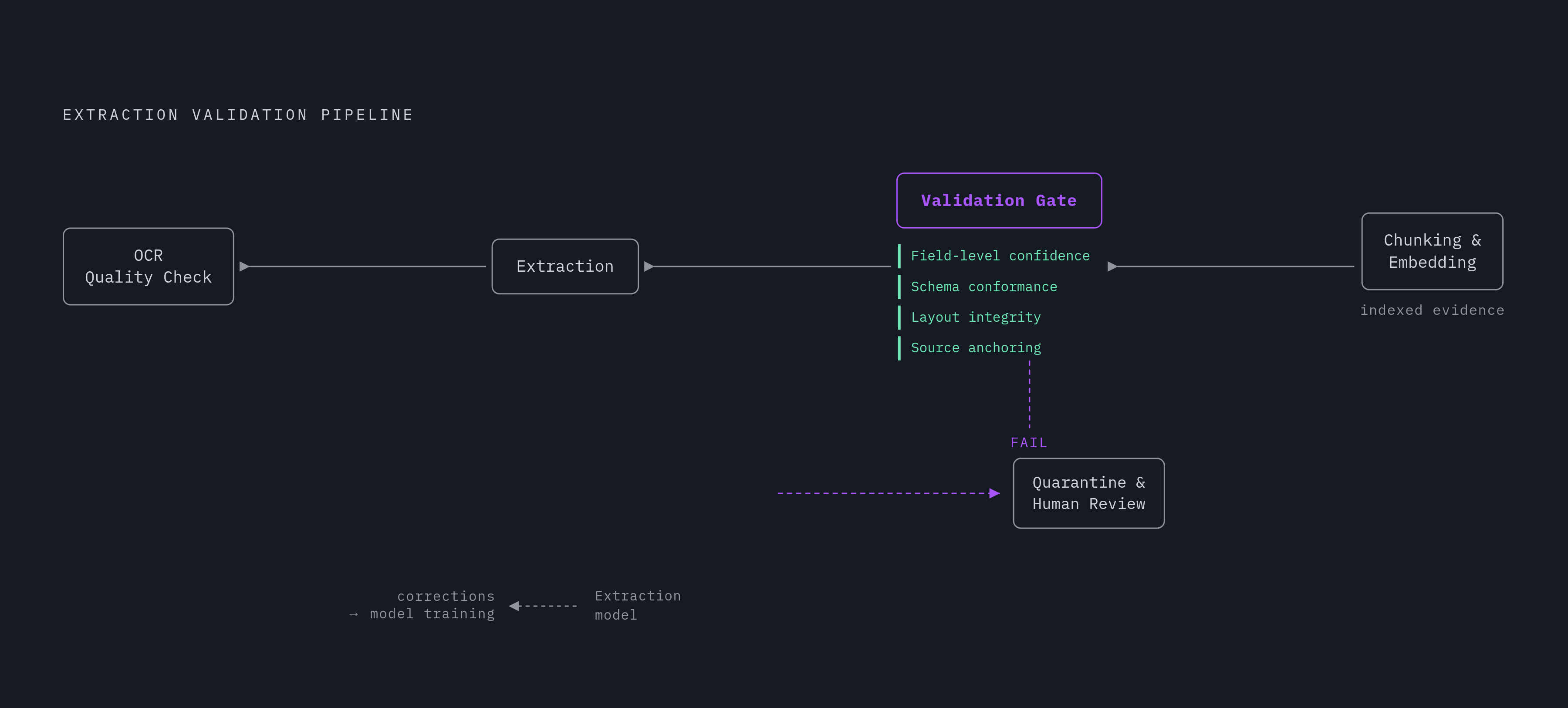
The ingestion path should be extraction → validation gate → chunking and embedding, with failed records diverted to quarantine and review. OCR quality checks sit earlier still. They reject or flag low-quality scans before extraction starts, so unreadable input does not become evidence that looks usable.
Provenance belongs at ingestion, while the extraction context is available. Each chunk needs a source document identifier, document type, section title, extraction timestamp, and field-level confidence scores. Adding these after embedding requires re-indexing and loses the confidence signal where it is most useful. Freshness checks belong at the same gate, using content hashes to detect updates and reprocess only changed chunks. Deleted documents and documents with revoked access must also be removed from the index.
Quarantine should serve as more than an error bin. Human corrections should feed back into extraction model training, so review improves future output as well as resolves the current record. Sampling parsed output by eye also belongs in the standing workflow. It is a cheap, direct test of whether the text still makes sense. If a person cannot read the parsed chunk, the model cannot recover its intended meaning.
Why building this validation layer in-house costs more than it looks
An in-house estimate often prices the clean path and misses the exceptions. Rotated scans, merged-cell tables, multi-page headers, and custom font encodings each need their own fixes that affect how the existing rules work. Validation adds work beyond those parser repairs. The team also owns calibration, schema checks, source anchoring, review routing, ground-truth evaluation, and the feedback path from corrections to extraction.
On-premise deployment, zero-data-retention architecture, SOC 2, GDPR, and ISO 27001 requirements are not simply configuration switches on an open-source stack. They require engineering, audit work, and ongoing maintenance. Data residency also needs a legal check before the choice is made based on accuracy. For European workflows, location can trigger transfer obligations, but GDPR does not itself require personal data to remain inside the EU.
Building earns its keep under a demanding combination of conditions. These include sustained high monthly page volume, repetitive document types the team controls, an ML team already on payroll, and a sovereignty mandate a vendor cannot satisfy. Mixed documents at moderate volume rarely fit that case. When comparing what to buy, teams should check the validation layer as well as whether an API returns text or JSON. Per-field results from production and review controls that work show more than a demo that succeeds with clean documents.
The validation checklist a production ingestion pipeline needs before going live
First, the pipeline should reject or flag low-resolution, heavily degraded, and blank-text-layer pages before extraction, while keeping visual rendering separate from text-layer parsing to detect discrepancies. Field-level confidence should then use calibrated thresholds for each field type, with the middle band routed to human review.
Next, every extracted record should pass its typed JSON schema and structural checks. Required fields must be there, table headers must stay paired with data rows, and column counts must stay the same from one page to the next. Financial values need arithmetic cross-checks, and dates need to be in a logical order.
Source anchoring should then test whether each value exists in its attributed text or image region. Values that cannot be located should be flagged rather than passed, and missing values should remain explicit gaps rather than invitations to invent content. That distinction is the hallucination safeguard. A schema-valid record is not ready for ingestion until its values have support in the source.
Finally, ingestion should attach provenance and confidence metadata, hash content for update detection, and support incremental re-indexing of changed chunks. Removal and access revocation must trigger deletion from the index. Before going live, per-field evaluation should use documents that reflect the production mix to test how well extraction and review routing work, while corrections from quarantine should be used to train the model. Validation is not an afterthought but the engineering gate that determines whether RAG reasons over facts or noise.