Agentic Validation Layers in Document Extraction Pipelines
Agentic systems resolve extraction ambiguities themselves before routing documents to humans.
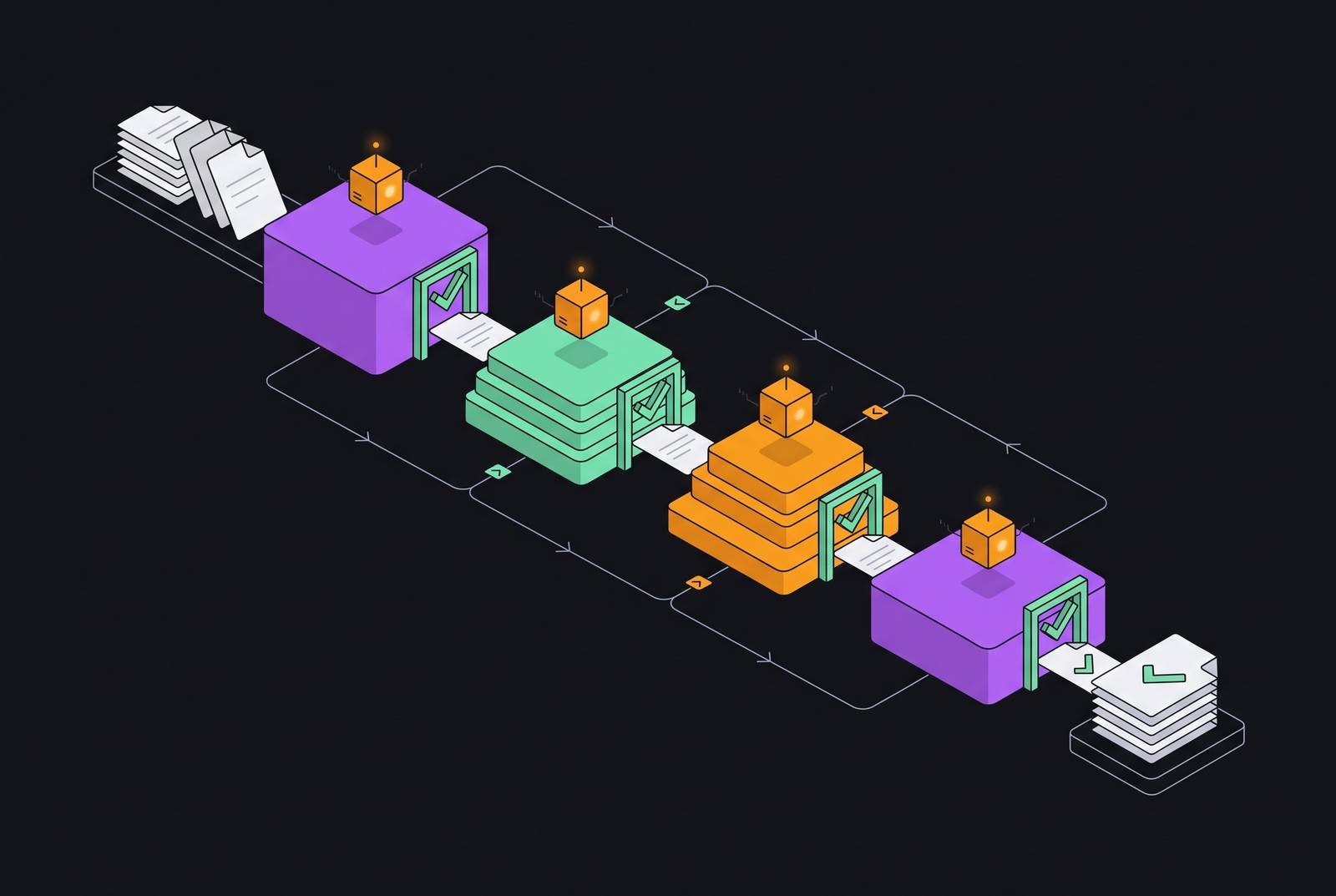
Extraction and validation get treated as one step in most conversations about document AI, and that conflation is where reliable pipelines start to fail. An extractor reads a document and returns structured data. A validation layer decides whether that data deserves to be trusted before it reaches a downstream system, and that decision is a distinct engineering problem with its own failure modes, its own metrics, and its own architecture. Agentic validation adds a further wrinkle: instead of routing every low-confidence field straight to a human, the agent tries to resolve the ambiguity itself first, checking the document again, comparing against related fields, before it ever raises a hand. That difference, resolution before escalation rather than escalation on sight, is the entire premise behind calling a validation layer "agentic" instead of just automated.
Trusting extraction output without a validation layer
The failures that matter in production are rarely the loud ones. A missing page or a garbled PDF gets caught immediately. What gets missed are the errors that pass every standard metric and still corrupt the output.
The PureDocBench benchmark documents three of these failure classes directly. E1 is header metadata omission: an entire product header block absent from the reconstructed document, with nothing in the surrounding text to flag that it's gone. E2 is a reading-order error, where a table survives the extraction intact but is in the wrong section of the reconstructed document, changing what it appears to describe. Technical symbol recognition errors occur where an engineering unit like nH gets silently rendered as mH, a factor-of-a-million error hiding inside a value that looks perfectly plausible on the page. In a safety-critical spec sheet, that's a wrong answer dressed up as a right one. That's a wrong answer dressed up as a right one. PureDocBench's finding that both of these errors showed up in leaderboard-leading models should unsettle anyone leaning on benchmark rank as a proxy for trust: a model can top the leaderboard and still reproduce a document incorrectly in ways that matter.
Vision-language model pipelines carry their own separate failure signatures. Production reporting on agentic document OCR has documented repetition loops and recitation errors as structurally distinct problems, each with a different root cause and a different API behavior, and some of these have traced back to isolated service disruptions rather than any visible degradation in the model itself. A repetition loop that stems from a transient service issue needs a retry, not a model swap.
Then there's the layout-level mess that never makes it into a benchmark paper. Scanned purchase orders come back with field labels fused into their values. Insurance claim forms lose entire sections because the PDF has embedded fonts the parser can't decode. Financial statements extract as clean-looking text with line breaks landing mid-sentence, which quietly breaks every downstream regex built to parse them. None of this shows up as a confidence score of zero. Confident, well-formatted, wrong data appears in the extraction output without triggering a confidence score of zero.
The four-tier structure of a production validation layer
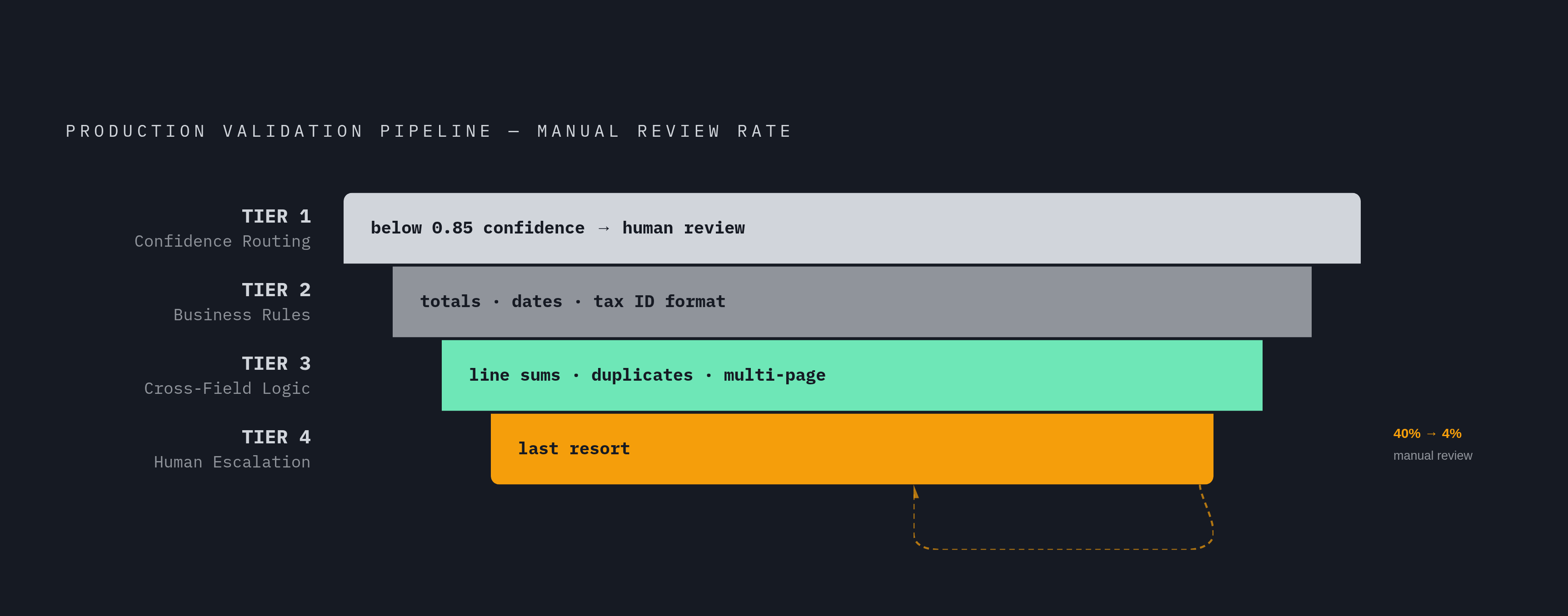
A validation layer that works in production isn't one check, it's four, stacked in a specific order, each one catching what the last one missed.
Tier 1 is confidence threshold routing. Every extracted field carries a confidence score, and that score functions as a gate, not a grade. A threshold around 0.85 is a common routing line: fields scoring below it get pulled into manual extraction or a human review queue. Push the threshold up and automated output gets more accurate, but more documents get routed to review, which costs time. Pushing the threshold down raises throughput while accuracy slips. That trade-off isn't something to set once globally, either. Field-level confidence varies by what's being extracted: one dataset showed minimum payment amount averaging 0.89 confidence, statement balance at 0.779, and payment due date down at 0.675. A single global threshold applied across fields that behave that differently is a blunt instrument, and it will misroute in both directions.
Tier 2 is business-rule verification, the deterministic layer sitting on top of the probabilistic one. Does the invoice total match the sum of its line items? Is the date inside a plausible range? Does the tax ID match a known format for its jurisdiction? These are yes-or-no checks that a confidence score cannot generate on its own, because confidence measures how sure the model is about a value, not whether that value makes sense in context. Some pipelines have started replacing static rule engines here with LLM-driven logic for the more complex compliance checks, a shift that trades rigidity for flexibility but introduces its own calibration questions. Either way, this tier is where domain knowledge actually lives in the system.
Tier 3 extends the check outward: cross-field and cross-document consistency. Do the line items sum to the subtotal on the same invoice? Does the "ship to" address match the purchase order it's paired with? Is this invoice number a duplicate of one already in the system? Agentic approaches to this tier describe it as a self-verification loop, where the agent holds its own extraction against the document's internal structural logic before accepting it. This is also where multi-page and multi-document packets create a kind of complexity that a single-pass extractor simply cannot see, because the inconsistency only exists across pages, not within one.
Tier 4 is human-in-the-loop escalation, meant to be the last resort. The first three tiers exist specifically to keep this tier from firing often. An agentic system, faced with an ambiguous field, looks for the same value elsewhere on the page, checks it against a known pattern, or attempts a re-extraction with a different strategy before giving up and asking a person. One accounts payable team, cited in Parsio's research, dropped its manual review rate from 40% down to 4% after adopting this kind of approach, because the system resolved far more edge cases on its own before they ever reached a human queue, even as extraction accuracy itself stayed roughly the same. And when escalation does happen, a well-built agentic system identifies the specific field and the specific reason, not a blanket rejection of the whole document. Corrections made at this tier are also the raw material for continuous learning, which closes the loop instead of leaving it open.
How confidence scores are generated
Two families of methods currently produce confidence scores for LLM extraction. Verbalized confidence has the model self-report a numeric score directly. Token-level log-probability methods derive confidence from the model's internal probability distribution over its own output tokens. As of 2026, how these two approaches compare specifically for structured document extraction remains largely unexplored territory, which is a striking gap given how much production infrastructure already depends on these scores to route documents.
There's also no systematic benchmark yet for confidence calibration in key information extraction for IDP specifically. A calibrated confidence score means something, while an uncalibrated one is just noise dressed as a number.
Real-world documents complicate this further. Scanning artifacts and physical degradation vary substantially across a real production stream, and that variation affects extraction accuracy and confidence estimation at the same time, in the same direction. A badly scanned page doesn't just produce a wrong answer, it can produce a wrong answer the model is falsely confident about, because the same degradation that corrupted the text also corrupted the signal the confidence score was supposed to be reading.
Some newer methods are trying to close that gap. One approach, described in work titled "Beyond Logprobs," fuses log-probabilities with consistency checks to generate a document field confidence score, reporting it against calibration metrics like expected calibration error, AUROC, and selective risk. Cleanlab's TLM approach takes a different route, offering model-agnostic trust scores with per-field granularity for structured outputs. Neither is a finished answer. Both are evidence that the field recognizes verbalized confidence alone isn't good enough yet.
Measuring whether the validation layer is working: per-field accuracy against ground truth
The only honest way to know whether a validation layer works is per-field accuracy against a ground truth dataset, built from real production documents, edge cases included. Not a vendor's demo set. Not a clean sample chosen to make a benchmark look good.
The standard method here is straightforward: pull a manually reviewed random sample, with n=200 giving a margin of error around ±4% at a 90% confidence level, and compare it field by field against ground truth using a binary match indicator, then aggregate the results at the section level. This beats vendor-published benchmarks for a simple reason. Vendors can and do report high accuracy on clean samples, but real-world performance depends on handwriting, scan quality, and layout complexity that a clean sample excludes by design. A number generated on easy documents tells a buyer almost nothing about performance on hard ones.
Cost and accuracy sit on the same continuum, and a 2025 evaluation put real numbers to that trade-off: o4-mini hit 95.00% accuracy at roughly $0.005 per document, while o3 reached 96.33% at roughly $0.05, ten times the cost for about a point and a third of accuracy. Whether that trade is worth it depends entirely on how much error a given business process can absorb. A tolerance question, not a technology question.
Where the validation layer sits in the microservice architecture
A production document pipeline is a composition of services: classification, OCR, text stitching or layout reconstruction, field extraction driven by a language model, and validation, each one a separate stage that can succeed o... It is a composition of services: classification, OCR, text stitching or layout reconstruction, field extraction driven by a language model, and validation, each one a separate stage that can succeed or fail independently of the others.
A microservice architecture paper on this exact composition lays out the key design choices: hybrid classification, separating GPU-bound inference from CPU-bound orchestration, asynchronous processing for anything IO-bound, and independent horizontal scaling for each service. Every one of those decisions has a validation consequence, because validation can only check what actually made it through the upstream stages intact.
The paper's most counterintuitive finding is that OCR, not the language model doing the parsing, dominates end-to-end latency on text-heavy multi-page documents. That reshuffles where investment should go. Pouring accuracy improvements into the extraction model does little good if the OCR layer upstream is already introducing errors that no downstream validation tier can recover, because validation checks the extracted data against rules and cross-references, not against the original pixels. If the OCR step already mangled a number, no business rule downstream will know to flag it unless the mangled version happens to fail a sanity check by coincidence.
Routing is itself a validation decision, and this is where it gets easy to underestimate the stakes. An agent that sends a handwritten field to a handwriting-specific model and a table to a table-extraction model is making a judgment call before extraction even happens. Get that routing wrong, send a table to a model tuned for prose, and the failure happens before validation ever gets a chance to run. No post-extraction check fixes a pre-extraction misrouting, because the data validation would need to check was never generated correctly to begin with.
The build-vs-buy decision reframed around validation complexity, not extraction cost
Extraction alone has gotten cheap. Open OCR pipelines can self-host on a single GPU for around $0.001 a page, which weakens the traditional buy-side argument that per-page cost justifies a vendor contract. If extraction cost is the entire pitch, that pitch is thinner than it used to be.
Validation is a different story, and it does not appear in a per-page cost comparison. Building it requires per-field confidence calibration, a business-rule engine, cross-field consistency logic, human-in-the-loop review queues, ongoing benchmarking infrastructure, and drift monitoring to catch when the pipeline starts degrading on new document types. None of that is a one-time build. Each piece is a maintenance surface that needs attention indefinitely, long after the initial extraction model has been chosen and deployed.
Open-weight models now cover the extraction side reasonably well: PaddleOCR-VL-1.6, Apache 2.0 licensed, under a billion parameters, supporting over 100 languages and running roughly 45 pages a minute on an L40S GPU; DeepSeek-OCR at a few billion parameters under an MIT license; GOT-OCR 2.0; and Granite-Docling, a compact model with a couple hundred million parameters also under Apache 2.0. PaddleOCR-VL-1.6, DeepSeek-OCR, GOT-OCR 2.0, and Granite-Docling solve extraction. None of them solves validation, because validation isn't a model, it's an architecture built around several models plus deterministic logic plus a feedback loop.
The edge cases are what make this compound over time. Failures in production come from documents that never showed up in a demo: scanned PDFs with embedded fonts that break the parser, forms with field labels merged into their values, multi-column tables that an open-source parser reads out of order. Each new edge case discovered in production is a maintenance event, and that ongoing cost, not the per-page extraction fee, is the real number to weigh in a build-versus-buy decision.
Continuous learning as the mechanism that makes the validation layer improve over time
A validation layer that escalates fields to a human and then does nothing with the correction is, functionally, a manual process wearing an automation costume. The loop has to close for any of this to compound into something better than where it started.
Continuous learning is what separates a genuine document AI product from a static extraction tool bolted to a review queue. Corrections made at the human-in-the-loop tier should feed back into field-level confidence calibration, expand business-rule coverage to catch the pattern next time, and, where the architecture supports it, update model weights directly. Without that feedback path, the same edge case gets escalated over and over, forever, and the system never gets cheaper to run.
Canary set benchmarking is the mechanism for knowing whether any of that feedback is actually working. Comparing performance against a fixed set of known documents over time shows whether corrections are genuinely improving the pipeline, or whether new document variants entering the stream are quietly eroding accuracy even as the correction loop churns along. That comparison also reveals the underlying precision-recall trade-off the whole system is making: tighten the gate and fewer bad extractions slip through, but more good ones get pulled into review unnecessarily. Loosen it, and the reverse happens. There's no setting that eliminates the trade-off entirely, only calibration that reflects what a given business is actually willing to get wrong.