What a Contractual Per-Field Accuracy SLA Actually Looks Like in an API Agreement
Accurate API guarantees need named fields, ground truth rules, and measurable consequences.

A contractual per-field accuracy SLA for document extraction APIs guarantees measured correctness for named fields alongside a working endpoint. A real commitment defines the measurement formula, ground truth, confidence requirements, drift protections, remedies and verification rights. Without those terms, an “accuracy guarantee” gives the buyer no reliable way to prove a breach or demand a remedy.
Why a standard uptime SLA fails when applied to document extraction APIs
An API can return HTTP 200 on every call while returning the wrong invoice total. The endpoint worked. The extraction did not. If that value causes a payment error, an uptime clause has nothing to say about it, because the service was available and the request succeeded. A latency clause is equally unhelpful when the wrong answer arrives on time.
That gap changes what the agreement must cover. The standard framework of uptime percentage, response time, incident duration and service credits addresses whether a service can be reached and used. An accuracy SLA must test the returned values against the documents, because a response that arrives successfully can still be wrong.
The unit-of-measurement problem — what makes an accuracy guarantee genuinely per-field?
“Accuracy” is not a usable contract term by itself. The agreement must name the fields being evaluated, the metric applied to them and the formula used to calculate the result. For a per-field commitment, the operative metric is Field Perfect Match Rate. It is the number of target fields whose extracted value matches ground truth, divided by the number of evaluated target fields. A model-level benchmark score is not a substitute.
A vision model can score well overall on a mixed insurance form while performing far below an acceptable level on boolean checkbox fields. If the contract promises only an aggregate result, strong performance on other fields can conceal failure on the fields the buyer needs.
Measurement also changes depending on the level being tested. Character strings can be evaluated using character error rate, while fields can be evaluated using exact match rate, precision or recall. Full documents also have an exact match rate. Business operations use measures including unmanned direct processing rate, document correction occurrence rate, field correction required rate and verification time. A contract covering only one layer leaves the others unprotected, so a field-level promise should not be read as a guarantee of correction-free processing.
The ezel.ai AI Performance SLA Agreement makes some of this specificity visible in Section 4.1. Its table names each model or service, one metric per row, a minimum value, a target value and a measurement dataset. The lesson for buyers is to require named fields and a named formula in the SLA exhibit. Without them, the commitment is a marketing claim formatted to look like a per-field SLA.
How ground truth is constructed and why its methodology determines whether the SLA is testable
Once the contract defines what counts as a match, it must define the answer against which the extraction is judged. That reference is the ground truth. If the vendor controls both its construction and the benchmark dataset without contractual limits, it controls the test of its own compliance. Even a precise formula needs reference answers that can be trusted.
The methodology should name who annotates the documents, typically multiple independent annotators, and explain how disagreements are handled. Fields on which all annotators agree can be marked as high-confidence ground truth. Fields on which they disagree because the document is ambiguous can be marked ambiguous and excluded from accuracy calculations. That exclusion is honest measurement. But the contract must define and make the exclusion set auditable, with a cap beyond which the methodology itself can be challenged.
The dataset’s origin is another contractual decision. Is it the vendor’s own training-adjacent corpus, or a customer-supplied holdout set drawn from actual production documents? Those are not equivalent tests. The first can show the vendor at its best, while the second tests how well it handles the buyer’s real work. The agreement should make that choice explicit rather than leave the buyer to discover it during a dispute.
The template’s Section 4.2 requires measurement frequency, measurement method, a benchmark dataset description or reference, and reporting frequency. A signed agreement that still says “[DESCRIBE]” leaves the measurement process unsettled. Buyers should also have clear rights to check how ground truth is built and get copies of independent assessments, including SOC 2 reports and evaluation results. Without those rights, the buyer must still check whether the reference answers are sound but has no way under the contract to do so.
Confidence scores as contract instruments, and why a high score is not the same as a correct answer
A confidence score can control how an extraction is handled, but it cannot prove that the extraction is correct. The contract mechanism is a routing rule. If a field’s confidence falls below a defined threshold, the document must go to human review before it can be delivered as a completed extraction. This gives the score an operational consequence instead of leaving it as an unexplained number beside a value.
That protection depends on calibration against actual accuracy. A score that reports high confidence on fabricated values can send the wrong documents past review. High confidence is not the same as correctness. Buyers should demand calibration requirements in the contract alongside a threshold, so that the routing rule rests on tests of how reliable the model is, independently of its own view of its answers.
The score must also be traceable to pixels or tokens on the source page. That grounding distinguishes evidence about the extracted value from confidence inferred without a reliable link to the source region. For example, a wrong invoice total taken from a value actually printed on the page is a parsing error. A total fabricated from context and never printed there is a hallucination. The contract should treat them differently because the buyer’s downstream exposure differs, and a confidence threshold without calibration and source traceability does not resolve that distinction.
Model versioning, drift monitoring, and the rollback right vendors most consistently resist giving
An accuracy commitment must survive changes to the model. A vendor can update its underlying model to improve average benchmark performance while introducing regressions on the buyer’s document types, layouts or field configurations. The API remains available throughout. The new version may also do well on the vendor’s test set, so neither uptime reporting nor general benchmark claims would show that the buyer’s extraction quality has fallen.
The contract should establish a baseline accuracy threshold and require the vendor to monitor for drift against it. A drop below that threshold should trigger an alert, followed by retraining or rollback if the breach is confirmed. Reporting alone is not a corrective action. The template’s Section 4.3 has promises to monitor drift, alert the customer, retrain or update models, and provide drift reports. It does not include establishing a baseline threshold or a rollback requirement as checkbox commitments.
That omission is a substantive negotiation point. A buyer’s right to demand the prior model version depends on a contractual definition of “material degradation.” A meaningful definition specifies a percentage decline in accuracy on the agreed benchmark test suite, or a percentage increase in P95 latency, that triggers the right. The agreement needs the trigger and the right together. Without a defined trigger, the parties can disagree over whether deterioration is serious enough to justify reversion.
Enterprise deprecation notice is moving toward giving buyers more time, with the previous version staying available throughout the notice period. Buyers should get that promise into the agreement. Otherwise, the model validated during procurement can be replaced by one the buyer has not tested, without a contractual remedy for that replacement.
Remedies that create real vendor accountability versus credits that just offset the invoice
Standard service credits are often capped, require a customer claim and calculate compensation as a fraction of the fee, independently of the damage caused by a wrong extraction. A delayed mortgage closing can cost more than an invoice credit addresses. The remedy should be proportionate to the actual exposure.
The claim process can weaken even that limited protection. When buyers must file within thirty days, give incident details and wait for the vendor to verify the claim, they have more work to do while already dealing with the miss. Enterprise buyers should push for credits that are issued automatically when measurement data shows a breach. That makes the agreed measurement process do commercial work instead of merely producing a report the customer must use to argue for compensation.
A flat credit rate treats a one-day miss and a six-week period of degraded accuracy alike. Credit rates should escalate for each measurement period that a breach continues. Repeated breaches should also trigger termination for cause, with repetition defined as a specified number of breaches in a rolling period. Otherwise, additional credits can become the vendor’s recurring cost of missing the promise while the buyer remains tied to the service.
Pricing can put revenue at risk more directly. Under a model tied to correctly processed pages, the buyer pays only for pages extracted at or above the agreed accuracy threshold. That makes correctness part of the commercial structure rather than only an after-the-fact remedy. It still depends on the same field definitions, ground truth and verification rights, because a payment rule is no stronger than the test used to decide which pages qualify.
Who bears the verification burden and how the contract should allocate it
Even a carefully defined SLA can fail if the buyer cannot independently test compliance. Vendor templates commonly make credits due when the vendor’s own monitoring, status page and telemetry show a qualifying breach. The buyer can trust or dispute the result. Neither option replaces a contractual right to inspect the evidence and reconcile it with the buyer’s work.
The agreement should allocate who measures, who reports, who challenges and who decides disputes. Customers should have monitoring dashboards they can access so they can check more than the metrics the vendor reports. Buyers should also have the right to export raw metric events and reconcile them against customer task IDs. If those measurements diverge from the vendor’s, a defined dispute resolution process should govern what happens next. Access without a way to settle disagreements leaves the central question unresolved.
The quality sample needs the same discipline. It should be a predeclared stratified random sample of production tasks for each measurement period, drawn from the buyer’s document types in production proportions. A vendor-selected showcase set is not an adequate substitute. For any accuracy breach, the contract should also require root cause analysis within a defined timeframe, so the buyer can distinguish an isolated miss from a systemic problem likely to recur.
EU AI Act Article 26 deployer obligations include monitoring and human oversight, which need the upstream provider to agree in the contract to help. Audit rights and evaluation logs therefore serve more than billing disputes. With zero data retention, there still needs to be a way to review an extraction when it is disputed. The agreement should specify how disputed field values can be adjudicated without requiring the vendor to store document content.
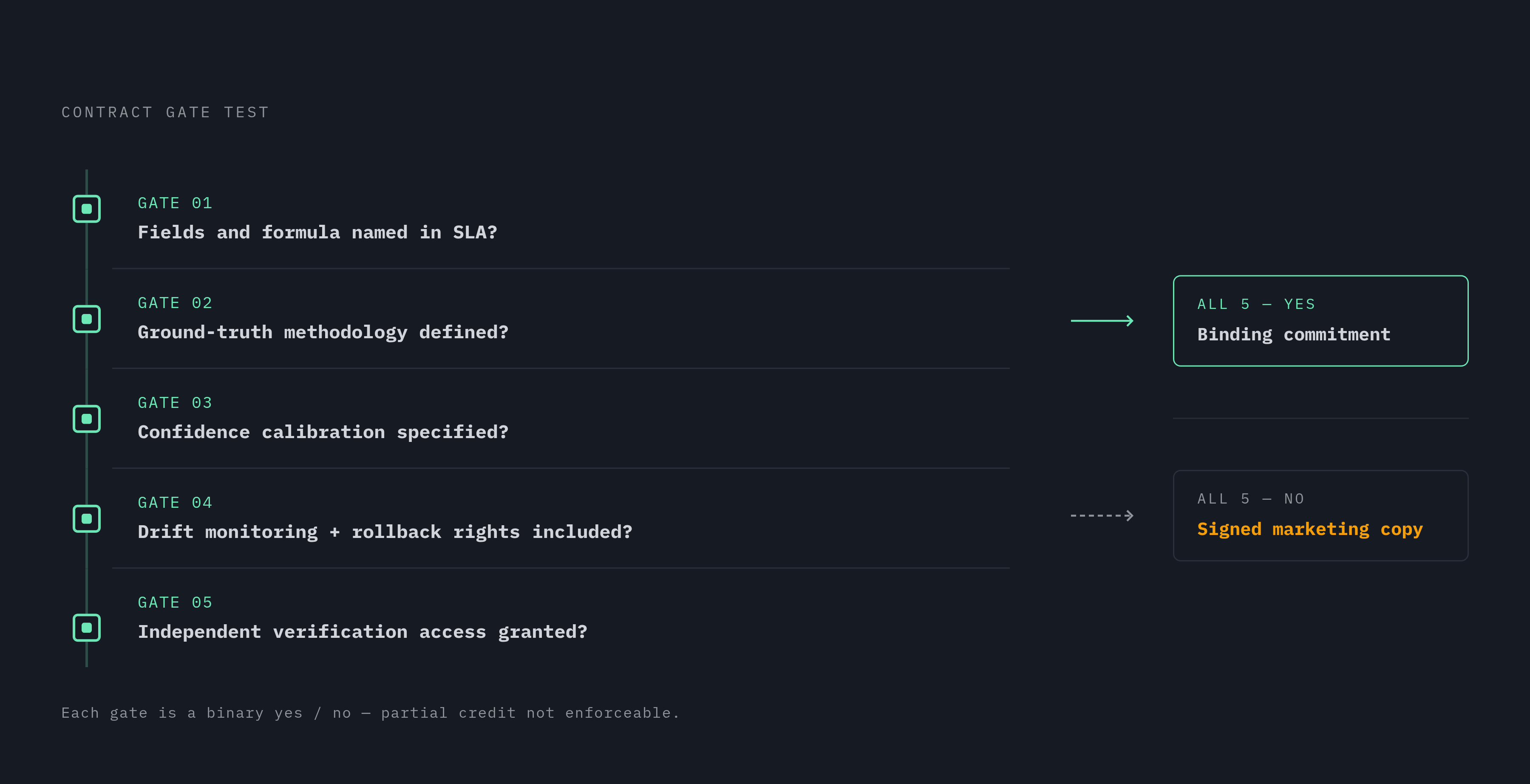
The final contract test comes down to five questions. Does the SLA name the fields and formula? Does it define the ground-truth methodology? Does it specify confidence calibration requirements? Does it include drift monitoring and rollback rights? Does it give the buyer independent verification access?
A vendor whose contract answers all five is making a real commitment. One whose contract answers none is offering marketing copy with a signature line.