Three-Way Match Automation Pipeline for Accounts Payable
Accurate data extraction is where three-way matching automation succeeds or fails.

Three-way matching is the control that stops accounts payable from paying for goods that were never ordered, never delivered, or billed at the wrong price. It works by cross-checking three documents before a payment goes out: the purchase order, the goods receipt note, and the vendor invoice. But the control is only as good as the data extracted from those documents, and that is where most three-way match programs quietly fall apart. This piece looks at three-way matching as an engineering problem first and a finance policy second, because that is the order in which it actually gets solved.
The purchase order states intent: what was ordered, at what price, from whom. The goods receipt note confirms delivery: what actually showed up, in what quantity, on what date. The invoice is the vendor's payment request. Three-way match asks whether those three tell the same story. Was the purchase authorized? Were the goods received? Does the bill match the terms everyone agreed to? One "no" and the invoice stops before payment.
This logic fits physical goods and capital purchases best, since there's a delivery event to anchor the middle step. Service invoices usually skip the third leg and get a two-way match or manual review instead, because there's no goods receipt for a consulting engagement or a software license. Some regulated or quality-sensitive purchases add a fourth document, an inspection or acceptance report, making it a four-way match. For most physical procurement, though, three-way is the standard, and for good reason: it balances control against the sheer volume of paperwork AP already handles.
The fraud backdrop makes this more than a bookkeeping nicety. AFP's Payments Fraud and Control Survey found 76% of organizations experienced attempted or actual payments fraud in 2025, and 74% were targeted by Business Email Compromise scams. A matching control that actually checks the underlying documents is one of the few mechanisms standing between a convincing fake invoice and a wire transfer that can't be clawed back. But that control's integrity depends on how accurately and completely the data gets pulled from those three documents. That's where the real engineering problem starts.
Why manual matching breaks down before scale, not after it
Manual three-way matching is slow by design, not by accident. Someone has to pull up the PO, find the corresponding GRN, lay the invoice next to both, and eyeball the line items. Manual three-way matching takes 15 to 30 minutes per invoice, and it is estimated to eat up roughly 40% of total AP processing time.
The cost gap is not subtle. Ardent Partners' 2025 State of ePayables report puts the average manually processed invoice at $9.84, against $2.65 for Best-in-Class automated AP teams. Multiplying that by invoice volume, the difference stops being a rounding error on someone's budget spreadsheet.
The failure modes are familiar to anyone who has worked AP: a discrepancy gets missed because the reviewer is on their eighth invoice of the hour, a document goes missing between receiving and finance, approvals stall because nobody knows who has the file. None of these are process-design failures in the usual sense. They are data integrity failures, plain and simple. Someone had the right information somewhere in the building, but it never made it to the person who needed it, in the form they needed it.
Three departments touch this workflow, procurement, receiving, and AP, and when their systems don't talk to each other, every handoff adds delay. Invoice exceptions are already a leading operational complaint inside accounts payable, and matching disputes are one of the main sources of those exceptions.
Automation does not fix bad data. It executes faster on whatever data it's handed. A poorly configured automated match doesn't solve the manual failure mode, it just runs that same failure mode at machine speed, and nobody notices until the payment has already gone out.
The structure of an automated three-way match pipeline
An automated pipeline breaks into distinct stages, and each one deserves its own scrutiny rather than getting lumped into "the AI part."
Documents arrive first, in whatever format the vendor happens to use: PDFs, scanned images, email attachments, ERP exports. Nothing about this stage is standardized, and that's the whole difficulty. From there, an extraction layer pulls structured data out of each document, line items, quantities, unit prices, PO reference numbers, vendor identifiers, totals, currency, entity. A normalization layer follows, reconciling field names, units, date formats, and SKU conventions that differ across documents because two vendors rarely format things the same way.
The matching engine does the comparison work, checking extracted fields across the three records against tolerances set per field, price within a configurable percentage, quantity exact or allowing for partial shipment. Anything outside tolerance gets routed to a human for review; clean matches move on to an approval queue. Approved records finally get written back to the general ledger with an audit trail attached.
When extraction is clean, automated matching tools can compare an invoice against a PO in under five seconds, surfacing only genuine discrepancies for a person to look at. Automated matching tools can compare an invoice against a PO in under five seconds when extraction is clean, surfacing only genuine discrepancies for a person to look at, but that speed depends on clean extraction and isn't guaranteed. Escalante Golf offers a concrete data point here: processing around 8,000 invoices a month, the company used GenAI extraction and OCR inside NetSuite and cut per-invoice processing time by 70%, from 2.5 minutes down to 45 seconds.
Most major ERP platforms, NetSuite, SAP, QuickBooks, carry built-in or add-on matching modules. Platforms like Bluecopa and Tipalti connect natively into major ERP systems including SAP S/4HANA and Oracle NetSuite. Coupa integrates natively with SAP S/4HANA and Oracle NetSuite, though it does not list Sage Intacct among its supported ERP integrations. Everyone can see and demo the matching logic. The extraction layer stays invisible right up until it fails, and most pipeline breakdowns start upstream of the matching engine, not inside it.
What the extraction layer must get right for matching to work
The matching engine depends on a specific set of fields: PO reference number, vendor identifier, line-item descriptions, quantities, unit prices, totals, currency, tax amounts, delivery entity, invoice date, invoice number. Getting any one of these wrong produces a different consequence depending on which field it is, which is why treating extraction as a single pass/fail check misses the point.
A wrong PO reference is the gentlest failure, because the invoice simply can't be linked to a record and becomes an exception right away. A wrong quantity is worse: the match still looks clean, but the payment amount is off, and that's an overpayment or underpayment nobody catches. A wrong unit price behaves the same way, and it's the exact failure mode a fraudulent invoice would exploit, since an inflated price on a document that otherwise matches sails through as legitimate. Get the currency or entity field wrong and a multi-entity company can end up paying the wrong legal subsidiary, or paying in the wrong currency entirely, which turns into a cross-border compliance problem rather than a simple correction.
Invoice number errors break something less obvious: duplicate detection. Consider a supplier who resets invoice numbering every calendar year, issuing "INV-001" in January and then "INV-001" again the following January. A matching system relying only on invoice number can't tell a new bill from a resubmission of an old one. Catching that requires correct invoice number extraction paired with a date and amount cross-check, not either one alone.
A matching engine is only as trustworthy as the fields it's fed, and that means accuracy has to be measured field by field, not document by document. A document-level score hides exactly the failures that matter most, which is where the next problem begins.
Why document parsing failures in production are often invisible
A pipeline that fails loudly is cheaper to run than one that fails quietly. Garbled text on a screen gets noticed and fixed. A confidently wrong number does not, and that asymmetry is the core danger of document extraction at scale.
Coordinate-dependent extraction is a good example of a failure that hides in plain sight. A vendor invoice arrives with its column positions shifted slightly from what the parser expects, a bounding box off by a few pixels, and a field just drops silently before it ever reaches the approval engine. The match then proceeds on incomplete data, and unless someone is specifically checking for missing fields, it looks like a normal transaction.
Real production folders tend to surface these problems fast. A scanned purchase order can have its field labels merged directly into the values by the parser. An insurance claim form might lose two full sections because the parser can't handle the embedded fonts. A financial statement can come out as clean-looking text that nonetheless breaks mid-sentence at every line wrap, which then breaks every downstream regex expecting a full sentence. None of these are exotic edge cases dug up after months of testing. They are, plausibly, the first three documents pulled from any real client folder, because messy formatting is the norm, not the exception.
Open-source parsers do fine on clean, text-layer PDFs with predictable layouts. Accuracy drops on scanned documents, multi-column layouts, and tables that span page boundaries, because the underlying assumption is a fixed spatial structure that real-world documents don't respect. The first check any production pipeline should run, before extracting a single field, is whether the PDF even has a text layer. If it doesn't, pixel-level OCR has to run first. Skipping that check is one of the most common sources of silent failure in the industry.
OCR hallucination adds another layer to worry about. OCR hallucination on degraded documents is an active area of benchmarking research, and it is exactly where this failure mode costs the most. Research on failure taxonomy backs this up: failure modes cluster by document type, and business documents concentrate their failures on structural integrity and metadata completeness. Several of these failure types stay invisible under average accuracy metrics, because the sub-metrics used to score models don't penalize missing block-level completeness or sidebar content. A model can rank well on a leaderboard and still reproduce a complex document incorrectly.
Garbage in, garbage out applies here without exception. Any LLM or retrieval pipeline sitting downstream of document extraction is only as good as the structured input it receives. A poorly parsed invoice isn't a minor blemish, it's corrupted data, and it propagates through every system that touches it afterward.
Measuring extraction accuracy at the field level, not the document level
Document-level accuracy is the wrong unit of measurement. An invoice can score "95% accurate" overall while every single quantity field on it is wrong, because the matching engine reads field values, not a composite score.
One published study took this seriously enough to manually review 200 records, with each record's extracted fields checked independently by human reviewers. A sample size of 200 gives a margin of error of about 4 percentage points at 90% confidence, which is the kind of rigor a production pipeline actually needs before trusting a vendor's claimed accuracy number.
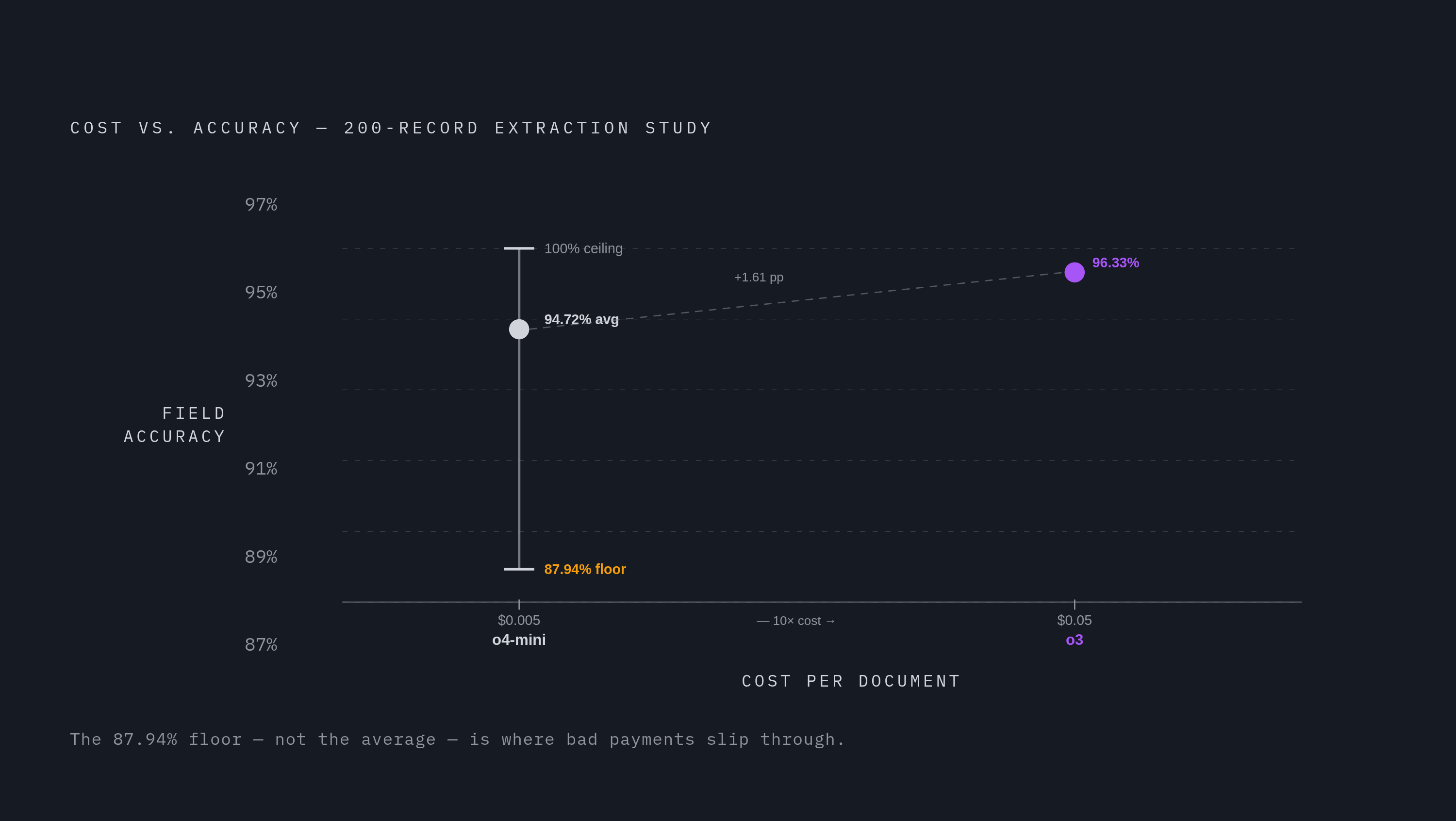
The results tell the real story. Using the o4-mini model, the study found per-field accuracy running from 100% on simple categorical fields down to 87.94% on the harder ones, averaging 94.72% overall. That spread, not the average, is the finding that matters, because the fields at the low end of the accuracy range are also the fields where an error slips a bad payment straight through the matching engine.
Model choice turns out to be an economic decision as much as a quality one. The same study found o4-mini hitting 95.00% accuracy at roughly $0.005 per document, while o3 reached 96.33% at roughly $0.05 per document, ten times the cost for a marginal accuracy gain. At real invoice volumes, that gap compounds fast, and it argues for choosing models per field type and per document type rather than picking one model for the whole pipeline.
Confidence calibration remains an open problem on top of all this. Calibration quality varies widely across models evaluated on document extraction tasks, and confidence scores should not be assumed to be well-calibrated out of the box. Vendor-reported accuracy scores should not be taken at face value until they've been tested against a company's own document population, because a model calibrated well on someone else's invoices may not behave the same way on this year's vendor mix.
Confidence scoring and threshold design as the mechanism for routing exceptions
Thresholds are the lever that decides how much of the workload automation actually carries. When a field's predicted confidence score drops below a set cutoff, say 0.85, the extraction gets routed to manual review instead of proceeding into the matching engine.
That tradeoff is explicit, and it should be tuned deliberately rather than left at a vendor's default. Raising the threshold makes the auto-processed extractions more reliable, but more documents land in the review queue. Lowering the threshold makes the automation rate climb, but so does the amount of extraction error that slips into the matching engine unchecked.
Thresholds belong at the field level, not the document level. Unit price and quantity fields deserve tighter thresholds than vendor name or invoice date, because a price or quantity error that slips through doesn't just cause a paperwork headache, it becomes a false-positive match and a wrong payment. The financial consequence is not evenly distributed across fields, so the threshold shouldn't be either.
There are two competing ways to generate the confidence signal in the first place: verbalized confidence, where the model reports its own numeric score, and token-level log-probability methods, which look at the model's internal certainty. Which one works better for structured document extraction is still underexplored, and teams shouldn't assume a vendor's exposed confidence score is well-calibrated for their specific document types without testing it. A preprint, "Beyond Logprobs" (arXiv:2606.24420), described fusing cross-call disagreement with OCR and spatial layout signals into a single confidence signal for document fields, reported using quantitative calibration metrics. That kind of work signals calibration methodology is still an active research question, not something settled and shipped.
Running a fixed set of canary documents through the pipeline on a regular schedule catches drift before it becomes a production incident. A model update or a new vendor invoice format can quietly degrade field accuracy over time, and without a standing check against known documents, that degradation goes unnoticed until exceptions start piling up downstream.
Designing the exception-handling layer so it does not become the new bottleneck
Invoice exceptions are already the biggest operational complaint inside accounts payable, and matching disputes sit near the top of the list of causes. A poorly designed exception layer doesn't eliminate manual work, it just relocates it, and often makes it harder to trace.
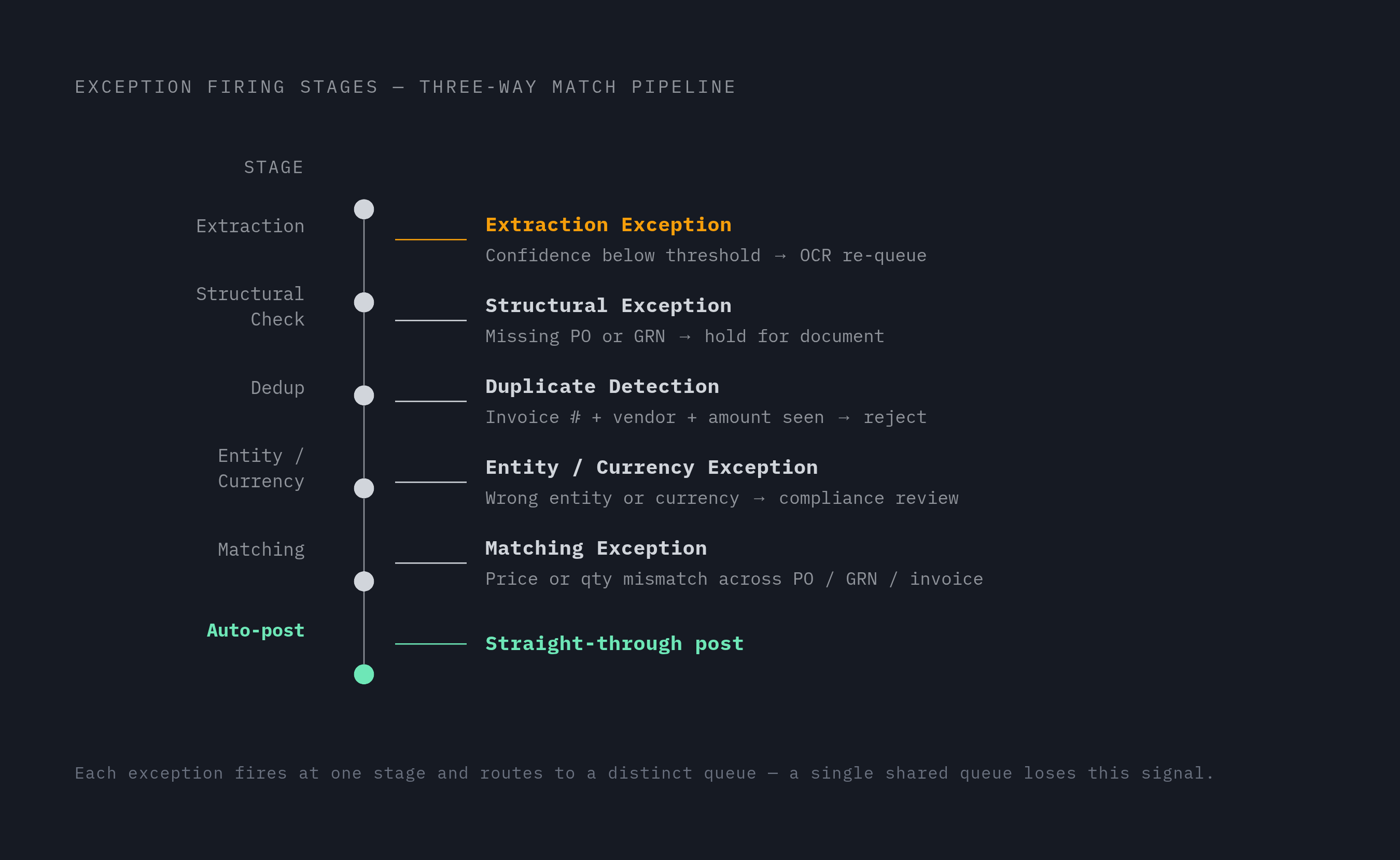
Exceptions come in a handful of distinct flavors, and lumping them into one queue defeats the purpose of automating. An extraction exception fires when a field's confidence falls below threshold, stopping the record before matching even starts. A matching exception means extraction succeeded fine, but the values genuinely disagree across PO, GRN, and invoice, a price mismatch or a short-shipped quantity. A structural exception occurs when one of the three documents simply isn't there yet, an invoice arriving before its GRN, which under three-way match logic leaves no basis for payment. A duplicate detection exception fires when invoice number, vendor identifier, and amount all match a record already processed. And an entity or currency exception catches an invoice referencing the wrong legal entity or a currency inconsistent with the PO, the kind of error that matters most in multi-entity or cross-border operations.
Tolerances need the same field-by-field, vendor-by-vendor attention as thresholds do. A fixed-price PO should carry zero tolerance on unit price. A volume-based contract, by contrast, might reasonably accept some quantity variance within an agreed band. Setting one tolerance globally across every vendor and contract type ignores the fact that those two situations carry entirely different risk profiles.
The resolution workflow itself needs a clear path: flag and hold, identify the cause, resolve it (a corrected invoice, a delivery confirmation, a credit note, a PO amendment), and re-enter the pipeline. Every one of those resolutions should be captured as a labeled correction rather than letting it disappear once the invoice clears. Human review isn't just a cost center in this design, it's a source of ground-truth data. A static extraction model doesn't learn anything from the exceptions it keeps generating, but a continuously trained one can use those corrections to improve field-level accuracy over time.
Routing everything through a single monolithic AI model that tries to handle extraction, normalization, matching, and exception routing all at once is an anti-pattern. Specialized components, kept separate, can each be monitored, tested, and improved on their own. A monolithic system makes it nearly impossible to tell which stage caused a given failure, which defeats the purpose of building a pipeline with distinct stages.
Build vs. buy calculus for the extraction and matching layers
Building this in-house always looks reasonable at the demo stage. A parser handles a handful of clean PDFs correctly, the matching logic for a simple invoice isn't complicated, and it's tempting to conclude the hard part is basically done.
The real cost is visible in what actually happens after the demo. Vendors don't submit documents in one tidy format, they send PDFs, scanned images, and photographs of paper invoices, each with its own layout quirks, embedded fonts, and column structures that a parser tuned on the demo set has never encountered. Every new vendor format is effectively a new edge case, and at any real invoice volume, new vendors show up constantly.
Sustaining accuracy against that kind of format diversity, keeping confidence calibration honest, tracking drift with canary documents, and rebuilding exception-handling logic as new failure modes occur, is a standing engineering commitment, not a project with an end date. That's the calculus to run honestly before deciding whether to build the extraction and matching layers from scratch or adopt a platform built by people who've already absorbed that cost across many customers' document populations. Either path can work. What doesn't work is treating extraction as a solved problem because the demo went well.