File Intake Architecture for High-Volume Document Pipelines
Silent failures in intake compound quietly across thousands of documents before anyone notices.
Garbage in, garbage out used to mean one wrong record. At production scale, a broken intake layer doesn't produce one wrong record, it seeds the same error across thousands of documents before anyone notices a pattern. That's the real risk in high-volume document pipelines: not that intake fails loudly, but that it fails quietly, and the failure looks like a normal result all the way through the system.
Most engineering teams put their time in the wrong place. Months go into tuning extraction models, adjusting confidence thresholds, and refining validation rules on the output side, while the intake layer stays what it was on day one: a pile of upload handlers and format checks somebody wrote under deadline pressure, never revisited since. It works in the demo. It works in the pilot. Then volume goes up, the input mix gets messier, and the cracks that were always there start leaking bad data downstream.
Silent failure looks like this in practice. A document lands in the pipeline sideways, or its text layer is broken, or it's a password-protected PDF that opens without error but returns nothing. The pipeline doesn't reject any of this. It processes the file, hands back structured data, and that data looks completely normal. Nothing in the output tells anyone the input was already broken.
The damage doesn't stay contained to the one document, either. Misclassify a document type at intake and the routing logic sends it to the wrong extraction schema, so every field it returns is a plausible-looking wrong answer. A skewed scan degrades OCR accuracy before a single model gets a say in the outcome. A file truncated mid-upload produces partial JSON that happily passes schema validation, because the schema only checks structure, not completeness, and the failure appears only when a business rule downstream chokes on a missing value nobody flagged.
The anatomy of a production intake layer: stages, responsibilities, and failure points
Intake is not "the upload step." Treating it that way makes the boundary between intake and everything else get fuzzy fast. Intake ends at a specific, checkable point: the moment a normalized, validated file gets handed to the extraction engine. Everything before that line is intake's job, and everything after it belongs to extraction.
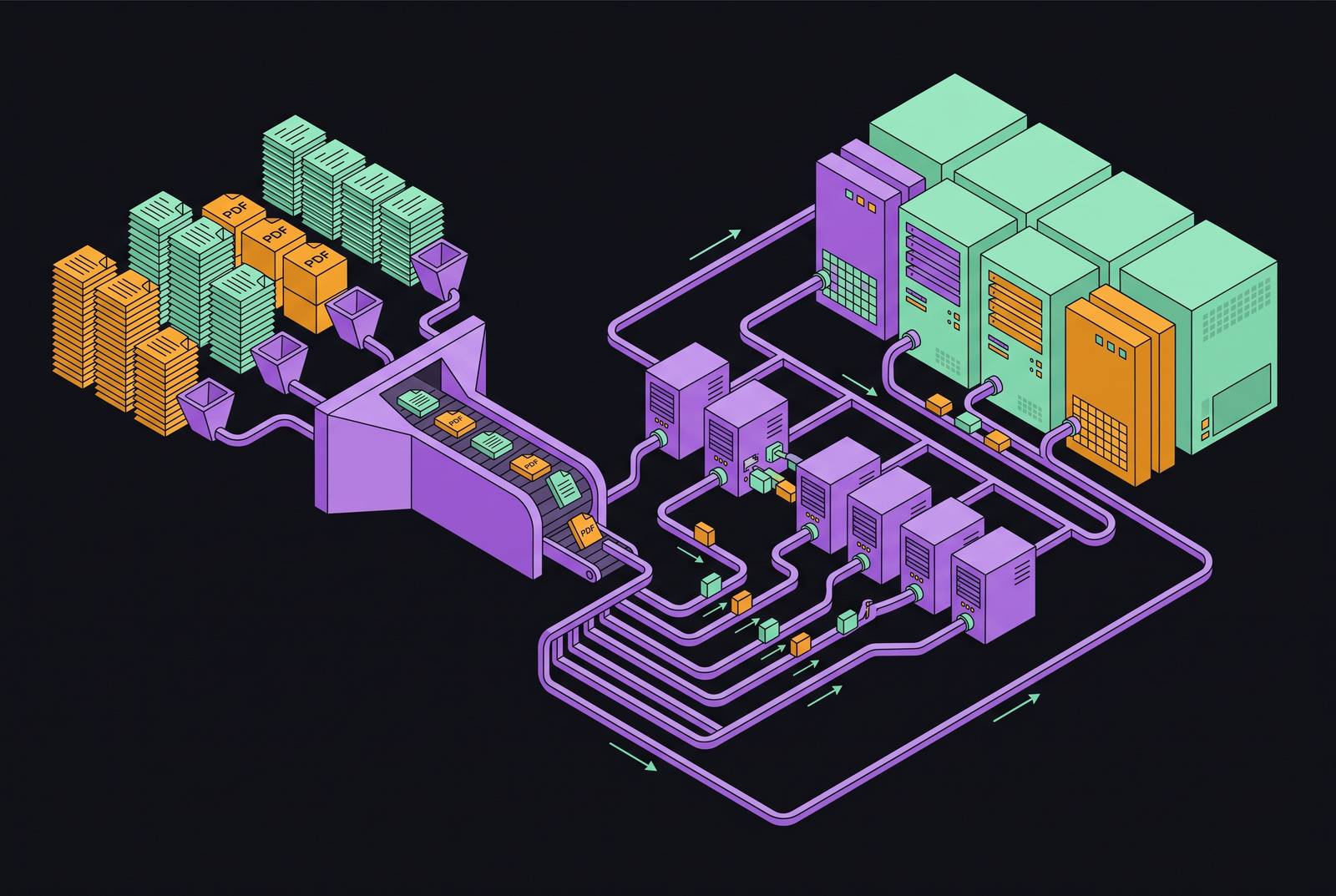
Inside that boundary sit several distinct stages, each with its own job and its own way of failing. Ingestion takes files in from wherever they come from: email attachments, SFTP drops, API pushes, webhook payloads, S3 event notifications. Format normalization converts whatever arrives into one canonical internal format, so nothing downstream has to guess what kind of file it's looking at. Preprocessing does the image quality work, deskewing, denoising, contrast correction, resolution normalization, that determines how much of the document an OCR engine can actually read. Classification and routing figures out what kind of document this is and sends it to the right extraction schema. Validation gating decides, before any of that extraction work gets kicked off, if the file is processable. Queue management handles buffering, prioritization, backpressure, and retries, and the other stages depend on it to function.
The dangerous part is that each stage's failures are invisible to the stage after it, unless somebody has built in a way to surface them. A preprocessing step that silently hands a degraded image to OCR looks, from the outside, exactly like a preprocessing step that did its job. The OCR engine has no way of knowing the input was bad, so it just does its best with what it got, and the resulting errors get attributed to "OCR accuracy" rather than to the image quality problem that actually caused them. Staged architecture matters because it ensures a failure at any given stage produces a signal instead of a shrug.
Ingestion: handling the diversity of sources, formats, and file states that production delivers
The intake surface in a real production pipeline is wider than most teams plan for. Born-digital PDFs, scanned PDFs (single-page and multi-page), photos taken on a phone in bad lighting, TIFF and PNG images, Office documents converted to PDF somewhere upstream, attachments buried inside forwarded emails, ZIP files with a mix of formats stuffed inside. Every one of those needs to land in the same pipeline and come out the other side handled correctly.
Format diversity is only half the problem. File state is what actually breaks naive handlers. A password-protected PDF can appear to open just fine while yielding no usable content, which looks a lot like a successful ingest until someone checks the output. A file can carry a perfectly valid PDF extension while its contents are unprocessable. Uploads get cut off mid-transfer when a network connection drops, leaving a truncated file that still passes a basic file-exists check. Zero-byte files slip past size validation if that validation only checks for a size limit and not a size floor. And the same document can arrive through more than one channel inside the same processing window, and nothing catches the duplicate unless someone built a check for it specifically.
None of these are exotic edge cases. They're the normal cost of doing business at volume, and engineers need to design and test for them explicitly: password protection, corrupt files, timeouts, rate limits, retries, asynchronous completion. Each one needs its own handling path designed for it specifically.
Source diversity compounds this because every channel carries different reliability guarantees. An S3 event trigger behaves nothing like a webhook callback. SFTP polling has its own latency and failure characteristics, separate again from email parsing or a direct API POST. The job of the ingestion layer is to take all of that variation and flatten it into one canonical intake event, so nothing downstream has to know or care which door the document walked in through.
Format normalization: why every document must become the same thing before preprocessing begins
Normalization has one target: turn every incoming file into a single internal format that every later stage can assume without checking. Usually that's a rasterized page at a fixed DPI, or, for born-digital files, a linearized PDF with a text layer that's actually trustworthy. Once that target format is set, every stage after it gets to stop asking "what kind of file is this" and start asking "what does this file say."
Skipping that step causes mismatches to appear fast. Preprocessing tuned for scanned TIFFs does the wrong thing when it's handed a vector PDF. Running OCR on a file that already has a text layer causes the engine to produce duplicate or conflicting character streams sitting on top of each other. Layout models calibrated against clean 300 DPI scans degrade noticeably on grainy 72 DPI phone photos, because the visual features they were trained to look for simply aren't there at that resolution.
The text layer that doesn't line up with the printed page deserves its own attention. Some PDFs, particularly ones that went through older scan-to-PDF workflows, can carry an embedded text layer that doesn't line up with what's actually printed on the page. Trust that layer blindly and the pipeline reports data that's confidently wrong. Normalization has to detect a broken or misaligned text layer and throw it out rather than pass it downstream as if it were authoritative.
Office documents add a separate wrinkle. A.docx or.xlsx file has to get converted to PDF before it enters the pipeline at all, and the conversion library doing that work introduces its own failure modes, font substitution, tables that reflow into a different shape, formulas that render as something other than their intended value. That conversion step isn't a formality. It deserves its own test coverage as a distinct slice of the format matrix, not an assumption that "it converted" means "it converted correctly."
Preprocessing: the image quality work that determines OCR accuracy before the OCR engine runs
The accuracy gap here is large enough to change how a team should think about where to spend engineering time. A clean digital PDF can push character accuracy up around 99.5%. A photographed, crumpled receipt can land closer to 85%. That's a roughly 14.5-point gap, and it exists before anyone has picked an OCR engine or tuned a model. The gap is a property of the input, not the algorithm.
Four preprocessing operations do most of the work of closing that gap. Deskewing corrects rotation: even a 1 to 2 degree tilt measurably degrades OCR accuracy, and bounding-box-based field extraction can fail outright once columns shift even slightly, long before the error ever reaches an approval step. Binarization converts grayscale or color scans into black and white, cutting noise for the character recognition engine, though picking the right threshold takes care on faded ink or watermarked pages where the contrast between text and background is already thin. Denoising strips out fax artifacts, scan lines, salt-and-pepper speckling, and JPEG compression rings, all of which an OCR engine will otherwise try to read as if they were characters. And resolution upscaling recovers detail on anything captured below roughly 200 DPI, pulling back some of what the capture device threw away during capture.
Classical OCR compounds errors across three stages: detection, recognition, and post-processing. A detection failure means a field never even reaches the recognition stage, so it goes missing entirely rather than being misread. A recognition error that gets "corrected" by a spell-checker into a plausible but wrong value is worse than a raw OCR typo, because a raw typo looks broken and a spell-checked substitution looks fine.
Preprocessing improvements tend to yield better returns than swapping OCR engines. The practical implication follows directly: tune the input before spending engineering cycles evaluating which model to use, because a better engine fed a bad image still produces a bad result.
Document classification and routing
Classification belongs at intake, not buried inside extraction, and the reason is mechanical. Applying the wrong schema to a document makes every confidence score that extraction produces afterward meaningless. Running a payslip through an invoice schema causes the system to still return values, confidently, for fields that don't correspond to anything real on the page.
Intake has several signals available for making that call before extraction starts: the file's metadata (which channel it came through, who submitted it, patterns in the filename), page count and aspect ratio, the presence of a text layer and its language, visual layout cues like logo placement, table density, or form field structure, and keyword anchors pulled from the first page. None of these alone is decisive. Together, they're usually enough to route correctly.
Multi-document bundles complicate this further. A single PDF might contain an invoice, a remittance advice, and a purchase order stapled together into one file, and classification has to work at the page or section level to catch that, not just the file level. Splitting logic, deciding where one document ends and the next begins, belongs here in intake, not somewhere downstream after the wrong schema has already been applied to the whole bundle.
Classification models get things wrong sometimes, and the intake layer should be built assuming that. Emit a confidence score alongside every predicted document type, and route anything below a defined threshold to human review instead of forcing it through automated extraction on a guess.
Queue design and backpressure: managing throughput without letting rate limits and timeouts become silent failures
Rate limits are a documented, recurring production failure mode, not a theoretical risk. In February 2026, 5% of all LLM call spans reported an error, and 60% of those errors traced back to exceeded rate limits. By March 2026, rate limit errors totaled close to 8.4 million in March 2026 alone. Those numbers describe what happens when volume outpaces the system's ability to absorb it.
A queue between intake and extraction isn't a nice-to-have. Without one, an upstream burst, a batch upload, an end-of-month invoice run, a mortgage closing rush, translates directly into rate limit errors and dropped requests, because nothing is smoothing the spike before it hits the extraction layer.
Getting queue design right means making a handful of specific decisions. Priority lanes need to separate urgent documents (same-day payroll, time-sensitive closings) from standard batch work and from the retry queue, and each lane needs its own throughput ceiling and its own backpressure policy, because treating them identically defeats the purpose of having separate lanes. Visibility timeout, how long a worker can hold a job before the queue assumes it died and re-enqueues it, has to be set longer than the worst-case extraction latency including retries, or the system starts duplicating work on jobs that were actually still running fine. Dead-letter queue depth sets how many failed attempts a job gets before it stops retrying automatically and goes to a human instead. And idempotency keys prevent the queue from handing the same document to two workers at once, which matters because double-delivery means double-extraction, and double-extraction on a billed-per-page or billed-per-call system means double-billing.
Backpressure is the design requirement the rest of queue management depends on. When extraction is saturated, intake has to slow down, either by rejecting new submissions with a retry-after signal or by buffering them in the queue until capacity frees up. Pushing that problem back to the submitter, visibly, is a better outcome than swallowing the overflow and quietly dropping documents on the floor.
Validation gating at intake: catching the failures that extraction will never surface on its own
Production pipelines need two distinct layers of validation, and confusing them is where a lot of the silent failure discussed earlier actually originates. Intake validation asks one question: is this file processable? That covers format, file integrity, size, language, and classification confidence, checked before extraction ever touches the document. Extraction validation asks a different question entirely: are the field values this document produced actually correct, checked against business rules, cross-field consistency, and confidence thresholds on the output.
Extraction validation can only ever check what came out. It has no way of knowing that the input was a password-protected PDF returning an empty text layer, or a corrupt file with a valid-looking extension, or a duplicate of something already processed ten minutes earlier through a different channel. Those are intake failures, and by the time extraction runs, the damage is already baked into the input it received. Catching them requires a gate at intake specifically, one that checks processability before committing a single document to the extraction queue, because no amount of validation logic on the far end can reconstruct information that never made it into the pipeline.