Integrating Document Extraction APIs With SAP and ERP Systems
Accurate extraction fields at the boundary prevent silent corruption in SAP.
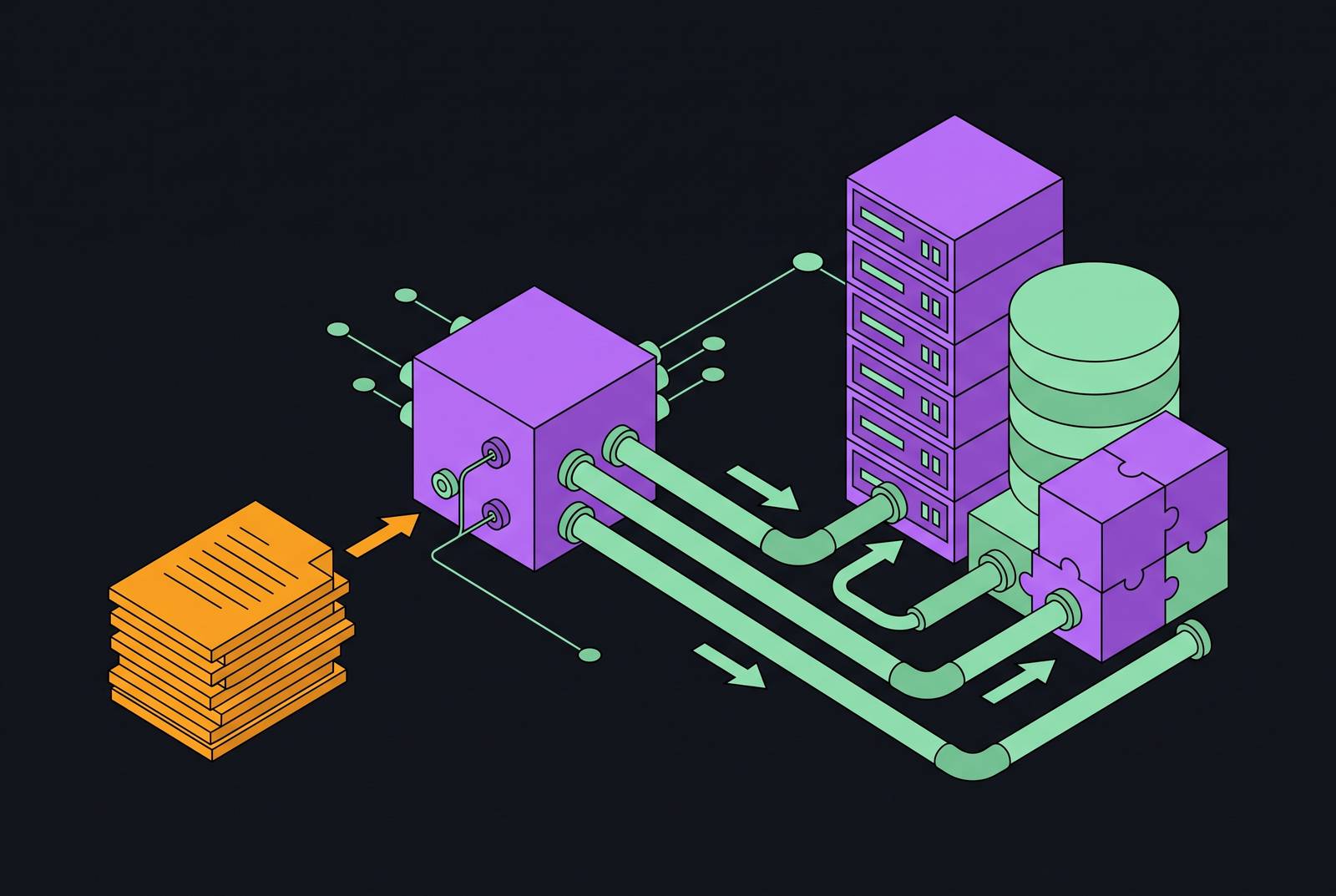
An accounts payable team connects a document extraction API to SAP S/4HANA and thinks the integration is done. The issue is not connectivity. It is data quality at the moment structured JSON crosses into the ERP's transactional layer, where a wrong vendor ID or a hallucinated invoice total becomes a rejected posting or a silently corrupted record.
SAP accepts or rejects postings based on strict field validation rules. One bad field can block an entire invoice run. A vendor ID that fails to match master data stops the posting, but the downstream damage is larger: payment runs, reconciliation, and audit trails all inherit the error.
Most teams treat this as a plumbing problem. The real work is making sure the fields arriving at the ERP are correct, typed correctly, and complete. That work is engineering.
What the SAP data handoff layer actually looks like
SAP exposes several distinct integration surfaces for document data. SAP Document AI sits on SAP Business Technology Platform and offers two API families: REST APIs in the Base Edition and OData V4 APIs in the Embedded Edition and Premium Edition. Before you commit to one, audit which access patterns your integration architecture needs.
The Embedded Edition integrates natively into SAP S/4HANA Cloud, SAP Ariba Central Invoice Management, SAP Concur ExpenseIt, and SAP Business Network. If you already run these SAP applications, extraction output is consumed inside the SAP workflow, with no custom handoff layer. The extraction and the posting happen in the same environment.
When the extraction source is an external API rather than SAP Document AI, the handoff must go through a published, supported API endpoint. Undocumented internal endpoints that happen to work are an unsupported dependency. They can break without notice.
For ERP deployments without a REST API surface, such as older on-premise SAP instances or non-SAP ERPs, RPA tools sometimes post extracted data through the UI layer. This approach bypasses the data validation layer entirely and is architecturally fragile. The integration surface decision determines what validation is possible. RPA-based UI entry skips schema validation altogether.
SAP CAP, or SAP Cloud Application Programming Model, gives you a structured way to build custom services on SAP BTP. A CAP service can consume extraction output, validate it against a defined schema, and write to SAP HANA or post to downstream SAP systems via OData. This is a common pattern for teams building bespoke AP automation on top of SAP Document AI.
Where extraction pipelines fail before the data reaches SAP
The data quality problems that cause ERP posting failures originate in the extraction pipeline, not in the integration layer. They cluster around a predictable set of failure classes, and each one produces a specific defect in the JSON payload that reaches the handoff boundary. Table extraction is the highest-risk failure class for AP documents. Line-item data is exactly what ERP posting requires: quantity, unit price, tax, and total. It lives in tables. When table structure is misread, every field in the table shifts.
Label variation compounds the table problem. One vendor writes "Invoice Number," another writes "Invoice #," another writes "Rechnungsnummer" or "Factura No." A regex-based extraction layer that worked for the first hundred vendors starts failing silently on the next fifty. The failures do not announce themselves. They arrive at the ERP as plausible-looking wrong data.
Template brittleness is a related problem. Template-based extraction systems break when a vendor changes an invoice layout. Each new format requires a new template, and the maintenance backlog grows faster than the team can service it.
Training distribution bias is subtler. A parser trained mostly on digital PDFs can show strong aggregate accuracy scores while hiding significant weaknesses on scanned documents, handwritten annotations, or multi-column layouts. For AP teams in insurance or logistics, where scanned inbound documents are common, this hidden weakness surfaces only in production.
Error cascading turns small problems into severe ones. When a multi-column layout is flattened into a single text blob, the model assigns values to the wrong fields. A hallucinated invoice total or vendor ID enters the JSON payload with full confidence and propagates to the ERP posting without triggering a validation error at the extraction layer. Extraction failures do not announce themselves. A document extraction API like Invofox, which enforces per-field accuracy guarantees and validates extracted JSON against a configured document schema before delivery, draws the distinction between a successful API call and a reliable data pipeline.
Why per-field accuracy and confidence scores are the only meaningful quality signal at the handoff boundary
Aggregate extraction accuracy scores are not actionable at the ERP handoff layer. A system may extract vendor names at very high accuracy, but payment due dates at materially lower accuracy. It is the date that determines payment run timing in SAP.
Per-field accuracy and calibrated confidence scores are what give the integration layer enough information to route documents correctly. A confidence score is only useful if the stated probability corresponds to observed accuracy at that threshold. A model that assigns 0.90 confidence to fields it gets right only a fraction of the time is useless as a routing signal.
The production routing rule that works is straightforward. If a field's confidence score falls below a defined threshold, such as 0.85, route the document to human review before it enters the ERP posting queue. This keeps throughput high for clean documents and catches edge cases before they become posting errors.
The distinction between omission and hallucination matters for integration design. A hallucinated field, where the extractor returns a wrong value with high confidence, passes validation and corrupts the record. These are different risk profiles requiring different mitigation strategies.
Field-level grounding is the strongest signal against hallucination. Verifying that an extracted value is traceable to a specific location on the document page turns a prediction into evidence. A confidence score that cannot be traced to pixels on the page is not a confidence score. It is a guess.
For teams evaluating extraction APIs, test calibration directly. Do not rely on vendor-reported benchmarks as a substitute. The test takes an afternoon and tells you more than any aggregate accuracy number.
Schema validation and type enforcement between the extraction API and the ERP posting layer
A validation layer between extraction output and ERP ingestion is not optional. It is the mechanism that converts field-level confidence scores into posting decisions and catches type mismatches before they reach SAP. Field types carry semantic meaning, so the extraction API must communicate it and the integration layer must enforce it. A plain TEXT field type would pass these through uncorrected into the ERP. The type declaration is what triggers the normalization logic.
Mandatory field checks are the next gate. Quarantine before posting is cheap. Fixing a posted record is expensive.
Master data matching functions as a validation step. The vendor name extracted from the document must resolve to a vendor ID in SAP master data. Getting it wrong poisons the entire financial record.
Batch processing requires error isolation. In high-volume AP pipelines, corrupt PDFs or unsupported formats should return errors at the document level without failing the entire batch. The integration layer must handle errors per document, so successful extractions in the batch are preserved.
The SAP CAP pattern handles this directly. A CAP service on SAP BTP can validate extracted JSON against a defined schema before writing to HANA or posting via OData. Confirmed corrections feed back into the extraction model to improve future accuracy on similar documents.
Why static extraction tools compound errors over time while continuously learning systems do not
A document extraction pipeline that does not learn from human corrections accumulates edge-case failures as vendor and document variety grows. The maintenance cost of a static system is not fixed. It compounds. Every AP operation adds new vendors over time. The maintenance backlog is a function of vendor onboarding velocity, and it grows without bound. Even non-template AI extractors trained on a fixed dataset degrade on document types outside their training distribution. The failures keep happening, month after month, on the same document shapes.
SAP Document AI describes its "instant learning" capability as enabling the system to continuously learn from user corrections and adapt to new formats. This is the architectural property that separates a document AI product from a static OCR tool in a production ERP context. Teams that implement structured human review, rather than ad-hoc exception handling, generate the feedback data that improves the system over time.
The counterargument, that a well-trained initial model is sufficient, fails in practice. The document population at go-live is not the document population at month eighteen. New vendors, new document formats, regulatory changes such as e-invoicing mandates, and acquisition-driven ERP consolidations all introduce document types the original training set did not cover. Extraction failures cluster around predictable classes: table brittleness, label variation, template drift. Its SLA accuracy guarantee is sustainable only because the system improves on the cases that fall below it.
Data security constraints that shape how extraction APIs can be wired into SAP pipelines
If documents flow through an AP or payroll extraction pipeline, they contain sensitive financial and personal data. That means the extraction API's data handling architecture is an integration constraint, not a procurement afterthought. Invoices, payslips, and closing disclosures contain PII, payment details, and tax identifiers. The retention policy becomes a liability sitting inside the pipeline. Zero data retention is the architectural requirement. If the payload is gone after the response returns, there is nothing to leak.
LLM-in-the-pipeline creates specific GDPR complications. If the extraction layer routes documents through a third-party LLM inference endpoint outside the data subject's jurisdiction, cross-border transfer mechanisms under GDPR apply. The security properties of the model provider become the security properties of the ERP pipeline.
Hidden text in PDFs is an active attack surface. An attacker can embed instructions in the PDF text layer that the LLM executes, potentially corrupting field values in the extraction output that then propagate to the ERP. The fix is architectural: the pipeline must distinguish what a document looks like from what its text layer claims.
For teams selecting an extraction API, Invofox offers an optional zero-data-retention processing mode on its Scale and Enterprise plans, plus SOC 2, GDPR, and ISO 27001 certifications, and EU, US, and on-premise deployment options. These address the compliance constraints that determine whether an external extraction API is permissible in a regulated SAP pipeline. Data handling architecture must be verified before integration, not after.
Build vs. buy at the extraction layer: what teams consistently underestimate
If you build your own extraction layer to feed SAP, you consistently underestimate the cost of edge cases, validation logic, and continuous improvement infrastructure. Production volume makes all three mandatory. What a general-purpose LLM or OCR model does not include out of the box is substantial: business rules for mandatory field validation, per-field confidence scoring, exception routing, audit trail, purchase-order matching logic, and straight-through ERP export. For recurring AP volume, building and maintaining this infrastructure is the real cost. The model is the starting point, not the product. Integration with SAP is identified in practice as the largest implementation variable, not the AI model itself. The posting loop takes months. The strongest argument for buying an extraction API with an accuracy SLA is that the vendor absorbs the edge-case maintenance cost and the continuous learning infrastructure. The team's integration scope is bounded to the handoff layer, which is a solved engineering problem, rather than unbounded model maintenance, which is not.
Invofox's pay-per-page pricing model with automatic credits for incorrectly extracted pages makes the calculus concrete. The cost of the API is proportional to successful extractions, not raw volume. The vendor has a commercial incentive to handle edge cases correctly, because they are not paid for pages they get wrong. RPA-based integration, using tools like UiPath to post extracted data through the SAP UI, is the pattern teams fall back on when the ERP API surface is limited. It is a workaround, not an architecture.
Engineering the handoff correctly: a practical integration architecture for document extraction to ERP posting
A reliable extraction-to-ERP pipeline has five distinct layers, each with a defined responsibility. The most common integration failures can be traced to collapsing two or more of these layers into one. The layers are: Layer 1, document intake and pre-processing: receive the PDF or image, separate visual rendering from the text layer to prevent prompt injection, classify the document type, and route to the correct extraction schema. Batch ingestion handles corrupt or unsupported files at the document level without failing the entire batch.
Layer 2, extraction with per-field confidence: call the extraction API and receive structured JSON with per-field confidence scores and grounding references. Invofox fits here: a document intelligence API that returns validated structured JSON with field-level confidence scores, operates under zero data retention, and improves from confirmed corrections. It hands off to the validation and posting layers without requiring the integration team to build extraction infrastructure.
Layer 5, ERP posting and error handling: post via a published, documented API. OData V2 works for SAP S/4HANA Cloud. Write posting results to an audit log that preserves extraction confidence scores alongside the posting outcome.
Two constraints cross all layers. The extraction API must operate under zero data retention, and you should mask sensitive fields before they enter any LLM context. Second, the feedback loop runs from Layer 3 and Layer 5 back to the extraction model. Human corrections confirmed in the review queue and posting failures that trace to extraction errors are the ground-truth data that drives continuous improvement.
That loop is what prevents edge-case accumulation over time. The handoff is not where the integration ends. It is where the engineering begins.