OCR Engine Comparison for Structured Financial Documents
Real OCR engines fail on production documents where vendors' demos excel.
Choosing an OCR engine for structured financial documents is not a feature-list decision. It comes down to per-field accuracy on the edge cases that actually show up in production: multi-column tables, handwritten annotations, low-quality scans, and data that spans a page break, the places where engines that shine in demos routinely fall apart once real documents start arriving. Vendor demos are built on clean samples for a reason: they look good. Production folders don't cooperate.
Consider what happened to a developer integrating a parsing library into a live pipeline. In a single afternoon, three documents produced three distinct failure modes. A scanned purchase order merged its field labels directly into the values, an insurance claim built with embedded fonts silently dropped two entire sections, and a financial statement broke every downstream regex because the parser inserted line breaks mid-sentence. None of these were unusual documents pulled from some stress-test folder. They were the first three files in a real client's intake, which is the detail that matters most here.
That detail scales into a bigger pattern. Research on in-house parsing pipelines finds that fewer than 10% ever reach production, and the reason isn't a lack of engineering talent, it's that edge cases accumulate faster than any team can patch them. Every new document type introduces a new failure mode, and the backlog of fixes grows quicker than the backlog of documents shrinks.
Financial documents concentrate nearly every hard problem OCR faces into one file type. Multi-column tables, handwritten annotations, low-resolution scans, data continuing across pages, embedded fonts, and mixed content combining text, charts, and formulas all appear routinely in financial documents, often in the same document. A quarterly filing might have a scanned signature page, a dense income statement, and a footnote block that runs onto the following sheet, all requiring different extraction logic to survive intact.
The most dangerous failures are the quiet ones. An engine can produce output that looks perfectly clean while it has silently dropped a footnote anchoring a critical figure, misaligned a column beneath a merged cell, or lost the context that connected a value to its label across a page break. Nothing in the output flags itself as wrong. Those errors travel downstream into ledgers, underwriting decisions, and audit trails, undetected until someone reconciles a number that doesn't add up. Choosing an engine, then, is really an exercise in figuring out which system degrades least on the specific edge cases present in a given document corpus, not which one scores highest on a generic leaderboard.
The structural problems OCR must solve in financial documents
Tables built with merged cells and hierarchical headers are the first hurdle, and they're not cosmetic. A single header that shifts by one column, or a merged cell that gets split incorrectly, causes a downstream agent to extract the wrong value entirely, and it does so without any error message. Structural fidelity in a table isn't a nice-to-have; it separates a correct balance sheet from a confidently wrong one.
Cross-page continuity compounds the problem. Transaction tables and multi-year data series routinely span page boundaries, and any parser that treats each page as its own isolated unit breaks the table exactly where the page ends. The row splits, the header doesn't carry forward, and the second half of the table arrives disconnected from the first.
Handwritten annotations are common in mortgage packages, insurance claims, and loan applications: inline corrections, margin notes, signature fields. Engines with weak handwriting recognition don't approximate these poorly, they miss them outright, which matters enormously in underwriting contexts where a handwritten correction can override a printed figure.
Low-quality scans degrade accuracy fast in any engine built around the assumption of clean input. Skew, noise, low resolution, stamps, and unusual fonts all chip away at recognition quality. Preprocessing has to be evaluated as part of the engine, not treated as a separate concern bolted on afterward.
A harder problem produces all of this: OCR, by itself, has no concept of relationships. It can read the characters inside a table cell perfectly and still have no idea that the cell belongs to a particular row, or that the row's header defines what the number actually means. An engine that doesn't model layout semantics returns text that is character-for-character correct and structurally meaningless, which is arguably worse than an obvious error because it looks trustworthy. Reading order adds another layer of ambiguity: multi-column layouts, sidebars, and footnotes confuse any parser that assumes text flows in a straight line down the page.
Benchmark work backs this up with more precision than intuition alone can offer. PureDocBench, a separate 2026 benchmark, adds a domain-specific failure taxonomy: business-document pages concentrate their failures in structural integrity and metadata completeness, and the finance and certificate domain case studies in its appendix document recurring patterns of annotation contamination, formula semantic loss, and seal recognition failure. The paper's broader point deserves repeating: ranking well on a general leaderboard doesn't guarantee an engine reproduces a complex financial document correctly. Benchmark evidence from ParseBench (arXiv 2026) identifies the relevant capability dimensions for financial documents as structural fidelity (merged cells, hierarchical headers, cross-page continuity), content faithfulness (omissions, hallucinations, reading-order mistakes), and semantic formatting (strikethrough, superscript/subscript, bold, hyperlinks that carry meaning).
Measuring OCR accuracy on financial documents before committing to an engine
Accuracy has to be measured per field, against ground truth pulled from a team's own document corpus. Generic benchmarks and vendor marketing numbers won't tell anyone how an engine handles the specific mess of documents that actually arrive in a given intake pipeline.
Building that evaluation set starts with sampling real production documents, not clean examples chosen because they're easy to test. The sample needs low-resolution scans, multi-column layouts, tables that span page breaks, files with embedded fonts, and any document type already known to cause trouble. Testing only well-formatted documents produces a number that feels reassuring and means almost nothing.
Sizing that sample doesn't have to be guesswork. A peer-reviewed 2025 study published on arXiv manually reviewed 200 records, independently, using two human experts, and landed on a margin of error of ±4% at 90% confidence. That's a reasonable floor for a pilot evaluation: enough records to say something statistically defensible, without demanding a review effort no team can sustain.
Before running any of this, correctness needs a definition everyone agrees on. Does a field count as correct only when it matches ground truth exactly, or also when it clears some confidence threshold? Does a wrong table extraction mean one cell is off, or does it mean a whole row went missing? Answering these questions after the test runs guarantees an argument later.
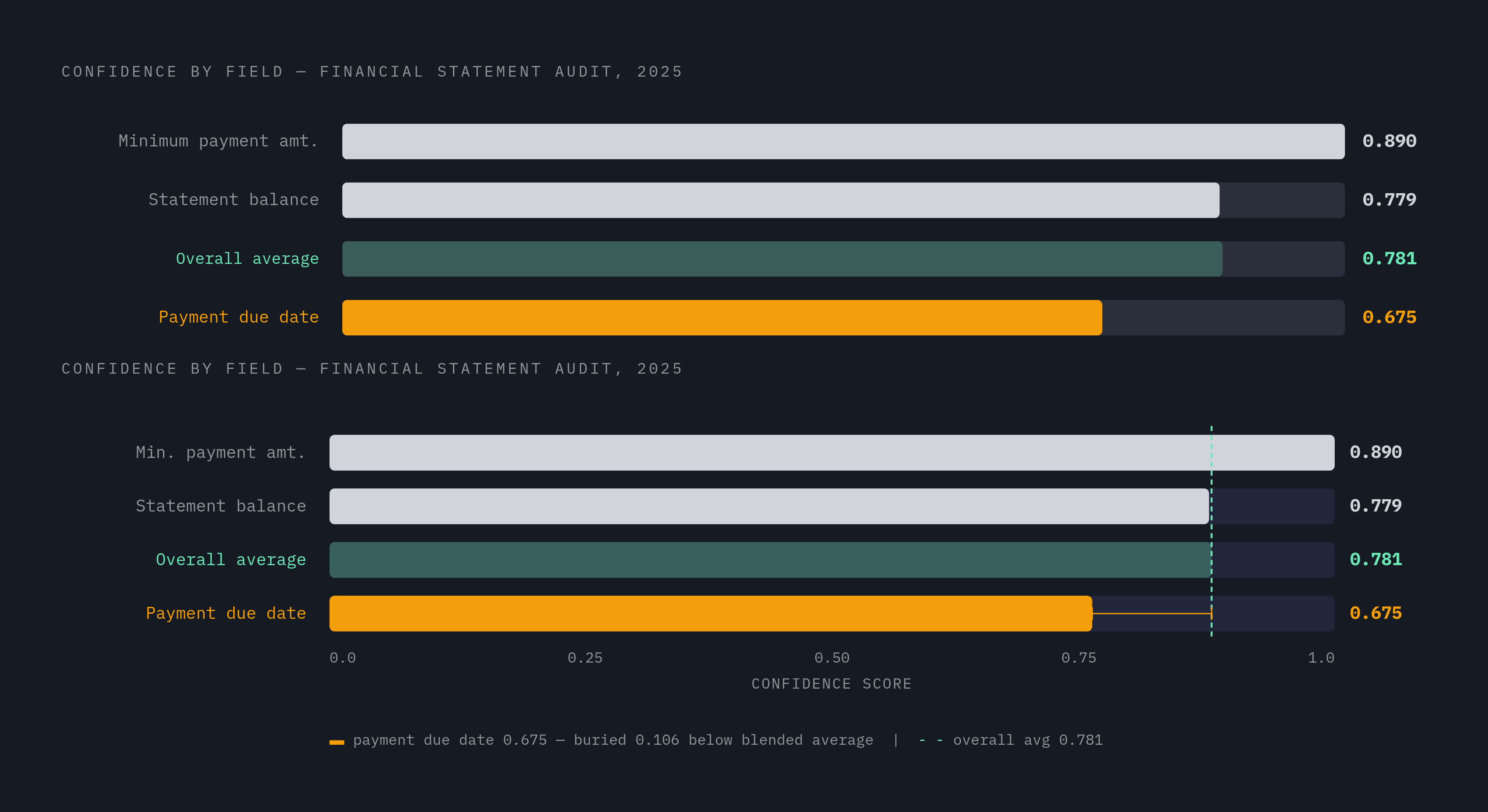
Document-level accuracy, reported as one blended number, hides exactly the variance that matters. Financial statement audit data from 2025, published on arXiv, shows a document intelligence model averaging an overall confidence of 0.781, but that average buries real spread: minimum payment amount is 0.89, statement balance is 0.779, and payment due date is just 0.675. Date fields underperform amount fields consistently, largely because dates move around the page depending on the template and depend more heavily on surrounding context to interpret correctly. A single blended score would have hidden that gap.
Confidence scores earn their keep only when they're grounded. Each extracted field should carry a confidence score, a grounding tied to a page and bounding box, and a decision either to accept the value or flag it for human review. On the CORD benchmark, only 49.0% of asserted fields turn out correct, while the correctness gap between grounded and ungrounded fields runs +0.352. That's not a marginal improvement. Grounding functions as a genuine filter for catching bad extractions before they reach a downstream system.
Field accuracy alone still doesn't capture business risk. Straight-through processing rate, manual review rate, and false auto-approval rate translate extraction quality into operational terms a finance team actually cares about. Performance should also get stratified by document condition, meaning digital versus scanned, skewed or noisy, stamped or handwritten, and unseen supplier templates, because averages across all conditions smooth over exactly the long-tail cases that cause the most damage.
Word Error Rate (WER) and Character Error Rate (CER) provide complementary views of transcription quality: WER measures word-level insertions, deletions, and substitutions normalized by reference word count, while CER provides a finer-grained character-level assessment. Neither replaces field-level accuracy, but both should get reported alongside it, since a field can be "correct" in a business sense while still carrying transcription noise that matters for downstream text processing.
Open-source engines on financial documents: strengths and breaking points
Tesseract remains the most widely deployed open-source engine, currently at version 5.5.3 as of July 2026, and it's been LSTM-based since version 4. Its genuine strength is breadth: it supports more than 100 languages out of the box, and on clean, high-quality black-on-white printed pages, its character accuracy can reach 95% or higher, putting it in the same range as some commercial engines for straightforward cases Comparative Analysis of AI OCR Models for PDF to Structured Text. Version 5.x added Adaptive Otsu and Sauvola binarization methods along with support for pulling images directly from URLs via libcurl. For clean, printed, budget-constrained, on-premise workloads, Tesseract earns its reputation. For structured financial extraction without a heavy post-processing layer built on top, it isn't a production-grade choice on its own.
TrOCR, out of Microsoft Research, takes a different architectural approach: a Vision Transformer encoder paired with an autoregressive text decoder, running end-to-end with no separate layout analysis step. It surpasses earlier OCR techniques on printed-text benchmarks and performs well on handwritten English once fine-tuned with separate weights for that task. It works best on segmented text lines or regions rather than full pages, doesn't inherently preserve layout or structure, and needs a GPU to run efficiently. TrOCR fits best as a component inside a larger pipeline, handling line-level or region-level recognition within a standalone financial document parser.
Its most practical feature for financial work is the optional --use_llm flag, which layers a language model on top of the pipeline for accuracy-critical documents. That flag is a real escape valve, but it adds cost and latency every time it's invoked, so it works best as a targeted fallback for documents known to be difficult rather than a default setting applied to every file that comes through.
Docling, built by IBM Research, targets production RAG pipelines directly and outputs a structured DoclingDocument object that preserves semantic hierarchy, capturing document structure, not just the words on the page. It handles an unusually wide range of formats, including PDF, DOCX, PPTX, XLSX, HTML, images, audio, LaTeX, and plain text, along with AsciiDoc, Markdown, CSV, video, and various XML schemas, and it integrates natively with LangChain and other generative AI frameworks. IBM's 2025 updates improved Markdown fidelity on complex digital documents and made local, lightweight deployments more efficient, and adoption reflects that investment: the project has drawn 61,000 GitHub stars and official integrations across every major LLM orchestration framework. Its limits are visible on exactly the documents this piece keeps returning to: accuracy degrades on scanned documents, multi-column layouts, and tables that cross page boundaries, with misaligned columns, dropped footnotes, and lost page-break context as the documented failure modes. Docling fits privacy-first or local deployments handling digital-born PDFs feeding into RAG pipelines. It's not suited to high-volume scanned financial intake without a preprocessing and validation layer sitting in front of it.
DeepSeek-OCR represents the newest entrant, an open-source vision-language model that processes text, charts, and formulas together end-to-end. The model can hallucinate, it lacks enterprise workflow controls out of the box, and teams adopting it need their own GPU infrastructure along with internal ML engineering resources to build a validation layer around it. It suits engineering-heavy teams that want full control over deployment and are prepared to build governance themselves. This open-source vision-language OCR model processes text, charts, and formulas end-to-end, and its latest release, DeepSeek-OCR 2, offers improved grounded Markdown conversion and a visual token reduction mechanism (256–1,120 tokens via DeepEncoder V2) that cuts computational costs for downstream LLMs. It is compatible with Hugging Face and vLLM pipelines, and is MIT-licensed (DeepSeek-OCR v1) and Apache 2.0-licensed (DeepSeek-OCR 2).
The pattern across all five is consistent: the license is free, but the infrastructure, the maintenance, and the ongoing edge-case patching are not. Those costs tend to compound faster than teams expect going in, which sets up the comparison against commercial platforms that follow. On financial documents, output is primarily plain text (or hOCR/ALTO with bounding boxes), complex layout structure like tables and forms requires post-processing, performance struggles with multi-column documents, rotated text, dense forms, and handwriting, and it falls behind newer AI models on low-quality scans. It converts PDFs, images, DOCX, PPTX, XLSX, HTML, and EPUB to Markdown, JSON, HTML, or chunks, uses Surya OCR for text recognition, and supports GPU, CPU, and Apple MPS.
Commercial cloud APIs: per-capability assessment for financial document workflows
LlamaParse stands out for financial services work specifically: parsing tax documents, bank statements, and filings into structured data for underwriting and risk workflows, and serving as a lead option for RAG and agentic pipelines where document structure carries as much meaning as the text itself. Its architecture favors semantic reconstruction over character-to-coordinate mapping, which lets it handle unseen layouts without requiring retraining. For financial documents specifically, it offers layout-aware parsing for nested tables and multi-column pages, whole-document parsing modes that reason across the full file rather than page by page (which measurably improves cross-page table extraction), and field-level confidence scores with citations that support an audit trail. Recent releases have moved quickly: agentic OCR capabilities delivered via Model Context Protocol in April 2026, a builder tool for constructing document-processing agents released in January 2026, a v2 API also in January 2026, a spreadsheet-focused beta in December 2025, skew detection with auto-orientation, and support for frontier models including Gemini 2.5 Pro and GPT-4.1. The tradeoff is complexity: it takes real engineering effort to implement well, more than a plug-and-play OCR tool would demand, and its ecosystem is younger than the legacy vendors it competes against.
Google Cloud Document AI has leaned hard into Gemini foundation models through 2025 and 2026, adding a Gemini Layout Parser in preview that improves table recognition, reading order, and text extraction from PDFs, along with Gemini-powered processors running on Gemini 3 Pro or Gemini 3 Flash. New capabilities include zero-shot splitting, custom splitter models with classification and confidence scores, and General Availability for DOCX, PPTX, XLSX, and XLSM files, plus Custom Extractor improvements using Gemini foundation models for variable layouts. Its strengths lie in strong computer vision, multilingual support across more than 200 languages, human-in-the-loop review tooling, and pre-trained processors for invoices, IDs, lending, and legal documents. Its limits become visible for teams building RAG pipelines: output is JSON-first, so Markdown or semantic document flow has to be reconstructed separately, privacy and regulatory configuration can get complicated, and niche financial instruments may need extra tuning. It's a strong fit for multinational finance operations handling mixed-language intake, large-scale digitization inside a GCP-standardized environment, and retail banking or archival search.
AWS Textract carries one standout capability for financial workflows specifically: the AnalyzeLending API, purpose-built for mortgage packages. Recent updates have expanded support for large-format documents, added integration paths into Amazon Bedrock, broadened the natural-language Queries feature for targeted field extraction, and extended specialized support for invoices, receipts, and identity documents. Handwriting recognition tends to lag behind Google's offering in practice, costs can climb quickly at high volume, and semantic understanding of charts, diagrams, and heavily distorted visual content remains a weak point. It's the natural choice for organizations already standardized on AWS, particularly for mortgage and tax document processing and accounts payable automation inside that ecosystem.
Azure AI Document Intelligence, formerly Form Recognizer, brings pre-built models for invoices, receipts, and tax forms, hybrid and on-premise container support, and enterprise security through VNets and managed identities, with 2025 pricing tiers refined for high-volume use and improved detection of hidden layer text. Recent additions include generative extraction and document Q&A features built on GPT-4o capabilities. It performs best inside the Azure ecosystem and can struggle with genuinely messy, unstructured financial reports, and its pricing structure across tiers takes some work to parse. It suits Microsoft-heavy organizations running accounts payable automation, mortgage processing, or contract digitization at enterprise scale.
Legacy enterprise OCR still has a place at this table. One long-standing platform, noted in an IDP survey for its broad OCR coverage, has focused its recent improvements on faster batch processing for very large digitization workloads while holding its OCR accuracy steady. Its strengths are mature template-driven extraction, genuine high-volume batch throughput, strong multilingual recognition on printed text, and both enterprise cloud APIs and on-premise SDKs for organizations that need to keep processing in-house. For institutions running large, stable document templates at scale, that maturity still counts for a great deal. OCR Engine Comparison for Structured Financial Documents.