Document Preprocessing Stages Before OCR
Proper preprocessing determines OCR accuracy more than the engine itself.

OCR does not fail randomly. It fails at specific, predictable points, and almost all of those points trace back to what happened to the document before the engine ever saw it. Preprocessing, the sequence of format checks, resolution fixes, deskewing, denoising, binarization, and layout segmentation, exists because an OCR engine has no way to tell a corrupted signal from a legitimate one. It just classifies whatever pixels arrive. General-purpose OCR gets cited around 95% accuracy under clean conditions, but that number collapses fast once the input is skewed, noisy, or low-contrast, and error rates on standard documents that already run 1% to 5% climb well past that on anything degraded or structurally complex.
The reason is architectural. OCR engines recognize patterns; they do not restore images. A blurred character, a speck of scanner dust, a shadow across a page fold: none of these come with a warning label. The engine reads the pixels it's given and produces its best guess, confidently, with no distinction between a clean read and a corrupted one. Given that most enterprise documents, by some estimates the vast majority of enterprise data, exist unstructured and arrive as phone photos, faxes, photocopies, and re-saved PDFs rather than studio scans, preprocessing is not a nice-to-have. Usable output separates from a spreadsheet full of confident-looking errors depending on whether preprocessing happens.
Format normalization: making the document a known quantity before anything else runs
Before any image processing happens, the pipeline needs to know what it's holding. A PDF with a native text layer is a fundamentally different object than a PDF that's just a scanned image wrapped in a PDF container, and treating them the same is the first mistake most homegrown pipelines make. One needs no OCR at all. The other needs the full treatment.
Format normalization handles the routing. It detects whether a text layer exists, pulls page images out of multi-page containers at a consistent bit depth and color space, and deals with embedded fonts or color profiles that tend to survive conversion as leftover artifacts nobody asked for. Converting to grayscale at this stage is usually the right call too, since it cuts complexity for every step that follows; color only earns its keep when it carries meaning, like a highlighted clause or a colored form field.
If this stage is skipped, the damage becomes visible only three steps later. It appears three steps later, when a denoising parameter tuned for a scanned image file in one format silently misfires on a re-saved copy in another common image format, and nobody can trace the bad output back to its actual cause. That's the trap with format normalization: the failure is delayed, so it looks like someone else's bug.
Resolution correction: the constraint every later stage inherits
Every later stage in the pipeline works on pixels, and resolution decides how many pixels a character gets to work with. Below a certain density, a letter stops looking like a letter to a denoising algorithm or a thresholding function, it just looks like noise with a vague shape.
300 DPI is the commonly cited floor, but it isn't a universal rule. Nutrient's own OCR guidance points out that 200 DPI sometimes produces better accuracy for certain font sizes, and pushing resolution past 300 DPI can actually push title fonts outside the character sizing range the OCR engine expects, which degrades accuracy rather than improving it. The recommended character size window is between 10 pt and 30 px; a font that reads perfectly at 300 DPI can fall outside the character sizing range the engine expects at higher resolutions, causing it to be skipped entirely or misread.
Upscaling can partially recover a low-resolution capture. Super-resolution techniques exist and they help. But they also introduce their own artifacts, and no amount of algorithmic upscaling replaces capturing the document properly in the first place. If resolution correction is skipped, the whole downstream chain runs on undersampled data: deskewing loses precision, binarization thresholds start guessing, and the OCR engine ends up staring at character boundaries that are genuinely ambiguous, not just hard.
Deskewing: why a few degrees of tilt erases characters the engine never misclassifies on straight text
OCR engines read in horizontal raster lines. Tilt the document even slightly and that raster line starts cutting across two rows of text instead of one, merging characters from adjacent lines or slicing a single character into two separate scan passes. On perfectly straight text, the engine never makes this mistake. On skewed text, it makes it constantly.
Tesseract-focused preprocessing research puts the improvement from deskewing at up to 10% in some cases, which is a meaningful jump for something as mechanical as rotating an image a few degrees. The standard approach detects the dominant angle of the text lines and rotates the page until they're horizontal, a process that is well-established and largely automated in most preprocessing toolkits. That part is well-established and mostly automated at this point.
The harder problem is the skew nobody notices. A page tilted 15 degrees gets caught, because it's visually obvious even to a human reviewer skimming the output. A 1 to 2 degree drift from a scanner's paper feed does not get caught, and it quietly corrupts word boundaries throughout the document. Mobile-captured documents complicate this further: a phone photo introduces both skew and a trapezoidal perspective warp, and correcting the perspective distortion is a separate operation from deskewing, not something deskewing handles as a side effect. Skip either one, and words that read cleanly in isolation get split or merged at line boundaries, which is exactly the kind of error that breaks a regex pattern or a field matcher downstream, even though the characters themselves are technically correct.
Denoising: separating the signal from the artifacts that impersonate characters
Noise doesn't register to an OCR engine as noise. A speck of dust, a smudge, a compression artifact, a bit of ink bleed: these all look like candidate characters, and the engine happily classifies them as letters or punctuation marks that were never on the page. These insertions are invisible in the output unless someone happens to know what the source document actually said.
Historical documents and archival scans concentrate this problem worst. Blur, ink bleeding, foxing, and paper texture stack on top of each other, and researchers behind the PreP-OCR pipeline (arXiv 2505.20429, from University College Dublin and Trinity College Dublin, May 2025) describe these combined degradations as capable of severely impacting OCR performance and driving character error rates up sharply. Tested against 13,831 pages of real historical documents across English, French, and Spanish, the PreP-OCR approach cut character error rates by 63.9% to 70.3% compared to running OCR on raw, unprocessed images, and the pipeline's restoration steps were central to achieving those reductions.
The specific techniques matter here, and they're not interchangeable. Median filtering handles salt-and-pepper noise, the isolated speckle pattern, without blurring the edges of the characters themselves. Gaussian denoising smooths out Gaussian noise distributions but can soften fine stroke detail if the parameters aren't tuned carefully. CLAHE, Contrast Limited Adaptive Histogram Equalization, does something different again: it fixes uneven illumination across the page rather than pixel-level noise, improving local contrast before thresholding even starts.
A modular preprocessing framework evaluated at the ICAIN 2025 conference (Springer) tested this combined sequence, grayscale conversion, CLAHE, sharpening, median filtering, Gaussian denoising, across roughly 5,000 images and found up to a 25.9% reduction in character error rate against unprocessed inputs. If denoising is skipped, the binarization stage that follows has no way to separate a noise pixel from a character pixel. The threshold errors just compound from there.
Binarization: the conversion that makes every ambiguity permanent
Binarization reduces a continuous-tone image down to ink versus background, pure black and white, which is the format most OCR engines are actually optimized to read. High contrast is what makes a character shape unambiguous to a classifier, and binarization is the step that either delivers that contrast or destroys it.
A single global threshold applied across the whole image works fine when lighting is even. Real documents rarely offer that. Shadows near a book's spine, an uneven scanner lamp, the natural gradient in a phone photo taken at an angle: any one threshold that correctly captures text in a bright region will obliterate it in a darker one. Adaptive thresholding solves this by computing thresholds locally across sub-regions of the image rather than globally, and academic preprocessing frameworks, including the ICAIN 2025 study, identify it as the key technique for documents with variable illumination.
What makes binarization different from the earlier stages is that its mistakes are permanent. A skew problem or a resolution shortfall can sometimes get partially compensated for later in the pipeline. A wrong binarization call deletes pixel information outright. A faint character that gets classified as background at this stage is gone. It does not exist for any step that comes after. Research on advanced OCR techniques points to adaptive binarization as a way to meaningfully improve clarity on faded or blurred text that simple thresholding just can't recover. If careful binarization is skipped, the failure modes stack up fast: faint text disappears into the background, noise pixels survive as false characters, and thin-stroke fonts, serif typefaces, many Asian scripts, most handwriting, fracture into pieces the engine reads as separate, unrelated glyphs.
Layout segmentation: teaching the engine where text regions are before asking it to read them
OCR engines process regions, not whole pages at once, and if the region boundaries are wrong, everything downstream inherits that error. The engine reads straight across a column divider, folds a header into the body text, treats a table border as a character, or drops an entire section because it fell outside the detected boundary.
Several distinct tasks live under this stage. Cropping removes borders, margins, and non-text graphics before they ever reach the engine; DocuClipper describes this as directing the OCR's attention to the essential areas of the page, which is a useful way to think about it. Column detection matters for anything laid out like a newspaper, a regulatory filing, or an academic paper, since without it the engine reads horizontally straight across the columns and produces text that's grammatically intact but semantically scrambled. Tables need their own handling entirely, with cells treated as discrete extraction units rather than continuous text, and whether a table gets detected at all depends on this stage doing its job. Headers and footers need to be flagged as structural, not content, or they end up corrupting whatever field extraction happens later. And for anything with a genuinely complex layout, the spatial position of each block has to be mapped to a logical reading order before a single character gets passed to the engine.
Layout failures of this kind, where upstream detectors misread region boundaries, or where headings are only signaled through whitespace or typography rather than any explicit marker, are recognized failure patterns that originate before the OCR engine ever sees the text. Both are recognized failure patterns that originate before the OCR engine ever sees the text. Thinning and skeletonization, reducing character strokes down to a single-pixel skeleton before the engine sees them, sits adjacent to this problem too, and it particularly helps with handwriting and dense fonts where character boundaries blur together.
If layout segmentation is skipped, the failure hides in plain sight. ParseBench (arXiv 2604.08538) documents cases where a single shifted header or a merged table cell causes an extraction agent to pull the wrong value entirely, while the output still looks complete, leaving the error invisible until something downstream acts on the bad value.
How these stages interact as a pipeline, not a checklist
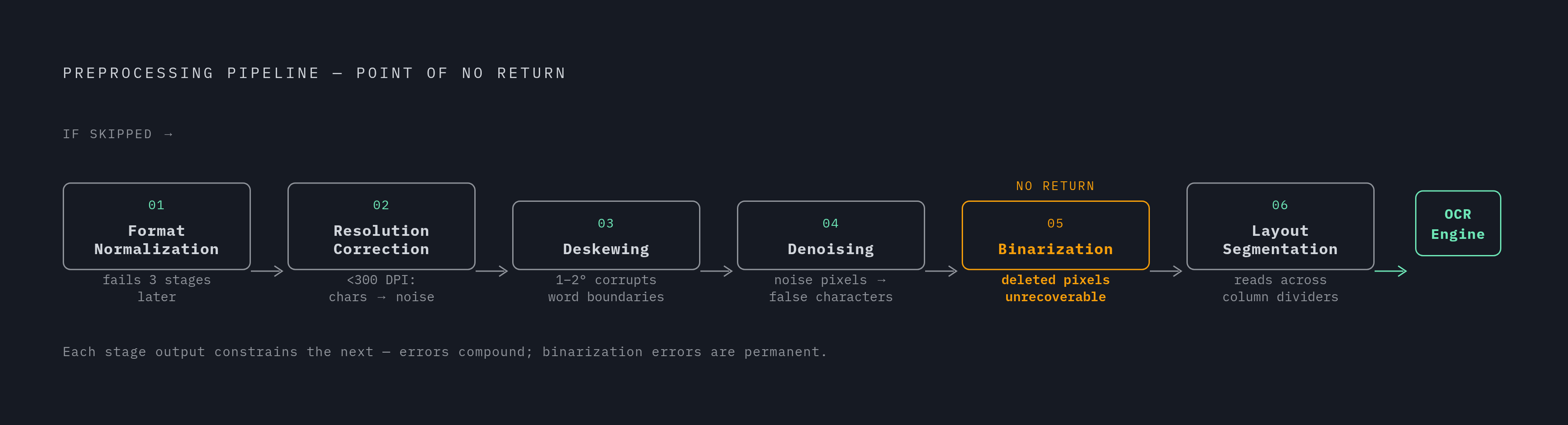
None of these stages work in isolation, and treating them as a checklist to run through in any order misses the actual mechanism. Resolution sets the ceiling for what denoising can recover. Denoising determines what binarization can threshold cleanly. Binarization determines what segmentation can detect as a legitimate text region. Segmentation determines what the OCR engine actually sees when it starts classifying characters. Each stage narrows the error space for the one after it.
Order isn't a stylistic choice, either. When binarization runs before denoising, the noise pixels get locked permanently into the binary image, immune to any cleanup after the fact. When segmentation runs before deskewing, the region boundaries get calculated against a tilted image, so once the page gets straightened, those boundaries no longer line up with anything.
Nutrient's own OCR documentation actually advises against manual preprocessing for its engine, noting that it preprocesses automatically with better results than most manual tuning would produce. That guidance applies specifically to managed commercial engines that already internalize these steps. The stages still run, they're just abstracted away from the user. For open-source engines like Tesseract or EasyOCR, and for custom pipelines built in-house, someone has to configure each of these explicitly, because nothing is happening automatically underneath.
Multilingual documents add a branch to the pipeline that's easy to overlook. Language identification needs to happen before or alongside layout segmentation, so the correct language model gets applied to each text region rather than one model getting forced onto the whole page. Nutrient's guidance requires specifying multiple language codes explicitly for mixed-language input, and its engine supports more than 30 built-in languages with extended support past 100. A study cited by SparkCo found that multilingual OCR systems using a newer class of models showed a 30% accuracy improvement on mixed-language documents compared to traditional methods, which is a substantial gap for something as basic as knowing which language a paragraph is written in.
The deeper point is that there's no single correct sequence that applies to every document. Document type, whether it originated as a scan or a native PDF, how degraded it is, how complex the layout is: all of it determines which stages actually matter and how aggressively each one needs to run. A production pipeline classifies incoming documents first and routes them accordingly, rather than forcing every file through the same fixed sequence regardless of what it actually is. Independent benchmarks across more than 800 documents show parser accuracy swinging by more than 55 points across different document domains, and most of that spread traces back to whether preprocessing was actually calibrated for the document type in front of it, not to any weakness in the OCR engine itself.
Where preprocessing ends and extraction accuracy must be measured
A document can look completely clean after preprocessing and still produce wrong data. That gap between "the image looks legible" and "the extraction is correct" is where a lot of pipelines quietly fail their end users. A correctly oriented, denoised, properly binarized document can still hand back a date field reading "01/O8" instead of "01/08," because the ambiguity between a letter and a similarly shaped digit never got resolved at the character level, and no amount of clean image processing fixes a classification error that specific.
Measuring this properly means checking per-field accuracy against ground truth, invoice number, date, supplier name, totals, line items, each measured on its own rather than folded into one aggregate score. Character error rate is the number researchers cite in papers. Field-level accuracy is the number that shows whether a business can actually use the extracted data.
That measurement also needs to be stratified. Digital-native documents and scanned documents behave differently and should be measured separately, and results should be broken out by skew level, noise level, and layout type, since averaging across all of it hides exactly where the pipeline is still weak. Testing against clean sample documents proves very little. The real test is the actual production corpus: low-resolution scans, multi-column layouts, tables that span a page break, and every other case that a document pipeline will eventually have to handle whether it's ready or not.
Sources
- OCR best practices | Nutrient Document Engine
- Enhancing OCR Quality with Advanced Techniques
- DocuClipper: Extract, Analyze & Automate Financial Documents
- PreP-OCR: A Complete Pipeline forDocument Image Restoration and Enhanced OCR Accuracy
- Modular and Interactive Preprocessing Framework for Enhanced OCR in Noisy Document Images | Springer Nature Link
- Boost Tesseract OCR Accuracy: Advanced Tips & Techniques