Low-Quality Scan Handling in Production OCR Pipelines
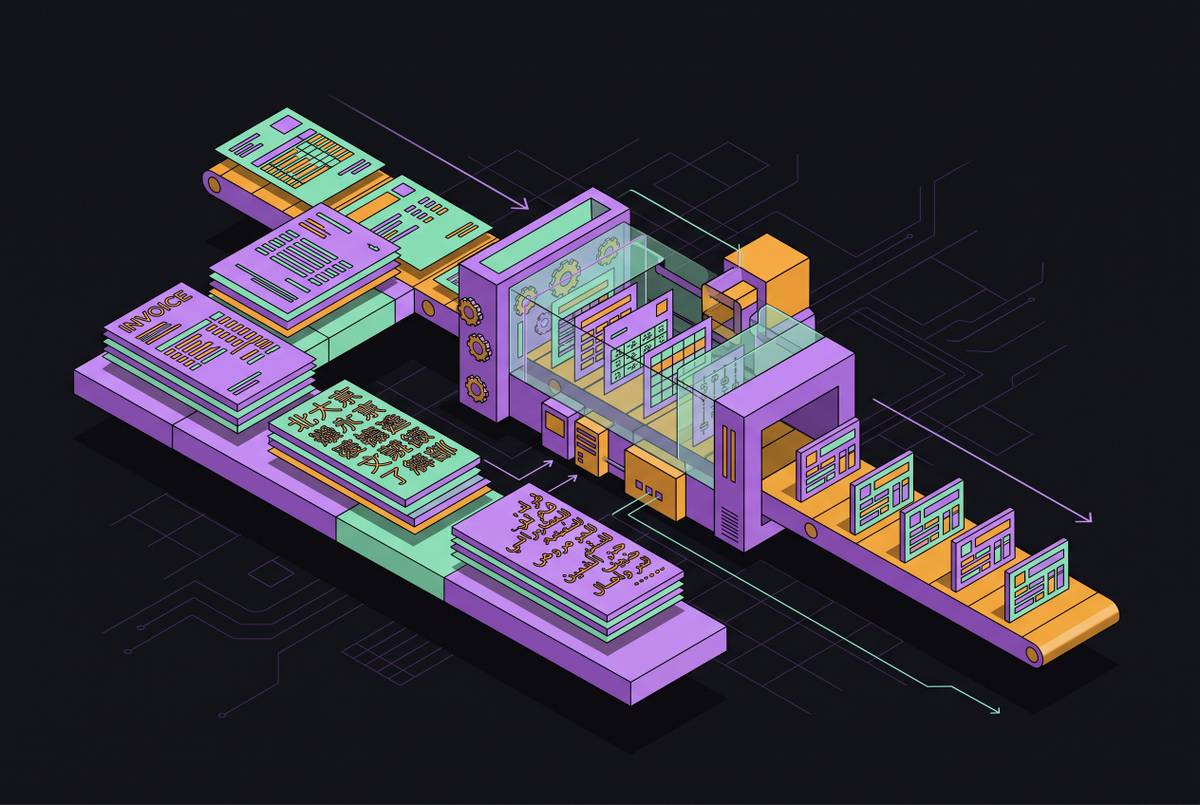
Building reliable OCR requires catching failures at each pipeline stage.

Low-quality scan handling in production OCR pipelines is a problem across stages, including recognition. For output to be reliable, each stage must catch failures, measure them, and route them before they spread. Extracted fields must match ground truth.
Why low-quality scans don't fail OCR pipelines at a single point
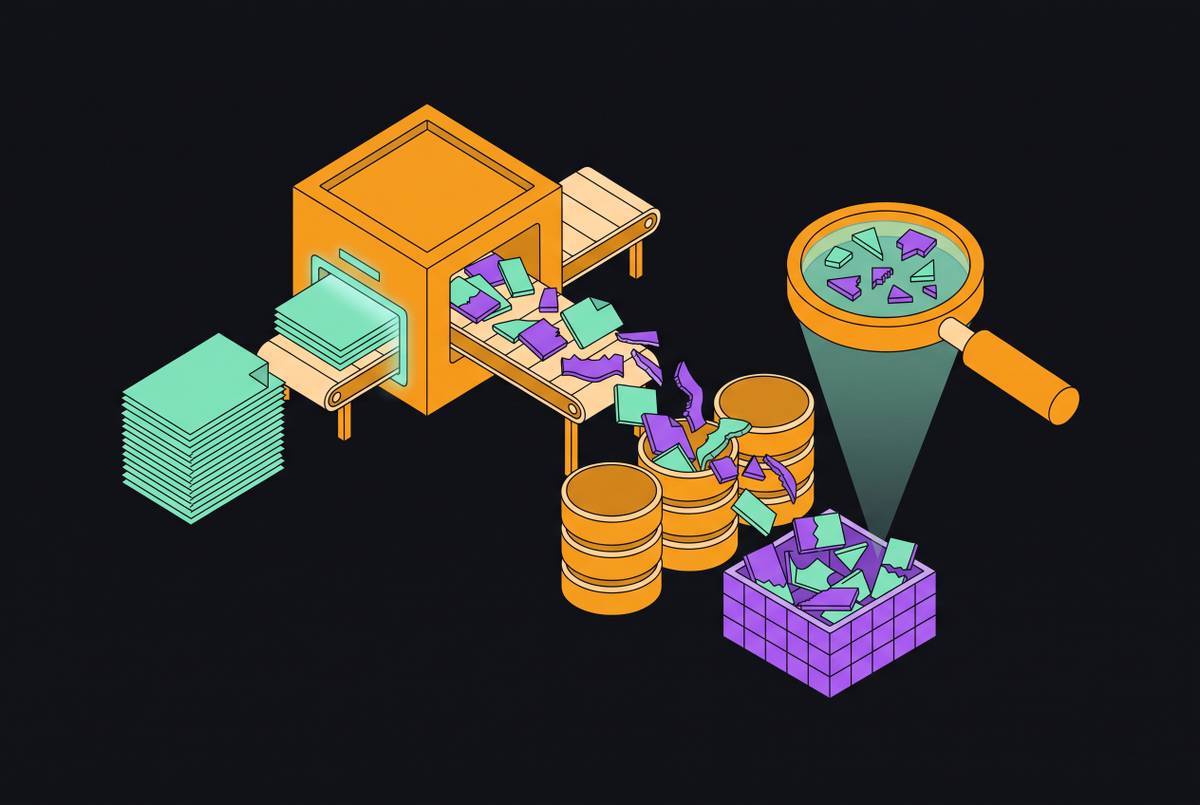
Blur, shadow, low DPI, and skew weaken detection before recognition begins. Detection then passes damaged or incomplete regions to the recognizer, which produces text from the wrong input. Losses from earlier stages persist through post-processing and validation, making the failure a cascade.
Small defects show why this matters. Even a 1–2 degree rotation degrades character recognition accuracy. Binarization applied to a noisy image can carry artifacts into recognition and change which characters the engine reads. These are not merely reasons to lower a confidence score, because the output itself may already be wrong.
Treating OCR as a single API call hides this chain. Without visible stage boundaries, there is no clear place to catch an error, measure its effect, or reroute the document. A detection failure can therefore produce a confident wrong field value. The engineering response has to follow the chain backward, starting with what enters the pipeline.
The PDF layer as an upstream trap that precedes image quality problems
The first mistake can happen before the pipeline processes an image. Digital PDFs already contain selectable text, so sending them through OCR adds recognition risk to data that did not need recognition. It also wastes compute. Checking first whether documents are scanned or digital avoids that extra work.
Native text extraction still needs scrutiny. A PDF text layer can store characters in the wrong reading order, so finding selectable text does not establish that its sequence is usable. That order must be verified before the pipeline reconstructs tables or field sequences. Otherwise, ingestion introduces structural errors while appearing to bypass recognition safely.
Hidden text also creates a security problem. An LLM-based extraction pipeline that does not separate visual rendering from text-layer parsing can encounter prompt injection invisible to a human reviewing the rendered page. Correct ingestion therefore classifies documents before routing them. Digital PDFs take the native text path, scanned images take the preprocessing and OCR path, and the classification decision remains logged and auditable.
What preprocessing must actually fix before a character is read
Once a scan reaches the image path, the recognizer needs preprocessing to receive usable input. Deskewing corrects rotational misalignment, while denoising removes fax, scanner, and compression artifacts. Contrast enhancement and resolution normalization address weak or low-resolution input, with a minimum of 300 DPI serving as a practical threshold for reliable recognition. Margin cropping and rotation correction handle problems that deskewing alone cannot fix, including pages rotated 90° or 180°.
These operations need an automated routing policy. Gaikwad et al. 2026 used a Laplacian variance-based analyzer to assign images to HIGH, MEDIUM, or LOW quality tiers. HIGH-quality scans went directly to OCR, while MEDIUM and LOW tiers received CNN enhancement. Gaikwad et al. 2026 found that 72.2% of images could be processed without that enhancement overhead. The architecture spends extra compute where degradation calls for it instead of charging every image the same processing cost.
The preprocessing design also has to account for watermarks, stamps, overlapping text, signatures, and mixed handwritten and printed text. These production inputs belong in the specification. An engine upgrade does not remove the need to handle them before recognition.
How layout complexity turns recognition errors into structural data loss
Readable characters are only part of a usable extraction. A correct value placed in the wrong cell, column, or field is still wrong. Tables make this distinction especially sharp because a cell gets its meaning from its row header, column header, and position. Merged cells and nested headers break logic that assumes a regular grid.
Other layouts create the same problem in different forms. Multi-column pages, rotated text blocks, footnotes, and repeating headers and footers need layout analysis to keep their regions distinct. Similar fields next to each other, including bill-to and ship-to addresses or multiple totals, need spatial disambiguation as well as text matching to tell them apart. Reading order is therefore a separate evaluation axis from character accuracy.
For RAG systems, this becomes a retrieval problem. A retrieval layer cannot bring back text or table structure lost during extraction. If a heading that scoped a paragraph disappears, chunk boundaries can stop matching the document’s logic and retrieval can return semantically incorrect results. Clean-looking text can thus pass the wrong meaning to an LLM downstream.
Why confidence scores from the recognition stage cannot substitute for field-level validation
A high confidence score describes the model’s internal assessment. A naive vision-model pipeline may generate a plausible answer instead of locating and transcribing a value from a specific pixel region. That can produce a convincing but wrong total. Confidence needs calibration and a bounding box that makes the value traceable to the page.
Validation must then consider the cost of accepting an error. A low-confidence total on a large invoice warrants human review, while the same confidence on a low-value receipt may allow automatic processing. A uniform threshold ignores that difference. Strong per-field accuracy also does not mean that every document is clean, because approximately independent field errors compound across a document.
Line items must sum to subtotals, and subtotals plus tax must equal totals. A value that passes the confidence threshold but fails arithmetic is still an extraction error. Finally, the extracted JSON must conform to a typed field schema, so a currency string in a date field fails regardless of recognition confidence.
Measuring pipeline accuracy per field against ground truth, not against model confidence
Those checks catch contradictions, but ground truth establishes whether the extracted values are correct. For plain text, Character Error Rate and Word Error Rate measure errors made when the text was transcribed. Case, whitespace, and punctuation normalization must be fixed before models are compared, or the comparison changes with the scoring rules.
For forms and receipts, Field exact match and Field F1 measure the outputs that downstream workflows actually consume. A correct amount assigned to the wrong row counts as an error. Document-level all-fields correctness should have its own report, separate from the per-field rates. Tables need a similarity metric to show errors in their structure and cell contents, while systems that read them in sequence also need a reading-order comparison.
When manual annotation is unavailable, pseudo ground truth can serve as the reference. Gaikwad et al. 2026 used OCR ensemble majority voting for this purpose. Evaluation also needs field provenance, including page, block, bounding box, original text, and normalization history, so an error can be located as well as counted. OCR needs its own evaluation layer because a single end-to-end score hides where accuracy was lost. A vendor offering confidence without per-field ground truth results leaves that uncertainty with the customer.
How the adaptive feedback loop handles images the pipeline cannot read cleanly on the first pass
Measurement becomes useful in production when failure has a defined destination. Gaikwad et al. 2026 implemented a confidence-driven adaptive feedback loop that re-enhances and resubmits images when the first OCR pass falls below a threshold. A fixed retry cap prevents unreadable images from consuming unbounded compute. Images that exhaust their retries are flagged and sent to human review. Graceful failure requires a deliberate routing decision.
The enhancement layer also addresses the cost of training data. Gaikwad et al. 2026 used self-supervised CNN enhancement trained through denoising, which needed no manually labeled training data. The quality router limits this expense to images that need enhancement. Together, selective enhancement and bounded retries make remediation more practical at scale.
Post-OCR language correction provides another repair layer, but its reach is limited. It can fix broken words, incorrect hyphenation, encoding artifacts, and character substitutions detectable from context. It cannot recover text that detection never found. The retry architecture must therefore keep repairs to recognition separate from repairs to the image that recognition receives.
What each stage must emit for the pipeline to fail observably rather than silently
To distinguish those failures, every stage needs to emit evidence beyond its primary result. Ingestion must log document classification, the routing decision, and the signal behind it. Quality assessment must record which tier it assigned, which metric it used, and whether enhancement ran. Recognition must emit per-word and per-field confidence, bounding boxes, and original pre-normalization text. Layout analysis must keep the regions it found and their reading order so its view of the structure can be seen.
Validation must record which fields passed or failed each check and whether the document was approved automatically or routed for review. Confidence-based routing also needs field-level logs, because a document can pass even when some of its values are wrong. These records make it possible to distinguish a bad route from bad recognition or a missed validation failure. Without that distinction, correction cannot reliably reach the component responsible.
Human review then becomes more than an output repair service. Corrections mapped to specific bounding-box regions can provide training signals for recognition and enhancement. That feedback targets the failure patterns present in production documents. Without provenance, the system can collect corrected values but lose what it needs to improve the stage that got them wrong.
Security and compliance requirements that apply to every stage of a document pipeline handling sensitive scans
The same audit trail matters when documents have financial, health, or personal data. Security requirements apply during both processing and storage. One zero-retention pattern avoids cloud storage uploads, keeps document data in memory, and persists only extracted metadata. This removes the document after processing rather than relying solely on controls around a stored file.
Relevant frameworks include SOC 2, GDPR, HIPAA, and the EU AI Act. High-risk status under the EU AI Act depends on what the pipeline is meant to do, beyond which sector it serves. Pipelines performing specific Annex III functions, including credit scoring, insurance risk assessment, or public-authority benefit eligibility, may meet that threshold. Audit records help meet expectations to record who accessed data, which decisions were influenced, who authorized deployment, and what human oversight took place.
Deployment location is another architectural constraint. On-premise or region-specific options matter where residency requirements bar images from being sent to third-party cloud APIs. For vendors handling sensitive scans, SOC 2 Type II, GDPR compliance, and a documented zero-retention architecture are part of the evaluation. Processing controls and observability belong in the same design.
Choosing between building and buying a low-quality scan handling pipeline
The build-versus-buy decision therefore covers much more than access to a recognizer. An in-house system owns quality routing, enhancement, layout analysis, validation, retries, provenance, and learning from corrections. The self-hosted open-source path also carries GPU infrastructure, deployment, model versioning, observability, on-call engineering, and continuous maintenance. Each stage adds something the system can do and a failure mode the team must manage.
That burden grows as production inputs change. New document types, changes in layout, and degradation patterns need to be diagnosed and repaired even when they fall outside the development dataset. Legacy OCR with rules-based extraction needs templates rebuilt for new document types, which adds technical debt as the range of documents grows. Handling common cases is therefore not the same as finishing the pipeline.
A managed API shifts infrastructure work outside the team and can define accuracy SLAs contractually. Its claims still need to be checked per-field against ground truth, beyond what vague model benchmarks can show. Paying only for correctly extracted pages aligns incentives differently from paying for every processed page. Choose a provider based primarily on who owns the full cost of detecting, measuring, and correcting wrong output, with text-return speed a secondary consideration.